


意见:1 创始人: Site Editor Publish Time: 2026-03-16 Origin: 网站


Component analysis and scientific
purchasing guide for solder wire
In the production and maintenance of the
electronics manufacturing industry, 焊锡丝is an indispensable key
material. At present, commonly used solder materials mainly include tin-lead
alloy solder, antimony solder, cadmium solder, silver solder, and copper
solder. These seemingly similar metal wires have significant differences in
intrinsic composition and performance, which directly affects the quality of
welding. The following will be analyzed in detail from the aspects of
ingredient composition, purchasing skills, shelf life and price factors.
1. The composition of solder wire: the
synergistic effect of metal alloys and additives
Solder wire consists of two parts: a tin
alloy matrix and an internally infused additive. The alloy composition
determines the basic properties of the solder, while the additives affect the
wettability and fluidity during the soldering process. Tin, as a core
component, is a metal with a low melting point (melting point 232°C) with a
slight bluish sheen, excellent ductility and oxidation resistance, and the
elemental symbol Sn. As one of the traditional "hardware", the
application history of tin can be traced back to ancient times, from the tin
utensils of the Zhou Dynasty to the tin foil packaging of the modern food
industry, and its safety has been proven for a long time - pure metal tin and
simple tin compounds have extremely low toxicity, which is also an important
reason why tin can be used in food packaging.
According to environmental protection
requirements, solder wires can be divided into two categories: leaded and
lead-free:
1. There is lead solder wire
The main components are alloys of tin and
lead, which have different proportions and different properties. The ratio of
63% tin to 37% lead is called eutectic solder, which has the lowest melting
point of 183°C and the best fluidity during soldering. As the lead content
increases, the melting point gradually increases (e.g., 60/40 ratio melting
point 190°C, 55/45 ratio melting point 205°C). It should be noted that lead, as
a toxic heavy metal, may be inhaled by the human body at high temperatures, but
the welding temperature is usually lower than the melting point of lead
(327°C), so lead vapor is relatively less harmful, but protective measures are
still needed.
Developed in response to the EU ROHS
environmental protection directive, the main components are tin copper, tin
silver copper and other alloys, and the lead content is strictly controlled
below 0.1%. This type of product not only meets environmental protection
requirements, but also meets the testing standards of export products. Among
them, tin, silver, and copper alloys can significantly improve the strength and
conductivity of solder joints due to the addition of silver elements (usually
0.3%-3%), making them suitable for high-reliability scenarios.
Whether it is leaded or lead-free products,
the internal additives are compounded with rosin and active agents, which work
to remove the oxide layer on the surface of the metal and promote the spread of
the solder. The fumes generated during welding mainly come from the
volatilization of additives rather than metal evaporation, so having a good
exhaust system and wearing protective gear can effectively reduce health risks.
2. Scientific purchasing: five-dimensional
identification method to lock high-quality solder wires
1. Visual identification: Look at the color
and color to distinguish the advantages and disadvantages
The surface of high-quality solder wire
should be mirror-smooth with a uniform metallic luster – a shiny silver-gray
color for leaded products and a pure silvery-white color for lead-free
products, with no oxidized blackening or mottling effects. High-quality
products are usually coated with a protective film to prevent oxidation, and
the wire diameter error is controlled within 0.1mm, without local thickness
unevenness or dented scratches.
Products with too high lead content or
excessive impurities often show a gray and dark tone on the surface, and even
obvious bubbles or granular impurities can be seen, which will lead to poor
fluidity during welding and problems such as insufficient solder joints. When
viewed at an angle of 45° in natural light, the reflection of high-quality tin
wire is uniform and soft, while the reflection of low-quality products is messy
and dim.
2. Tactile inspection: friction test shows
the truth
Take a 10cm long tin wire and rub it on
white A4 paper repeatedly 20 times, the traces left by high-quality products
are light and easy to erase, and the paper does not blacken; Tin wires with
high lead content or high impurities can leave black marks that are difficult
to remove because heavy metal impurities are more likely to fall off during
friction.
Twist the surface of the tin wire with your
thumb and index finger, and the qualified product should feel smooth and
burr-free, and your fingertips will not be stained with metal powder. The
high-purity tin wire has excellent ductility and is not easy to break when bent
180°; Products with more impurities have a brittle texture and are prone to
fracture.
3. Performance test: wettability and
welding performance
Wettability is a core indicator of solder
wire quality - place the solder wire on a clean copper sheet, heat it to a
standard melting point with an electric soldering iron, and the high-quality
product should be completely spread within 3 seconds, forming a continuous and
uniform solder layer without shrinkage. Lead-free products also need to meet
ROHS standards to detect flux residue (0.5mg/cm²) and
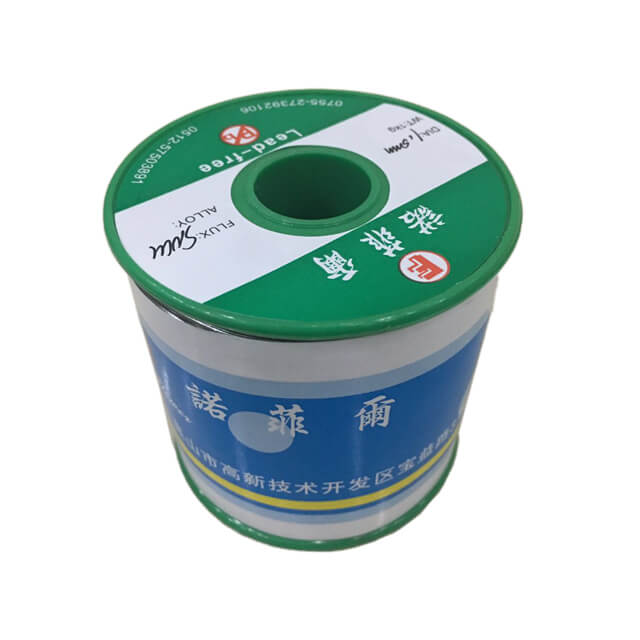
The amount of smoke and splashing during the welding process can also reflect the quality: high-quality products have less smoke and light odor, and no obvious splashing; Inferior products often produce thick black smoke due to improper ratio of additives, accompanied by pungent odor, and are prone to solder splashing.
4. Packaging verification: see the
specifications for details
The product packaging of regular
manufacturers should be labeled with complete information, including tin
content (e.g., 63/37, 99.3Sn0.7Cu), melting point, flux content (usually
2%-3%), weight, and production date. For example, products labeled "Sn63Pb37
183°C 2.0% Flux 500g" have clear and traceable information, making it easy
to verify quality issues.
Lead-free products must be clearly marked
with the words "ROHS Compliant" and have an environmental
certification report issued by a third-party testing agency. Products with
damaged packaging or vague information may have oxidation problems caused by
improper storage, so you need to be extra cautious when purchasing.
5. Brand selection: direct supply channels
to ensure quality
Preferential direct purchase from
manufacturers rather than dealer channels can avoid intermediate price
increases and obtain more reliable quality assurance. Regular manufacturers
such as Suzhou Nofil will provide component testing reports for each batch of
products, including key indicators such as spectral analysis data and melting
point test results, and can also customize products with specific wire
diameters or alloy compositions according to needs.
Although the products of the electronic
city or hardware store are convenient to purchase, there may be shoddy
situations, especially the inferior products that recycle scrap tin for
remelting, not only poor performance, but also may contain harmful elements
such as iron and zinc, which seriously affects the quality of welding.
3. Storage and cost: scientific management
to reduce costs and increase efficiency
1. Shelf life and storage conditions
The shelf life of solder wires is mainly
affected by oxidation – unopened products can be stored for 12 months in a dry
and cool environment (humidity < 60%, temperature 15-25°C) and are
recommended to be used within 3 months after opening. The surface of the
product beyond the shelf life is prone to oxidation, resulting in a decrease in
weld wettability, so the principle of "order as much as you use"
should be followed to avoid backlog.
In contrast, solder paste has a shorter
shelf life (typically 6 months) and needs to be stored refrigerated (0-10°C)
and warmed to room temperature before use to avoid water vapor condensation.
2. Price composition: Ingredients and
weight determine the cost
The price of solder wire is determined by
weight, tin content and alloy composition:
In terms of weight: common specifications
include 100g, 200g, 500g, and 800g / roll, and the larger the weight, the lower
the cost per gram, for example, the unit price of an 800g pack is usually
15%-20% lower than that of a 100g pack. In terms of tin content: the tin
content of leaded products ranges from 10% to 99%, and the price increases with
the increase in tin content, and the unit price increases by about 5%-8% for
every 10% increase in tin content. Special ingredients: Lead-free products have
a higher base price than leaded products due to their tin content of more than
99%; Lead-free solder containing silver, such as Sn96.5Ag3Cu0.5, is more
expensive, with costs rising by about 10% for every 1% silver content increase.
When purchasing, it is necessary to balance
performance and cost according to actual needs: general electronic repair
optional 63/37 with lead soldering (cost-effective); Precision electronics
manufacturing requires lead-free high-tin products; For high-reliability
scenarios such as aerospace, silver-containing alloy solder should be chosen.
4. Purchase suggestions: scene adaptation
and quality control
Different application scenarios have
different requirements for solder wires: precision soldering in consumer
electronics (such as mobile phone motherboards) is suitable for high-purity tin
wires with a wire diameter of 0.3-0.8mm; For terminal connections in power
equipment, 1.2-2.0mm thick wire diameter products are required to improve
welding efficiency.
Establishing an incoming inspection process
is crucial: take 3-5 rolls of samples per batch, conduct visual inspection,
weld testing, and wettability assessment, record key data such as solder joint
strength (should > 5N), conductivity, and establish quality files. For
long-term suppliers, it is recommended to conduct a full test every quarter,
including spectral analysis of components, halogen content determination, etc.
epilogue
The choice of solder wire may seem simple,
but it actually contains a lot of knowledge. From ingredient analysis to
performance testing, from visual identification to brand screening, every step
needs to be carefully considered. High-quality 焊锡丝 can not only improve
soldering efficiency and reduce defect rates, but also ensure the long-term
reliability of electronic products. In today's increasingly stringent
environmental requirements, prioritizing lead-free products that comply with
ROHS standards is both a smart way to comply with regulations and enhance
product competitiveness. Through scientific purchasing and standardized
management, this small metal wire can become a solid and reliable connection
link in electronic manufacturing.
 苏公网安备32058302004438