


意见:1 创始人: Site Editor Publish Time: 2026-03-17 Origin: 网站


Multiple classification system and application adaptation guide for solder wire
In the precision chain of electronic manufacturing, solder wire, as the core material for circuit connection, is divided into categories like a precise network, covering multiple dimensions such as metal composition, additive characteristics, and process requirements. There are significant differences in soldering performance and applicable scenarios between different classifications of solder wires, and mastering these classification logics is the basis for accurate selection. This paper systematically sorts out the main classification methods of solder wire, and analyzes the characteristics and scope of application of various products.
1. Metal alloy composition: the core dimension that determines the performance of the solder
The alloy composition of solder wire directly determines its melting point, strength and conductivity, which is the most basic and critical classification basis. At present, the alloy systems commonly used in industry can be divided into seven categories:
1. Tin-lead alloy series
This is the oldest type of solder used, and different properties can be achieved by adjusting the ratio of tin to lead. The ratio of 63% tin to 37% lead (industry name 6337) is a classic - the eutectic melting point of 183°C allows for the best fluidity during soldering, and the solder joint strength reaches 58MPa, making it the most efficient class among leaded solders. Other common configurations such as 60/40 (melting point 190°C) and 50/50 (melting point 214°C) are widely used in civil electronic products with no special requirements for environmental protection due to their low cost.
2. Pure tin and binary alloy series
Pure solder wire (Sn≥99.9%) has excellent oxidation resistance, but the melting point is as high as 232°C, which is difficult to weld, and is mainly used in special anti-corrosion scenarios. Tin-copper alloys, such as Sn99.3Cu0.7, are the mainstream choice for lead-free production, with a melting point of 227°C and a cost of only 60% of silver-containing alloys, making them suitable for large-scale production of consumer electronics. The tin-bismuth alloy (typical ratio Sn42Bi58) is known for its low melting point of 138°C, making it ideal for welding heat-sensitive components.
3. Multi-alloy series
Tin-silver-copper alloys, such as Sn96.5Ag3Cu0.5, increase the strength of the solder joints to 65MPa and increase the conductivity by 15% through the addition of silver elements, making them indispensable in high-end fields such as automotive electronics and aerospace. Tin-nickel alloys have become special materials for marine engineering electronic equipment with their excellent corrosion resistance. These special alloys often require customized production to match specific working conditions.
2. Flux characteristics: Key factors affecting the soldering process
The flux inside the solder wire is like an "invisible pusher", and its composition and shape directly affect the soldering quality, according to which a rich classification system can be formed:
1. Divided by the form and structure of the additive
Rosin core solder wire is the most common category, with 2%-3% of internally infused flux, which is compounded with rosin, activator, and stabilizer. The single-core structure is suitable for ordinary welding, while the three-core design improves the wettability of complex welding joints by releasing additives at multiple points. Solid core 焊锡丝 does not contain flux and needs to be used with external flux, which has obvious advantages in scenarios with strict requirements for residues such as military industry.
2. By chemical properties
The flux of water-soluble solder wire can be cleaned with water, and the residual amount < 0.1mg/cm², making it suitable for fields with high cleanliness requirements, such as medical electronics. The special solder wire for aluminum welding contains fluoride activator, which can break the oxide film on the aluminum surface and achieve reliable connection; Stainless steel solder wire adds special organic acids to solve the welding problem of high chromium alloys. These specialty additives usually need to be matched to specific substrates and cannot be mixed.
3. Divided by activity level
The internationally accepted classification system of R (inactive), RMA (medium active), and RA (high activity) is based on the acid value and corrosion properties of flux. Type R is suitable for easily weldable materials such as copper, while Type RA is used for heavily oxidized metal surfaces, but must be cleaned after welding to prevent corrosion. The practice of an electronics foundry showed that the wrong use of the activity level could cause more than 30% of the solder joints to fail.
3. Melting point range: an important indicator for adapting to the process temperature
Different alloy compositions create the difference in the melting point of the solder wire, which becomes the natural basis for classification and determines its process suitability:
1. Low-temperature solder wire
Represented by tin-bismuth alloys, the melting point is below 180°C and the highest is not exceeding 200°C. In the soldering of heat-sensitive components such as LED strips and sensors, it can effectively avoid device damage caused by high temperatures. Test data shows that the use of low-temperature solder can increase the yield of heat-sensitive components by more than 25%.
2. Room temperature solder wire
Mainstream products covering melting points of 183-260°C, 6337 leaded solder and Sn99.3Cu0.7 lead-free solder are both in this category. These products are adapted to the process temperatures of most electronics manufacturing and are the most versatile category, accounting for more than 70% of the market share.
3. High temperature solder wire
Tin-antimony alloys (e.g., Sn95Sb5) have a melting point of up to 265-310°C and can remain stable in high-temperature environments such as engine compartments. In the soldering of power devices in automotive electronics, its thermal cycle resistance is more than 3 times that of room temperature solder, significantly improving product life.
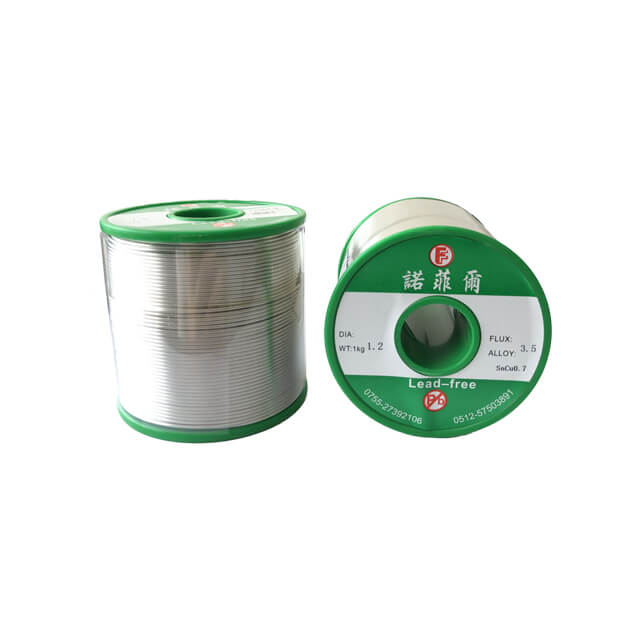
4. Environmental protection standards: classification methods that meet the requirements of the times
With the tightening of environmental protection regulations around the world, lead or not has become the most distinctive classification label for solder wires:
1. Lead-free environmentally friendly solder wire
The EU RoHS directive defines lead content < 1000ppm as lead-free, but in actual production, the safety margin is reserved, and high-quality products are usually controlled below 300ppm, and high-end models even < 100ppm. These solder wires are mostly made of tin-copper, tin-silver-copper alloys, which not only meet environmental protection requirements, but also make up for the performance loss caused by lead-free optimization through composition optimization.
Although the scope of use has been reduced due to environmental restrictions, it is still irreplaceable in some fields. 6337 solder wire continues to play a role in maintenance, military industry and other fields due to its near-perfect welding performance. It should be noted that the use of lead solder must meet occupational health standards, and the concentration of lead dust in the workshop must be controlled below 0.05mg/m³.
5. Process adaptation: subdivision of docking production methods
The diversity of production methods has led to targeted solder wire categories that directly serve manufacturing efficiency:
1. Divided by production process
The division between rosin core and solid core has been mentioned above, but it is worth noting the difference in process adaptation between the two: rosin core is suitable for manual welding and small wave soldering, while solid core is more suitable for precision spot welding equipment. Data from an automated production line of a mobile phone factory shows that the use of special solid core solder can increase the soldering speed by 40%.
2. Divided by application scenario
The soldering wire for manual soldering iron soldering usually has a thin wire diameter (0.3-0.8mm) and good toughness that is not easy to break; the special product for automatic soldering machine has a wire diameter of 1.0-1.6mm, emphasizing the stability of wire feeding. Sub-categories such as welding type, spot welding type, and post-welding type accurately match the characteristics and requirements of different welding processes.
3. Divide by physical parameters
The full range of wire diameters from 0.2mm to 3.0mm covers soldering needs from micro patches to large terminals. The weight specification (100g to 1kg/roll) is convenient for material management at different scales. The difference in additive content (1.5%-3.5%) can be adapted to the welding needs of clean to highly contaminated surfaces.
Selection suggestions and brand references
In the face of a complex classification system, the core of selection lies in "scene matching": consumer electronics give priority to lead-free room temperature solder; Precision instruments consider silver-containing alloys; Thermal elements lock low-temperature products; 6337 leaded solder is available for maintenance scenarios for increased efficiency.
As a professional solder manufacturer, Shenzhen Shuangchile provides a full range of solder wire products, and its lead-free series has passed SGS environmental protection certification, and the lead content is stably controlled below 100ppm; Leaded products strictly follow the 6337 gold ratio, and the welding utilization rate is more than 95%. For special needs, customized alloy solutions can also be provided, from composition design to additive formulation to achieve full-process services.
Understanding the classification logic of solder wires is not only a technical reserve but also the key to improving production efficiency. Through the combing of this article, I hope to establish a clear selection framework for readers, so that every welding is accurate and reliable. If you have more questions, you can follow the official channels of Double Chile for professional technical support.
 苏公网安备32058302004438