


Tampilan:1 创始人: Site Editor Publish Time: 2026-01-22 Origin: Site


Application scenarios and classification
analysis of anhydrous ethanol
Among the many basic raw materials of the
chemical industry, anhydrous ethanol occupies an important position with its
unique physical and chemical properties. This ethanol, which has a purity of
99.5% and above, and a moisture content of less than 0.1%, is like an
"all-rounder", with its strong volatility, flammability and
solubility ability, it is useful in industrial production, medicine and health,
electronics manufacturing and other fields. Its high purity properties allow it
to play an irreplaceable role in scenarios that are extremely sensitive to
impurity content, making it an indispensable key substance in modern industrial
systems.
1. Classification system of anhydrous
ethanol: precise division from purity to application
The classification of anhydrous ethanol is
not a simple difference in purity, but a scientific system formed by
comprehensively considering the production process, impurity control standards,
and target application scenarios. This classification method ensures that users
in different fields are accurately matched to the most suitable products,
ensuring application effectiveness and avoiding resource waste.
1. Industrial Grade Anhydrous Ethanol:
The "Base Solvent" for Industrial Production
The purity of industrial grade anhydrous
ethanol is typically between 99.5% and 99.9%, and while it has reached a high
level of purity, trace amounts of organic impurities such as methanol, benzene,
etc. are allowed. The presence of these impurities makes them relatively low in
cost, making them an economical choice in industrial production.
In application scenarios, it mainly plays
three roles: as a solvent, it is widely used in the dilution process of paints,
inks, and adhesives, and can quickly adjust the viscosity of these materials to
meet the requirements of the production process; As a fuel additive, it is
mixed with gasoline in a certain proportion to make ethanol gasoline, such as
the common E10 (containing 10% ethanol) and E85 (containing 85% ethanol), which
can not only reduce harmful gas emissions, but also reduce dependence on traditional
petroleum resources. As the basic raw material of chemical synthesis, it is an
important starting point for the preparation of organic compounds such as ether
and ethyl acetate, and plays a role in the organic chemical industry chain.
It is important to note that industrial
grade anhydrous ethanol is absolutely prohibited from being used in medicine or
food-related fields due to its potential to contain impurities harmful to
humans.
2. Pharmaceutical-grade anhydrous
ethanol: the "safety guard" of medical and health
Pharmaceutical-grade anhydrous ethanol has
more stringent purity requirements of 99.7% or more, and must strictly comply
with the standards of the Chinese Pharmacopoeia to ensure that it does not
contain any toxic impurities. This grade of anhydrous ethanol is under a strict
quality control system from production to storage and transportation.
In the field of medicine, its application
is mainly reflected in three aspects: in the pharmaceutical process, it is used
as a high-efficiency solvent for the extraction of active ingredients of
Chinese herbal medicine, such as the extraction of the antimalarial drug
artemisinin from Artemisia annua, and its excellent solubility can ensure the
full analysis of active ingredients; As the basic raw material of
disinfectants, it is diluted to make 75% medical alcohol, which is widely used
for disinfection and sterilization of skin surfaces and medical devices, and
its sterilization principle is to destroy the structure of microorganisms by
denatureing proteins; In the process of vaccine preparation, it is used for
disinfection and purification of specific links to ensure the safety of
vaccines.
Biosafety is the core requirement of
pharmaceutical-grade anhydrous ethanol, and it must undergo strict
sterilization during the production process to prevent microbial contamination.
3. Food-grade anhydrous ethanol: the
"invisible assistant" of the food industry
Food-grade anhydrous ethanol has a purity
of more than 99.8% and must comply with the GB 10343 standard, strictly
controlling the content of heavy metals and harmful residues to ensure
harmlessness to the human body. Its production process is fully monitored by
food safety manufacturing practices and usually requires internationally
recognized food safety certifications, such as US FDA certification.
In the food industry, it is mainly used in
two aspects: as a food additive, it is an ideal solvent for flavors, food
coloring, etc., such as in the extraction process of vanilla extract, which can
efficiently dissolve and retain its unique flavor substances; In alcohol
production, it is used to adjust the alcohol content or prepare liqueurs, and
its high purity characteristics ensure the taste and quality stability of
alcohol products.
4. Electronic-grade anhydrous ethanol: a
"clean partner" for precision manufacturing
Electronic grade anhydrous ethanol is one
of the purest grades, with a purity ≥ 99.9%, and its impurity control reaches
the ppm level (parts per million), especially impurities such as metal ions
that can affect the performance of electronic components, with extremely low
levels. This ultra-high purity and cleanliness make it an indispensable key
material in the electronic information industry.
In the field of electronics and precision
manufacturing, its application focuses on two core links: as a cleaning agent,
it can effectively remove grease, particles, and organic pollutants from the
surface of precision components such as chips and optical lenses, without
leaving any residue, ensuring that the performance of components is not
affected; In the lithography process of semiconductor manufacturing, its
excellent solubility and volatility can accurately control the removal range
and speed of photoresist to ensure the accuracy of lithography patterns.
5. Reagent-grade anhydrous ethanol: the
"precision tool" for scientific experiments
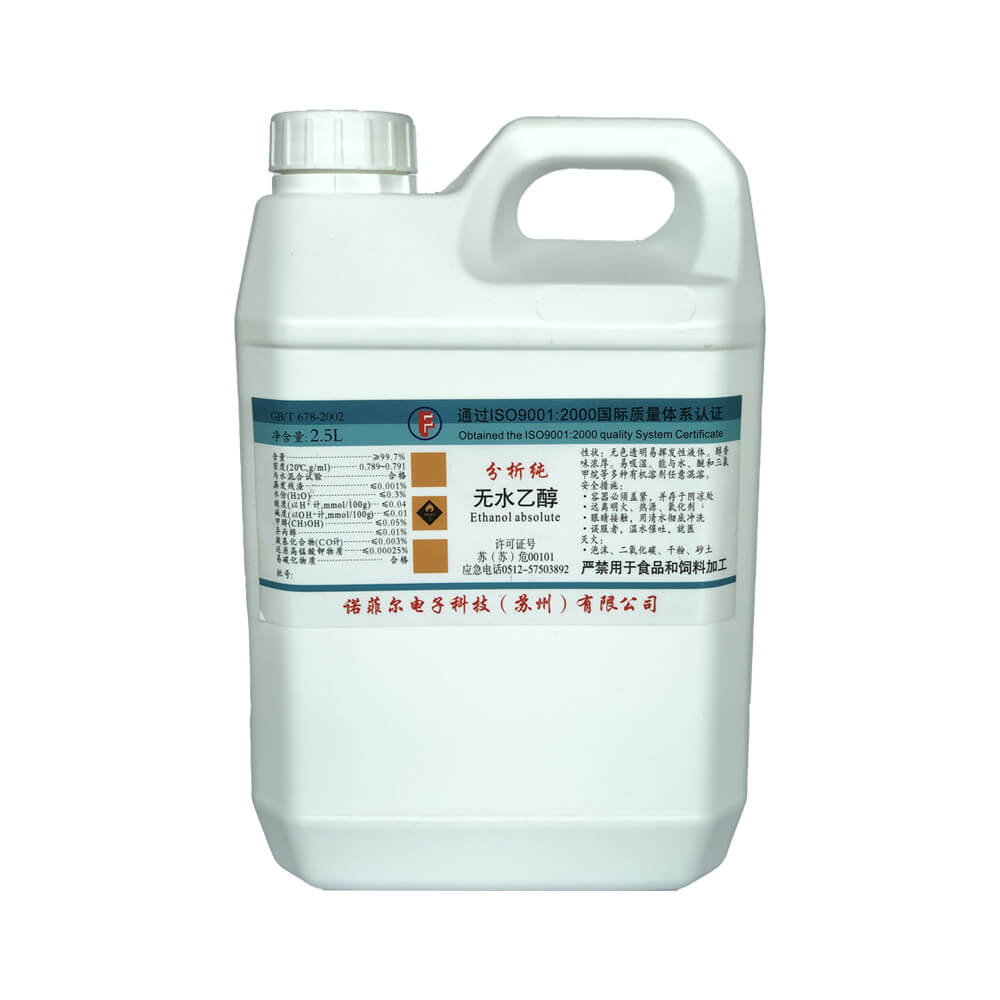
Reagent-grade anhydrous ethanol has a
purity range of 99.5% to 99.95% and can be divided into analytical pure (AR)
and chromatographic pure (HPLC grade) subdivisions depending on the purity and
applicable scenario. Analytical pures are suitable for general chemical
analysis experiments, while chromatographic purities are used in high-precision
analytical methods such as high-performance liquid chromatography (HPLC) for
tighter control of impurities.
In the laboratory and scientific research
fields, it has a wide range of applications: as an analytical reagent, it is
used for sample dissolution and instrument calibration in gas chromatography
(GC), nuclear magnetic resonance (NMR) and other experiments; In cryogenic
experiments, mixing with dry ice creates a low-temperature environment of
-72°C, meeting the special temperature requirements of certain chemical
reactions or materials testing.
Strict control of moisture and organic
impurities is the key to ensuring the accuracy and reproducibility of
experimental results with reagent-grade anhydrous ethanol.
2. Multiple application scenarios of
anhydrous ethanol: the key role of penetrating various industries
Anhydrous ethanol has a wide range of
applications covering almost all fields of modern industry and technology. Each
of its applications is closely related to its unique physical and chemical
properties, showing amazing adaptability and practicality.
1. Industrial Sector: The cornerstone
supporting chemical production
In industrial production, anhydrous ethanol
acts as a "lubricant" that drives the smooth flow of numerous
chemical processes. As a solvent, it can dissolve a variety of organic
compounds, and in the production of paints, inks, adhesives, and other
products, it controls the viscosity and fluidity of the product by adjusting
the concentration to ensure the stability of the production process.
In the energy sector, ethanol gasoline made
by mixing anhydrous ethanol with gasoline is an important measure to respond to
the energy crisis and reduce environmental pollution. This blend not only
reduces the emission of harmful substances such as carbon monoxide and
hydrocarbons in automobile exhaust, but also increases the octane number of the
fuel and improves the combustion efficiency of the engine.
As a chemical raw material, anhydrous
ethanol is the starting point for the synthesis of a series of important
organic compounds such as acetaldehyde, acetic acid, and ethylene. These
compounds are further used in the production of polymer materials such as
plastics, fibers, and rubber, forming a huge chemical industry chain.
2. Medicine and disinfection: protect
the barrier of public health
The application of anhydrous ethanol in the
field of medicine and disinfection is directly related to the health and safety
of the public. 75% medical alcohol is one of the most commonly used
disinfectants and has the best sterilization effect: too high a concentration
will form a protein coagulation layer on the surface of microorganisms,
preventing further penetration of alcohol; Too low a concentration cannot
completely kill microorganisms, while a concentration of 75% can just destroy
the cell structure of microorganisms to achieve the purpose of sterilization.
In terms of drug extraction, anhydrous
ethanol has become a key solvent in the modern production of traditional
Chinese medicine due to its high solubility in active ingredients in Chinese
herbal medicine. It is able to extract active ingredients at low temperatures,
avoiding the damage of active substances at high temperatures and improving the
efficacy and purity of drugs.
3. Food industry: ensure food safety and
quality
In the food industry, the application of
anhydrous ethanol, although not directly reflected in the final product, plays
an important role in the production process. As a solvent for flavors and
pigments, it can ensure the uniform distribution of these additives in food,
ensuring the stable flavor and color of food.
In the production of alcohol, anhydrous
ethanol has a long history of application. It can be used to adjust the alcohol
content of liquor, wine and other alcoholic beverages to meet different product
standards and consumer needs. At the same time, in the preparation of liqueurs,
anhydrous ethanol is used as a base liquor, which is able to dissolve various
spices and seasonings, giving the product a unique taste and flavor.
4. Electronics and precision
manufacturing: the key to helping technological progress
With the rapid development of the
electronic information industry, the precision and cleanliness of electronic
components are becoming more and more demanding, and the importance of
anhydrous ethanol in this field is becoming more and more prominent. In the
manufacturing process of semiconductor chips, from wafer cleaning to
photoresist removal, every link is inseparable from high-purity anhydrous
ethanol. It can remove contaminants at the micron or even nanoscale levels,
ensuring stable circuit performance of the chip.
In the production of optical lenses,
anhydrous ethanol is used as a cleaning agent, which can effectively remove oil
stains and fingerprints on the surface of the lens, ensuring the light
transmittance and imaging quality of the lens. Whether it's a camera lens, a
microscope lens, or an optical component of a laser device, they need to be
precisely cleaned with anhydrous ethanol.
5. Laboratory and scientific research:
the basic guarantee for promoting innovation
In scientific research laboratories,
anhydrous ethanol is an indispensable basic reagent. In chemical analysis
experiments, it acts as a solvent to dissolve a wide range of samples,
providing a stable experimental environment for qualitative and quantitative
analysis. For example, in gas chromatography, anhydrous ethanol is often used
as a solvent to prepare sample solutions, and its low volatility and chemical
stability ensure the accuracy of the analytical results.
In physics and materials science experiments, the low-temperature environment formed by the mixture of anhydrous ethanol and dry ice provides the possibility to study the performance of materials under extreme conditions. This low-temperature environment can be used in cutting-edge scientific research fields such as the preparation of cryo-EM samples and the performance testing of superconducting materials.
3. Future prospects and selection
guidelines for anhydrous ethanol
With the rapid development of the new
energy industry and biotechnology, the market demand for anhydrous ethanol has
shown a continuous growth trend. In the field of new energy, the promotion and
application scope of ethanol gasoline continues to expand, and the demand for
industrial-grade anhydrous ethanol will further increase. In the field of
biotechnology, pharmaceutical-grade and food-grade anhydrous ethanol will be
more widely used in vaccine research and development, biopharmaceuticals, and
natural product extraction.
Choosing the appropriate anhydrous ethanol
grade requires comprehensive consideration based on specific application
scenarios. In industrial production, if it is more cost-sensitive and does not
require strict control of impurities, industrial-grade anhydrous ethanol is a
cost-effective choice. In the field of medicine and food, it is necessary to
strictly follow relevant standards and choose corresponding
pharmaceutical-grade or food-grade products to ensure safety. In electronic
manufacturing and scientific research experiments, high-purity electronic-grade
or reagent-grade anhydrous ethanol is a prerequisite for ensuring product
quality and reliability of experimental results.
In short, as a versatile chemical substance,
anhydrous ethanol plays an irreplaceable role in modern society due to its
classification system and diversity of application scenarios. With the
continuous advancement of technology and the continuous expansion of
application fields, anhydrous ethanol will continue to provide strong support
for the development of various industries.
 Su Gongwang Security 32058302004438