


Tampilan:1 创始人: Site Editor Publish Time: 2026-03-02 Origin: Site


SMT Solder Paste Process vs. Red Glue
Process: A Dual Connection Scheme in Electronics Manufacturing
In the micron-level circuit of a smartphone
motherboard, the solder joints with a spacing of 0.3mm must not only achieve
stable transmission of current, but also withstand the mechanical stress caused
by the impact of the drop. On the PCB board of automotive sensors, the hybrid
layout of inserts and patch components requires a balance of holding strength
and soldering reliability—key challenges in electronics manufacturing, leading
to two complementary process options, pasta solder and red glue. As the core
processes of surface mount technology (SMT), they support a wide range of
applications from consumer electronics to industrial control through differentiated
paths of "conductive connection" and "mechanical fixation",
respectively. An in-depth understanding of the technical characteristics of
these two processes is crucial for balancing product quality, production
efficiency, and manufacturing costs.
1. SMT Solder Paste Process: A precision
solution for conductive interconnects
The solder paste process forms solder
joints with both electrical conductivity and mechanical strength at high
temperatures through the synergistic action of metal powder and organic
carriers, making it the mainstream choice for electrical connections in
electronic devices.
Material composition and working principle
Solder paste is a complex multiphase
system, and its formulation design directly affects the final soldering
quality: metal powder phase: 85-90% of tin-based alloy powder (such as SAC305:
Sn96.5%/Ag3%/Cu0.5%) constitutes the conductive skeleton, and the powder
particle size is graded according to the size of the solder joints (Type3:
20-45μm for conventional solder joints, Type5: 5-15μm for ultra-fine spacing
below 0.3mm); Organic support phase: 10-15% composite system includes flux (to
remove the oxide layer), thixotropic agent (to control the rheological
properties of printing) and solvent (to adjust viscosity) to ensure that the
solder paste retains its shape during printing and achieves active release when
heated; Functional additives: 0.5-1% organic acid derivatives (e.g., adipic
acid) improve soldering wettability, and antioxidants (e.g., BHT) extend the
shelf life of solder paste (refrigerated at 2-8°C for up to 6 months).
The process presents a clear three-stage
feature: the solder paste is transferred to the PCB pad through laser-cut
stainless steel mesh (thickness 0.1-0.2mm), and the precise matching of
printing pressure (5-15N) and scraper speed (20-50mm/s) ensures a deviation of
<±10% in pasta solder volume; The visual positioning system of the placement
machine (accuracy ±0.01mm) accurately places the component pins on the solder
paste, and the component weight and solder paste viscosity jointly achieve
preliminary fixation. In a nitrogen-protected reflow oven (oxygen content <
500ppm), the solder paste undergoes three stages: preheating (150-180°C,
60-90s), melting (220-250°C, 30-60s) and cooling (<150°C, 60s) to form a
reliable solder joint with an intermetallic compound (IMC) layer (thickness
1-3μm). Process data from a PCB manufacturer shows that when the solder paste
printing thickness is controlled at 120±±10μm and the peak reflow temperature
is stable at 2352°C, the void rate of BGA solder joints can be controlled below
5%, well below the industry average of 15%.
Technical characteristics and process
advantages
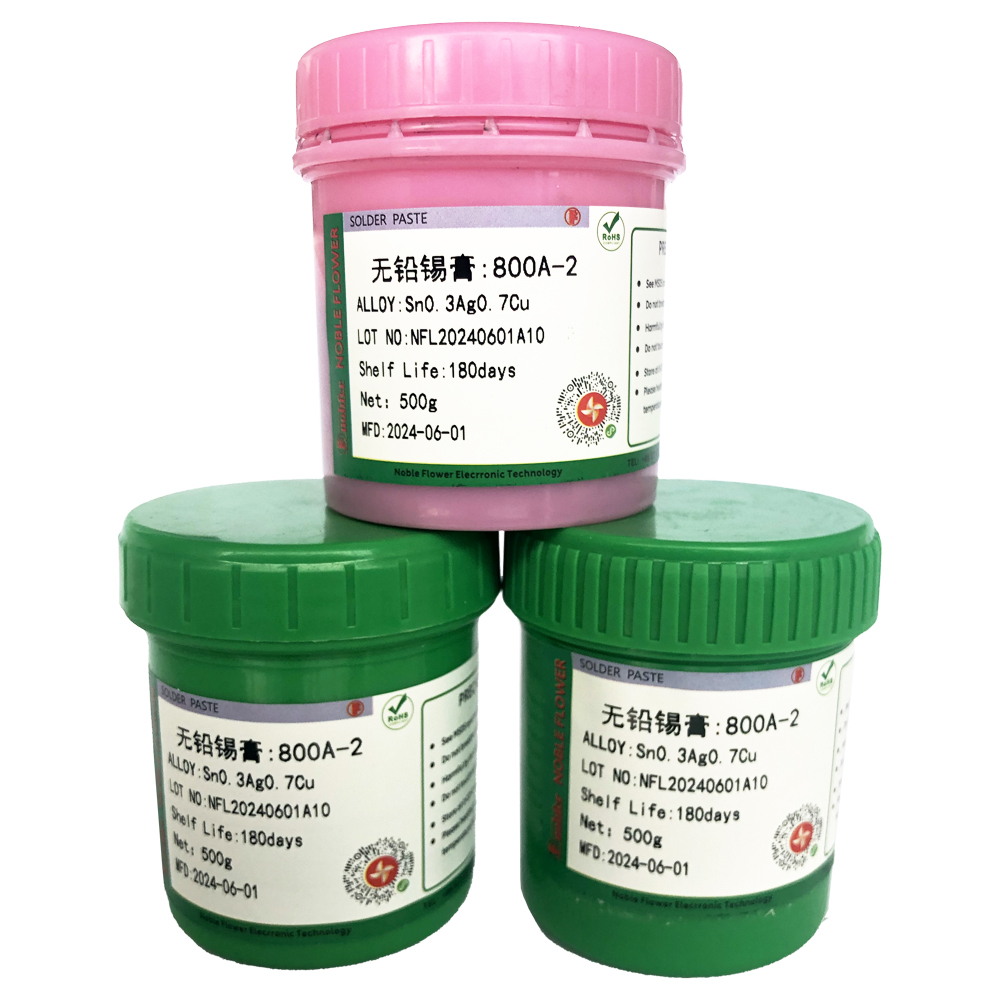
The core competitiveness of the solder paste process is reflected in the balance of its comprehensive performance: the solder joint achieves both electrical conduction (volume resistivity < 10⁻⁴Ω cm) and mechanical fixation (shear strength > 15MPa), meeting the reliability requirements of IPC-A-610F level 3; 0.2mm pitch QFP package soldering can be achieved through Type6 ultra-fine powder (2-11μm), which performs well in the RF module of 5G base stations; The modern solder paste production line adopts online viscosity monitoring (tested every 15 minutes) to ensure that the viscosity deviation of the same batch of products is < 5%, supporting the stable mass production of 5,000 PCBs per day. Compared with traditional cartridge processes, the solder paste process reduces PCB area by 40-60% and improves solder joint reliability by 3-5 times, demonstrating irreplaceable advantages in high-density packaging fields such as smartphones. Statistics from a consumer electronics foundry show that after using the solderpaste process, the defect rate of the motherboard has decreased from 2.5% to 0.8%, and the test time of a single machine has been shortened by 30%.
1.3 Process challenges and control points
The complexity of the solder paste process
requires strict process control: blockage of stencil openings (occurrence of
about 2% per hour) can lead to insufficient solder paste, which needs to be
identified by regular wiping (every 50 PCBs) and automatic optical inspection
(AOI); Solder paste exposed to air for more than 4 hours will cause poor
soldering due to oxidation, so the workshop needs to control humidity (40-60%
RH) and temperature (23±2°C). Minor deviations in the reflow curve, such as
peak temperature ±5°C), can lead to false solder joints or PCB deformation,
requiring real-time monitoring (archiving of temperature profiles for each
PCB); Failure analysis of an automotive electronics company showed that 38% of
soldering defects stemmed from uncontrolled reflow temperature curves, which
dropped to less than 6% by introducing an adaptive temperature control system.
2. Red glue process: an economical choice
for mechanical fixation
As an auxiliary fixation technology, the
red glue process realizes the temporary fixation of components through the
chemical curing of thermosetting resin, showing the advantages of cost and
process in specific scenarios.
Material properties and curing mechanisms
The performance of red glue depends on the
co-design of its epoxy resin matrix and curing system: 70-80% bisphenol A epoxy
resin provides basic bond strength, and its molecular weight distribution
(Mw/Mn=2.5-3.0) affects the flexibility after curing; 10-15% latent curing
agent (e.g., dicyanamide) releases activity at 120-180°C, combined with
accelerators (e.g., imidazole derivatives) for rapid curing for 20-60s; 5-10%
silicon micropowder (particle size 5-10μm) reduces curing shrinkage (from 3% to
1.5%) and improves dimensional stability; Its process implementation consists
of two key stages:
Precise dispensing: The red dot is applied
to the PCB pad gap through a pneumatic dispensing valve (accuracy ±0.05mm), and
the dispensing volume is controlled according to the component size (approx.
0.005mg/dot for 0402 components, approx. 0.05mg/dot for QFP devices)
Thermosetting: In an oven or reflow oven,
red glue undergoes gel (Tg transition), cross-linking (molecular weight
growth), and curing (network formation) to form a resilient cure (Shore
hardness D60-70)
Tests by a home appliance company showed
that red glue can achieve 90% of its final strength when cured at 150°C for 30
seconds, and the shear strength can reach 8-12MPa when fully cured (after 24
hours), which is sufficient for most components to be fixed.
2.2 Technical characteristics and
applicable scenarios
The unique value of the red glue process is
reflected in its process flexibility: a cured volumetric resistivity of >
10¹⁴Ω cm to avoid the risk of short circuits,
especially for power devices with large pin pitch (e.g., TO-220 packages); It
can be seamlessly integrated with the wave soldering process to solve the
problem of "float" of SMD components in wave soldering (defect rate
reduced from 15% to 2%); The material
cost is only 1/3-1/5 of that of solder paste, and the equipment investment
(about 100,000 yuan of dispensing machine) is much lower than that of
high-precision printing machine (50-1 million yuan); In the production of
traditional home appliance control boards (such as washing machine
motherboards), the red glue process can reduce the material cost of a single
PCB by 0.5-1 yuan, and the annual cost savings can reach 50-1 million yuan
based on the annual output of 1 million pieces. The practice of a company shows
that for PCBs with a mixture of inserts and patches, the process combination of
"red glue fixation + wave soldering" is used to reduce man-hours by
30% compared to the full solder paste process.
Performance limitations and improvement
measures
The application of the red glue process is
limited by its inherent properties: storage at 85°C/85% RH for 1000 hours
reduces bond strength by 30-40%, and moisture resistance needs to be improved
by adding silane coupling agents such as KH560; The cured red glue cannot be
dissolved and needs to be softened by a heat gun (250°C) and then physically
peeled off, which can easily cause PCB pad damage (about 5% incidence). The minimum dispensing pitch is 0.5mm, which
cannot meet the needs of high-density packaging (such as 0.3mm pitch components
in mobile phone motherboards); In response to these limitations, the industry
has developed improvements: UV-hot dual-cure red glue (UV pre-curing
positioning, then heat curing to enhance strength) has increased the success
rate of rework from 60% to 90%. The range of applications is expanded by
reducing the minimum dispensing diameter from 0.3mm to 0.2mm with jetting
technology (accuracy ±0.02mm).
3. Systematic comparison of process
characteristics
The difference in core performance betweenpasta solderand red glue processes determines their applicability in different
scenarios, and their technical boundaries can be clearly identified through
quantitative comparison.
3.1 Comparison of core performance
parameters
|
Performance metrics |
Solder paste process |
Red glue process |
|
Key features: |
Electrical connection + mechanical
fixation |
Mechanically fixed only |
|
Material costs |
High (500-800 yuan/kg) |
Low (100-200 yuan/kg) |
|
Equipment investment |
High (Printing press + reflow oven
approx. 1.5 million) |
Low (about 100,000 dispensers) |
|
Minimum spacing |
0.2mm (Type6 Solder Paste) |
0.5mm (Jet Dispensing) |
|
Solder joint strength |
High (shear strength > 15MPa) |
Medium (Shear Strength 8-12MPa) |
|
Temperature range |
-55°C~125°C (Industrial Grade) |
-40°C~100°C (Normal Type) |
|
The difficulty of reconstruction |
Easy (Hot Remelting) |
Hard (Physical Clear) |
|
Production efficiency |
High (suitable for large volumes) |
Medium (suitable for small and medium
batches) |
In reliability testing, solder paste solder
joints have a failure probability of < 1% after 1000 temperature cycles
(-40°C~125°C), while red glue-fixed components have a failure probability of
5-8% under the same conditions, limiting their application in long-life fields
such as automotive electronics.
Process fit differences
The requirements of the two processes for
production conditions are significantly differentiated: the solder paste
process needs to strictly control the temperature and humidity of the workshop
(23±2°C, 50±10% RH), while the red glue process can operate stably in a wide
range (18-28°C, 30-70% RH); Solder paste printers need to regularly calibrate
the stencil tension (every 5,000 prints), while red glue dispensers need to
change needles frequently (every 100,000 dots) to prevent clogging. Solder
paste welding needs to identify the internal defects of BGA solder joints
through X-ray inspection (X-Ray), and the position and size of the glue points
can be detected through AOI for red glue fixation. The production capacity data of an EMS
foundry shows that the daily production capacity of the solder paste process
(5,000 PCBs) is 2.5 times that of the red glue process (2,000 PCBs) under the
same equipment input, but the equipment utilization rate of the red glue
process (85%) is higher than that of the solder paste process (70%), reflecting
the flexibility advantage of small-batch production.
4. Scientific selection of application
scenarios
Process selection needs to be based on a
comprehensive evaluation of product characteristics, production scale and
reliability requirements to form an accurate matching technical solution.
Advantages of solder paste process
The solder paste process shows
irreplaceable value in the following scenarios: Smartphone motherboards
(component density > 100 pcs/cm²) use Type5 solder paste in a 0.3mm BGA
package to ensure simultaneous connection of 1000+ solder joints; The core module of the medical monitor (MTBF
requires > 10,000 hours) provides a stable electrical connection with solder
paste soldering and zero failures over a 3-year service life; The mass production line of smart watch
motherboards (with a daily production capacity of 10,000 pieces) achieves <
1% defect rate control through fully automatic solder paste printing and reflow
soldering. The practice of a
semiconductor packaging factory shows that for the soldering of chip modules
(such as CPU heatsinks), the thermal conduction efficiency of the solder paste
process (>10W/m·K) is more than 10 times that of the red glue process (<1W/m・K), ensuring
the heat dissipation requirements of the device under high load.
Scope of application of red glue process
The red glue process can achieve a balance
between cost and performance in specific scenarios: the microwave oven control
board (including 10 plug-ins + 50 patch elements) uses red glue to fix the
patch elements, and the soldering is completed in one go with wave soldering,
reducing the process turnover; The aluminum
electrolytic capacitors (10mm diameter) on the 32-inch TV backlight driver
board are fixed with red glue assist and have zero shedding in the vibration
test (10-2000Hz); The customized PCB for
industrial sensors (monthly output < 500 pieces) uses the red glue process,
eliminating the stencil production cost (about 500 yuan/piece) and shortening
the product time-to-market cycle
Tests by an auto parts supplier show that
in the engine compartment environment (-40°C~125°C, vibration 10g), the red
glue fixed sensor element (with wave soldering) can meet the service life
requirements of 5 years / 150,000 km, and the cost is 40% lower than that of
the all-solder paste solution.
Synergistic strategies for hybrid processes
For complex products, the combination of
the two processes can achieve complementary advantages: in automotive ECU
motherboards, the CPU core area (0.4mm pitch) uses solder paste technology, and
the peripheral connectors (2.54mm pitch) use red glue fixation + wave soldering;
The smart meter motherboard uses solder paste soldering for the power module
(high heat generation), and the red glue process for the signal processing part
(low stress) to balance reliability and cost. The A side of the mobile phone motherboard
(dense components) is re-soldered with solder paste, and the B side (a small
number of large components) is fixed with red glue to reduce soldering
deformation. Application data from an
IoT device vendor shows that the hybrid process reduces product costs by 15%
while maintaining high reliability in the core functional area (MTBF>5,000
hours), achieving an optimal balance between performance and cost.
epilogue
Solder paste and red glue processes are not
opposing choices, but complementary technical solutions in electronic
manufacturing - pasta solder supports the core connection of precision
electronic devices with its excellent conductivity and reliability; Red glue
provides cost-effective fixation solutions in specific scenarios with cost
advantages and process flexibility. As electronics manufacturing evolves toward
multiple goals of high density, high reliability, and low cost, both processes
will continue to leverage their strengths and meet the diverse needs of complex
products with hybrid application strategies.
Future technological development will focus
on boundary breakthroughs: lead-free solder paste will evolve to lower melting
point (<200°C) and higher reliability (-65°C~150°C), expanding its
application in the field of flexible electronics; Red rubber can be modified
with nanofillers (such as adding carbon nanotubes) to improve strength and
temperature resistance, expanding its application in the field of industrial
control. For manufacturing enterprises, establishing a process selection model
based on product characteristics, rather than simply relying on empirical
judgment, will be the key to improving competitiveness. As the SMT industry
agrees: the best process solution is always the exact match between technical
characteristics and application requirements.
 Su Gongwang Security 32058302004438