


Tampilan:1 创始人: Site Editor Publish Time: 2026-03-08 Origin: Site


1. Composition of ingredients: the
essential division of purity and impurities
The core difference between anhydrous
ethanol and alcohol is reflected in the strict distinction between ethanol
purity and impurity composition, which directly determines their application
boundaries.
1.1 Anhydrous ethanol: an almost pure
ethanol system
Anhydrous ethanol can be called a
"high-purity sample" in ethanol, and its composition control is
strict: industrial grade anhydrous ethanol has a water content of ≤1%, while
pure analytical reagents require a water content of < 0.5%, or even an
ultra-high purity of 99.9%, and only contain trace (ppm level) of methanol,
acetaldehyde and other impurities; The water content of ordinary alcohol is
completely removed by molecular sieve dehydration or azeotropic distillation
process, and the moisture content needs to be strictly monitored during the
process (usually Karl Fischer titration method with an accuracy of 0.001%); At
20°C, there are only 5 water molecules per 1000 molecules in 99.5% anhydrous
ethanol, and the rest are ethanol molecules (C₂H₅OH),
which makes it extremely lipophilic. This near-pure
composition makes anhydrous ethanol irreplaceable in scenarios where absolute
waterlessness is required – for example, cleaning lithium battery electrodes,
where even 0.1% moisture can cause battery short circuit failure, where only
anhydrous ethanol can meet the requirements.
1.2 Alcohol: A mixture of ethanol and
water
What we call "alcohol" on a daily
basis is essentially a binary mixture of ethanol and water, and the impurity
composition and concentration vary significantly depending on the use: It is
divided into two mainstream concentrations, 75% and 95%, with strict control of
methanol content (≤0.02%), and the removal of toxic impurities through
distillation and purification, suitable for direct contact with the human body. The purity is mostly 95%, but it contains
toxic ingredients such as methanol (usually 2-5%) and formaldehyde, which can
inhibit the central nervous system and cause blindness if ingested by mistake
in 10ml. Grain fermentation is used as raw material, and the impurities are
mainly esters, aldehydes and other flavor substances, and the methanol content
is < 0.05%, which can be used for wine blending. Concentration is the most
critical indicator of alcohol: 75ml of ethanol and 25ml of water per 100ml of
solution in 75% medical alcohol; 95% alcohol is a mixture of 95ml ethanol and
5ml water. This difference in water content makes it significantly different
from anhydrous ethanol in terms of physicochemical properties.
2. Physical and chemical properties:
concentration-led performance differences
The different ratios of ethanol and water
lead to regular changes in solubility, volatility, and combustibility between
anhydrous ethanol and alcohol, which directly determine their applicable
scenarios.
2.1 Solubility: From "universal
solvent" to "selective solubilization"
The solubility of ethanol aqueous solutions
at different concentrations showed obvious differentiation in the solubility of
various substances:
Anhydrous ethanol: With its strong fat solubility, it can dissolve many
water-insoluble substances such as resin, grease, rubber, and alkaloids. For
example, in traditional Chinese medicine extraction, anhydrous ethanol can
efficiently dissolve fat-soluble active ingredients such as tanshinone, with an
extraction rate 30% higher than that of 75% alcohol
75% alcohol:
The hydrogen bond network formed by water molecules with ethanol molecules
allows it to penetrate bacterial cell membranes (lipid bilayer) and denature
proteins, and this "balanced solubility" makes it the best
disinfectant
Low-concentration alcohol: After the water content exceeds 50%, the ability to dissolve fats
and fats decreases sharply, and 40% alcohol is more suitable as a solvent to
dissolve certain water-soluble drugs
Cleaning practices in the electronics
industry have shown that wiping flux residue on circuit boards with anhydrous
ethanol can achieve cleanliness up to level 5 of the ISO 16232-5 standard,
while using 95% alcohol can leave subtle water marks that affect subsequent
soldering quality.
2.2 Volatility and thermodynamic
properties
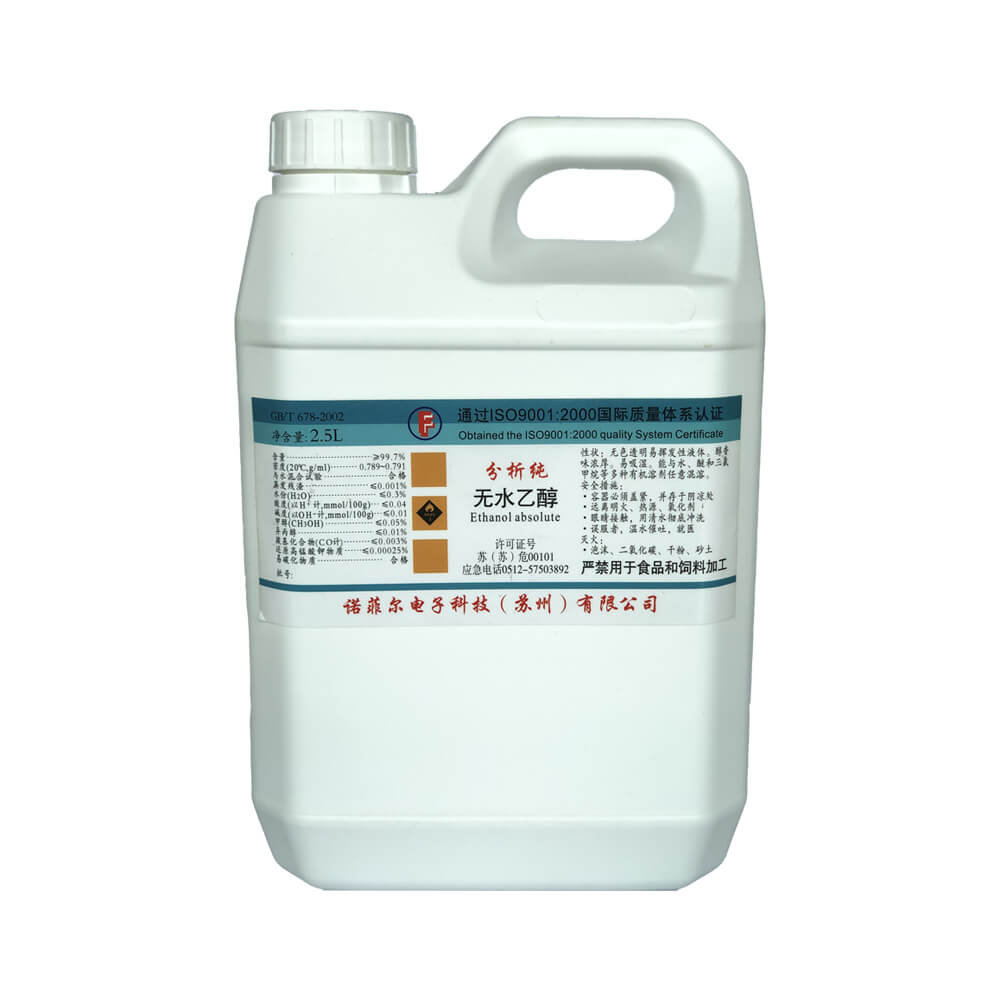
The mixing ratio of ethanol to water significantly affects its boiling point, density and other thermodynamic parameters: anhydrous ethanol has a boiling point of 78.3°C, and 75% alcohol rises to 78.5°C due to its aqueous boiling point, this small difference is crucial in distillation separation's anhydrous ethanol density 0.789g/cm³ (20°C), its lighter than water and insoluble in water properties allow it to quickly penetrate the grease layer; 75% alcohol density increased to 0.87g/cm³, slightly less fluid but stronger adhesion's evaporation time on the glass surface is about 30 seconds, while 75% alcohol takes 60 seconds, this difference makes anhydrous ethanol more suitable for rapid cleaning of precision instruments; In forensic identification, this property is used to determine blood alcohol concentration – by measuring the boiling point change after distillation, the ethanol content in the sample can be accurately estimated with an error of < 0.01%.
2.3 Combustion Performance: From
efficient fuel to controlled flame
Ethanol concentration directly determines
its combustion efficiency and safety:
Anhydrous ethanol: The flame is light blue (almost invisible) when burned, the
calorific value reaches 26.77MJ/kg, and the combustion is sufficient and there
is no black smoke, making it an ideal fuel for alcohol lamps and alcohol stoves
95% alcohol:
The flame is pale blue with a faint yellow color, with a calorific value of
about 24MJ/kg, and the burning time is 15% shorter than that of anhydrous
ethanol, and is often used as blowtorch fuel in industry
75% alcohol:
The flame is unstable and easy to extinguish, the calorific value drops to
21MJ/kg, and it is not suitable as fuel, which is why there is no need to worry
about the risk of spontaneous combustion when disinfecting
Laboratory safety data show that anhydrous
ethanol has a flash point of only 13°C (closed cup), which is more prone to
fire than 75% alcohol (22°C), so it must be stored in an explosion-proof
refrigerator and at least 3 meters away from the fire source.
3. Application scenarios: functional
boundaries determined by features
There is a clear distinction between
anhydrous ethanol and alcohol of different concentrations, which is based on
the precise use of the properties of the substance.
3.1 Professional application of
anhydrous ethanol
The high purity characteristics make
anhydrous ethanol irreplaceable in precision manufacturing and scientific
research:
Laboratory studies: As mobile phases for chromatographic analysis (e.g., HPLC-grade
anhydrous ethanol), the purity is required to be 99.99%, ensuring that the
detection signal is not interfered with; When formulating standard solutions,
their extremely low water content ensures concentration accuracy
Electronics manufacturing: Clean organic pollutants on the surface of semiconductor wafers,
wipe the sapphire lens of mobile phone cameras (to avoid water marks damaging
the coating), and deal with micron-level gaps in hard disk heads
Chemical production: as a solvent for synthetic pharmaceutical intermediates (such as
the preparation of cephalosporin antibiotics), extraction of plant essential
oils (rose essential oil yield is 2 times higher than that of water
distillation).
Production data from a lithium battery
factory shows that cleaning the electrode pads with anhydrous ethanol with a
moisture content of < 0.1% can increase the battery cycle life from 1,000 to
1,200 cycles, which is due to strict moisture control.
3.2 Grading and application system of
alcohol
Different concentrations of alcohol perform
their own duties in life and industry, forming a complete application system:
|
Concentration type |
Core applications |
Scientific principles |
Notes: |
|
75% medical alcohol |
Skin disinfection and medical device
wiping |
The ratio of ethanol to water penetrates
bacterial cell membranes, denatures and coagulates proteins, with a
bactericidal rate of 99.9% |
Avoid using it for mucosal disinfection
(such as eyes, nasal cavity), as it can cause irritation and pain |
|
95% medical alcohol |
UV lamp cleaning and slide dehydration |
High concentration makes protein
coagulate quickly, suitable for killing fungal spores; After dehydration, it
is easy to dye |
Do not apply the wound directly, it will
lead to tissue dehydration and necrosis |
|
Industrial alcohol (95%) |
Degreasing of metal surfaces, fuel
additives |
Dissolve the cutting oil after machine
tool processing; Mixing with gasoline improves combustion efficiency |
It is strictly forbidden to contact food
and skin, and methanol vapor is highly toxic |
|
40-50% alcohol |
Physical antipyretic, massage assistance |
volatilization and heat absorption after
application to the skin; Promotes local blood circulation and relieves muscle
fatigue |
Allergies should be diluted to 30% to
avoid dry skin |
Hospital infection control data shows that
75% medical alcohol inactivates the new coronavirus in only 30 seconds, while
95% alcohol cannot penetrate the virus shell, and the inactivation efficiency
is reduced by 60%, which confirms the scientific nature of concentration
selection.
4. Preparation process: technical path
from fermentation to purification
The production process of anhydrous ethanol
and alcohol is significantly different, and these differences directly affect
its purity and cost.
4.1 Refining process of anhydrous
ethanol
The production of anhydrous ethanol is an
"advanced version" of ordinary alcohol and requires a complex
dehydration process: 95% alcohol is used as a raw material (whether fermented
or synthetic), because ethanol forms an azeotropic mixture with water (95.6%
ethanol + 4.4% water), which cannot be further dehydrated by distillation alone
; Benzene or cyclohexane is added to form a ternary
azeotrope, the boiling point is reduced to 64.9°C, and anhydrous ethanol is
obtained after distillation, which is commonly used in laboratories to use
permeable vaporization membrane to achieve separation through the difference in
permeation rate between ethanol and water at 40°C, and the energy consumption
is 30% lower than that of distillation method. These processes make it 2-3
times more expensive to produce anhydrous ethanol than regular 95% alcohol,
which is the root cause of its higher price.
4.2 Large-scale production of alcohol
The production of alcohol pays more
attention to cost and efficiency, and there are two main technical paths:
starchy raw materials such as corn and potatoes, saccharified by amylase,
fermented by yeast to produce ethanol (concentration of about 10-15%), and then
purified to 95% by multi-tower distillation. This method produces less edible
alcohol impurities, which is suitable for the pharmaceutical and food
industries. Under the action of catalysts (such as zinc phosphate), ethylene
and water undergo an addition reaction under high temperature and pressure
(300°C, 7MPa) to produce ethanol, which directly obtains high-purity products
(95-99%), but may contain trace amounts of olefin impurities, which are mostly
used in industrial fields. About 60% of
the alcohol produced in our country every year is fermentation (mainly for
medical and edible use) and 40% is synthetic (industrial use), and this
industrial structure ensures the supply demand in different fields.
5. Safe storage and scientific selection
The flammability characteristics and
concentration differences between anhydrous ethanol and alcohol require strict
storage management and scenario-based selection.
5.1 Safe storage specifications
Different types of ethanol products require
differentiated storage measures: brown glass bottles (to protect against UV
exposure) + Teflon inner lid (to avoid metal corrosion); Cool and ventilated
place (temperature < 30°C) at least 10 meters away from oxidants, strong
acids; laboratory storage does not exceed 5L, and explosion-proof storage
cabinets are required in industrial sites
Medical alcohol: plastic spray bottle or sealed barrel, marked with the date of use
after opening, used within 30 days; Household use should be kept away from heat
sources such as stoves and heaters, and out of reach of children. To avoid
violent shocks, it needs to be transported at night during high temperature
periods in summer; According to the prevention data, alcohol fires are mostly
caused by improper storage - a laboratory stores anhydrous ethanol on a
windowsill in direct sunlight, resulting in increased pressure in the bottle
and rupture, and the steam explodes when exposed to open flames.
5.2 Scenario-based selection
decision-making guidelines
Scientific selection based on
characteristics can take into account both effect and economy:
Precision cleaning: Camera sensors, microscope lenses, circuit boards, etc., prefer
anhydrous ethanol, its residue-free property can avoid equipment damage
Disinfection and sterilization: 75% medical alcohol must be used for skin wounds, desktops,
medical devices, etc., and high concentrations reduce the effect
Industrial degreasing: grease cleaning on the surface of metal parts and molds, 95%
denatured alcohol is the most cost-effective, but it needs to be well
ventilated and protected
Fuel use:
Alcohol lamps, camping stoves, etc., 95% alcohol is enough to meet the demand,
without the need to use more expensive anhydrous ethanol
Pharmaceutical preparation: In the production of oral liquids, tinctures and other preparations,
food-grade alcohol must be selected, and the content of methanol and heavy
metals must be strictly controlled
A photo studio has shown that cleaning the
CMOS sensor of a DSLR camera with anhydrous ethanol completely removes dust and
oil, leaving images without any spots, while using 75% alcohol can leave subtle
water marks that affect image quality.
The difference between anhydrous ethanol
and alcohol is essentially the difference in properties created by purity and
impurity control - from 99.9% almost pure to 75% accurate ratio, from precise
analysis in the laboratory to daily disinfection at home, the application
scenarios of these transparent liquids reflect the precise connection between
chemicals and human needs. Understanding the significance of this difference
lies not only in the correct selection – but also in establishing the
scientific thinking that "the properties of matter determine the
use". When we know why 75% alcohol is the best disinfection effect, and
why anhydrous ethanol can clean delicate instruments, we have mastered the way
to see the essence through phenomena. In the intersection of chemistry and
life, this kind of thinking is more valuable than remembering a certain
conclusion.
The next time you are faced with
"anhydrous ethanol" and "alcohol" on the label, you may
wish to think about their concentration and impurity characteristics, and then
make a choice based on your specific needs - this kind of science-based
decision-making is the embodiment of rational living.
 Su Gongwang Security 32058302004438