


Tampilan:1 创始人: Site Editor Publish Time: 2026-03-20 Origin: Site


Preformed Solder
Sheets: Material Innovation in the Era of Precision Soldering
As the
wave of Industry 4.0 sweeps across the globe, the manufacturing industry is
undergoing a profound transformation from traditional machining to intelligent precision
manufacturing. The continuous emergence of new materials poses unprecedented
challenges to joining technology - when new base metals such as ceramics,
composites, and laminated functional materials enter industrial applications,
the shortcomings of traditional welding methods in terms of precision control
and material compatibility are becoming increasingly prominent. It is in this
context that Solder Preform emerged, which has become an indispensable key
material in the field of advanced manufacturing with the dual advantages of
"customized form + precise measurement", promoting the paradigm shift
of soldering technology from "experience dependent" to "digital
controllable".
1. The
essence of preformed solder sheets: the precise form of customized solder
Preformed
solder sheets are not simple solder workpieces, but metal or alloy solder is
prefabricated into functional parts with precise shapes, sizes, and thicknesses
according to the needs of specific soldering scenarios. This
"tailor-made" design approach allows it to perfectly adapt to the
characteristics of the base metal and the connection structure – whether it is
the low-stress connection of advanced ceramics, the interface matching of
composite materials, or the simultaneous welding of multiple layers of
laminated materials, the reliable bonding of preformed solder sheets can be
achieved.
Compared
with traditional wires and pastes, the core difference lies in
"morphological certainty": the length and cross-section of the wire
are difficult to control precisely, the amount of solder paste is easily
affected by ambient humidity, and the three-dimensional dimensional deviation
of preformed solder sheets can be controlled at the micron level, ensuring that
the error of solder dosage in each soldering <5%. Practical data from an
aero engine manufacturer showed that the solder gap consistency between the
turbine blade and the base increased from ±0.05mm to ±0.01mm after using
preformed solder sheets, significantly reducing stress concentration problems
caused by uneven solder distribution.
This
innovation in material morphology essentially transforms the "dynamic
variables" in the welding process into "static parameters",
providing a stable and controllable material basis for automated welding,
especially suitable for high-precision processes such as laser welding and
vacuum brazing.
2.
Multi-dimensional classification system: accurate matching from form to
performance
The
classification logic of preformed solder sheets is built on the diverse needs
of application scenarios, forming a multi-dimensional system covering form,
composition and performance:
1.
According to the appearance form: standard geometry: toroidal (inner diameter
accuracy ±0.02mm) is suitable for pipeline flange sealing welding; Square frame
type (right angle tolerance <0.01mm) adapts to the frame structure of
electronic packaging; Rectangular and circular shapes are widely used in flat
bonding, such as soldering sensor chips and substrates. Functional structure:
The opening design of the U-shaped solder lug makes it easy to wrap the edge of
the profiled workpiece, reducing the operating time by 30% in automotive sensor
wire welding; The boss type solves the problem of uneven heat distribution in
the soldering area through a local thickening design, and the solder joint
bubble rate is reduced from 8% to 1.2% after an LED packaging plant adopts this
type.
Customized
Special-Shaped Types: For complex components in aerospace, irregular shapes can
be made through precision stamping or laser cutting, with a minimum feature
size of up to 0.1mm, meeting the needs of miniaturized welding.
2. By
alloy composition: the core of performance regulation
Different
ground state alloys give solder wafers unique properties: Au and Ag: With its
excellent electrical conductivity (Au conductivity >90% IACS) and oxidation
resistance, it has become the first choice for high-frequency electronics and
aerospace, and a phased array radar uses Au-based preformed solder lugs to
reduce signal transmission loss by 15%. In-based and Bi-based: belongs to the
low-temperature system (melting point < 150°C), suitable for the welding of
heat-sensitive components, and the in-base soldering lug is in the fiber laser
package, which can avoid the damage of the gain medium by high temperature.
Sn-based vs. Pb-based: Sn-based lead-free solder lugs (such as Sn96.5Ag3Cu0.5)
comply with RoHS standards and are widely used in consumer electronics;
Although Pb-based solder lugs (such as 63Sn37Pb) are limited by environmental
restrictions, they are still used in special fields such as the military
industry due to their low cost and high reliability. Sb-based: It has high
high-temperature strength and excels in welding hot end parts of automobile
engines, with a shear strength of up to 45MPa at 300°C, which is twice that of
Sn-based solder lugs.
3. By
temperature characteristics: the key to process adaptation
Low-temperature
soldering lug (melting point < 200°C): suitable for dissimilar material
connections between plastics and metals, such as welding mobile phone antennas
with plastic shells.
Medium
Temperature Solder Lug (200-450°C): Balancing soldering strength with process
window, it is most widely used in PCB assembly. High-temperature solder lug
(>450°C): Mostly hard brazing solder (such as Cu-Zn alloy) used for
high-temperature working parts, such as pipe connections for heat exchangers in
nuclear power plants. The classification according to the liquid phase
temperature is more of process guidance: soft brazing solder at < 450°C is
suitable for electronics and precision machinery; Hard brazing solders >
450°C serve high-temperature structural parts, and this division directly
corresponds to different welding equipment and process parameter selection.
3.
Dimensional accuracy: the technical confidence of micron-level control
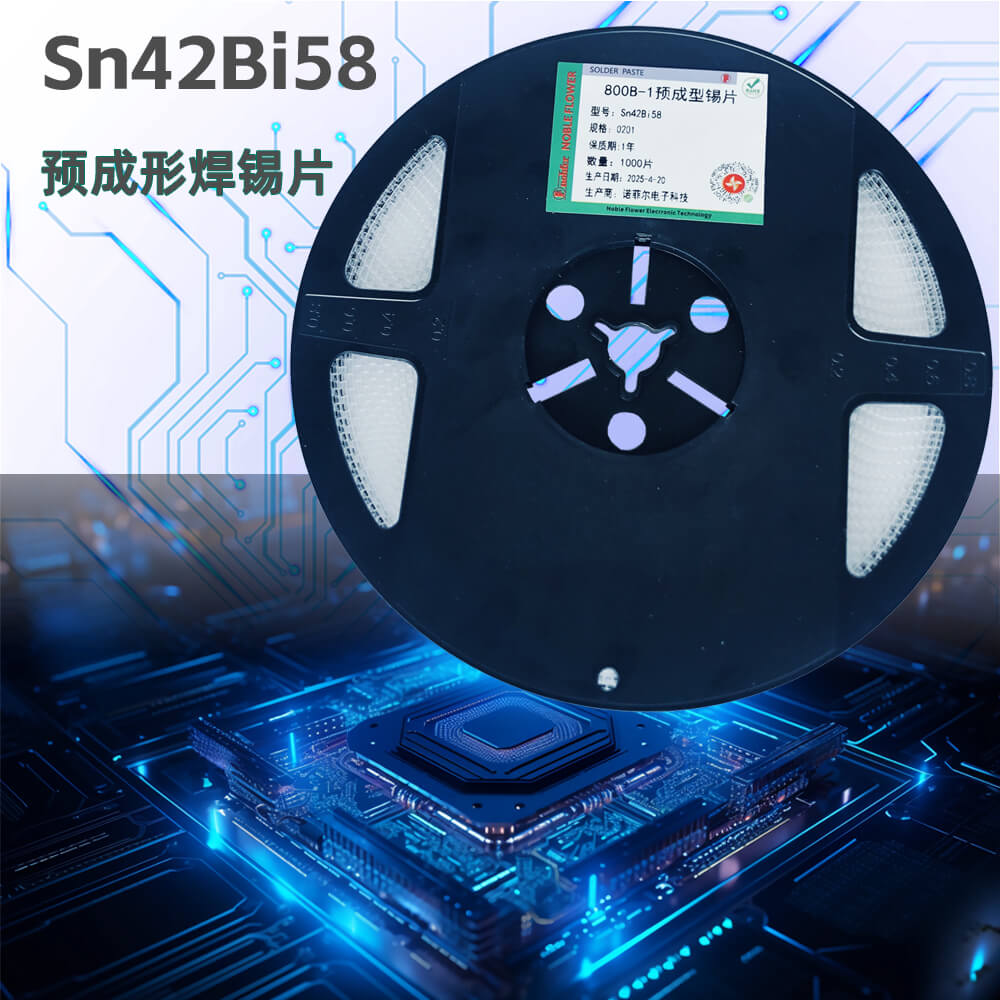
The core competitiveness of preformed solder sheets lies in the ultimate control of dimensional accuracy, which is also a key feature that distinguishes them from ordinary solders. Taking the industry-leading Jinchuan Island company standard as an example, its dimensional tolerance control system covers: thickness tolerance: 0.01-0.1mm thickness of welding lugs, tolerance can be controlled to ±0.002mm; The thickness of 0.1-1mm is ±0.005mm, which ensures consistent welding gaps. Flatness: The flatness deviation within every 100mm length <0.01mm to avoid uneven solder distribution due to warping. Contour accuracy: The special-shaped welding lug made by laser cutting has a contour error of < 0.01mm, meeting the precise positioning of complex shapes. This micron-level control stems from precision manufacturing techniques: a heat-affected zone of < 5 μm for laser cutting and a surface roughness of Ra<0.1 μm for EDM machining, ensuring the morphological integrity of the solder blades at the microscopic scale. Tests by a MEMS sensor manufacturer showed that the parallelism error of the device package was reduced from 0.05mm to 0.008mm after using high-precision preformed solder lugs, significantly improving the measurement accuracy of the sensor.
4.
Technical advantages: reshape the value chain of welding process
The
application of preformed solder sheets fundamentally changes the process logic
of traditional soldering and brings multi-dimensional value enhancement:
1.
Process innovation: breaking through the bottleneck of automation; In
special-shaped structure soldering, which is difficult to cover by SMT
placement equipment, preformed solder lugs enable an efficient process of
"one-placement, integral soldering". After using a box-type preformed
welding lug in an automotive electronic module, the original three processes
were simplified to one, and the production efficiency was increased by 200%.
Its preset form can also avoid bridging defects caused by solder flow, and the
solder joint defect rate has been reduced from 5‰ to 0.3‰ after application in
a camera module factory.
2.
Reliability Leap: From experience to controllability; While traditional
soldering relies heavily on operator skill, preformed solder sheets standardize
the soldering process by fixing the amount and shape of the solder. In the
welding of aero engine fuel nozzles, the repeatability error < 3%, well
below the 15% of manual welding, and this stability translates directly into
improved product life – with preformed lugs increasing fatigue life by 1.5
times. For areas that are difficult to solder, such as the connection of
ceramics and metals with dissimilar materials, the problem of solder
wettability differences is solved by pre-forming solders, and the sealing pass
rate of a ceramic packaging factory has increased from 75% to 98% after using
AG-based preformed solder lugs.
3.
Economic benefits: cost optimization of the whole chain
Labor
costs: By eliminating the need for highly skilled welders, the training cycle
was reduced from 3 months to 1 week, reducing the need for skilled workers at
an electronics foundry by 50%. Material Utilization: Solder utilization has
increased from 60% to over 95% compared to traditional methods, saving millions
of dollars in costs based on 10 tons of solder per year. Quality inspection
efficiency: The uniform solder joint morphology enables automated optical
inspection (AOI) in the QC process, increasing the inspection speed by 5 times
and reducing the missed detection rate to less than 0.1%. According to the
calculations of a new energy battery manufacturer, after the application of
preformed solder sheets, the comprehensive soldering cost per unit product
decreases by 22%, and the payback period is only 3 months.
epilogue
The
development of preformed solder sheets marks the entry of soldering technology
into the era of "precision measurement". From the customized design
of geometric shapes, to the performance control of alloy compositions, to the
micron-level size control, every dimension of innovation responds to the higher
requirements of advanced manufacturing for connection technology. In the smart
factory of Industry 4.0, preformed solder sheets are deeply integrated with
automated soldering equipment and digital twin systems, driving the radical
transformation of the welding process from "skill" to
"engineering science". For manufacturing enterprises, the choice of
preformed solder sheets is not only a process upgrade, but also a strategic
investment in product reliability and cost control, and the value brought by
this material innovation will become increasingly prominent in the competition
of high-end manufacturing.
 Su Gongwang Security 32058302004438