


Tampilan:1 创始人: Site Editor Publish Time: 2026-03-21 Origin: Site


SAC305 Preformed Solder Sheets: A Precision
Joining Solution for the Lead-Free Era
Today, when the density of electronic
packaging exceeds 1,000 solder joints per square millimeter, welding materials
are facing unprecedented performance tests. While traditional SnPb solder
gradually withdrew from the mainstream market due to environmental constraints,
the Sn-Ag-Cu ternary alloy system became the mainstay of lead-free soldering
due to its balanced mechanical properties and process adaptability. Among them,
SAC305 preformed solder sheets show unique advantages in high-density packaging
fields such as 5G base stations and autonomous driving chips with their precise
composition control and customized form design, which not only continues the
structural strength of the alloy itself, but also makes up for the measurement
defects of traditional solder through the preforming process.
1. Component code: SAC305 element synergy
system
Behind the naming of SAC305 is a rigorous
set of component coding logic. The three letters correspond to the core
elements that make up the alloy: S stands for tin (Sn), which accounts for up
to 96.5% of the matrix metal, providing the basic fluidity and wettability of
the solder; A stands for silver (Ag), and the precise addition of 3% is the key
to the balance of performance; C stands for copper (Cu), and a micro-regulation
of 0.5% optimizes the solidification properties of the alloy. This gold ratio of
"96.5Sn-3Ag-0.5Cu" not only complies with the strict limit on lead
content (<0.1%) of the EU RoHS directive, but also maximizes the mechanical
properties under the premise of lead-free through the synergy between elements.
The role of silver can be called a "micro enhancer". When the Ag
content is precisely controlled at 3%, uniformly distributed Ag₃Sn intermetallic compounds (IMCs) are precipitated during the welding
process, and these nanoscale particles (about 0.5-2μm in diameter) act like
"micro-rivets" dispersed in the tin matrix, significantly improving
the mechanical strength of the solder joints. Experimental data shows that
SAC305's tensile strength can reach 45-55MPa, which is more than 60% higher
than pure tin solder, which is sufficient to meet the mechanical challenges of
electronic devices in vibration environments. An automotive electronics test
showed that sensor solder joints using this alloy still maintained 98%
connection integrity after 1000 vibration cycles (10-2000Hz). The trace addition
of copper element hides the wisdom of the process. The 0.5% Cu content reduces
the alloy's liquid phase temperature (from 232°C to 217-220°C for pure tin)
while refining the grain structure and reducing the tendency to thermal crack
during welding. In the BGA package reflow process, this composition design
reduces the solidification shrinkage rate of the solder ball to 2.5%, which is
much lower than the 4.8% of pure tin, effectively reducing the formation of
solder joint voids.
2. The Paradox of Performance: The Art of
Balancing Strength and Toughness
The SAC305's performance graph presents a
distinct "advantage-disadvantage" symbiotic character, a paradox that
mirrors the technical bottleneck of lead-free solder. Its core advantage is the
balanced performance of static mechanical properties: in addition to excellent
tensile strength, the elongation can reach 15-20%, which is nearly double that
of the more brittle Sn-Cu binary alloy, which allows it to absorb some of the
stress during the thermal expansion of the substrate and avoid sudden fracture
of the solder joint. However, in a dynamic service environment, the
shortcomings of the SAC305 gradually emerged. According to the authoritative
test of IEEE Transactions on Components and Packaging Technologies, its fatigue
life is only 60-70% of that of traditional 63Sn37Pb solder in a temperature
cycling test of -40°C~125°C. This difference is mainly due to the higher
elastic modulus (about 50GPa) - when temperature changes trigger the thermal
expansion and contraction of the substrate and chip, it is difficult for the
high-modulus solder joints to release stress through their own deformation,
resulting in the gradual propagation of cracks at the Ag₃Sn phase interface. An accelerated aging test by a communication
equipment manufacturer showed that after 500 temperature cycles, the added
resistance value of SAC305 solder joints was 1.8 times that of SnPb solder.
There are also challenges in terms of process performance. Oxidation
susceptibility is the most prominent issue: the tin matrix is prone to the
formation of SnO₂
oxide films at high temperatures, resulting in reduced wettability and a 15-20%
reduction in spread area on PCB pads compared to SnPb
solder. A higher melting point (about 30°C higher than SnPb solder) narrows the
soldering process window and puts forward higher requirements for the
temperature control accuracy of reflow soldering equipment (within ±2°C),
otherwise it is prone to false soldering or overheating damage of the pad.
3. Naming traceability: from patent logo to
industry lingua franca
The popularity of the name SAC305 is a microcosm of the standardization process of lead-free solder. It was originally named as a patent by Senju Metal Industry Co., Ltd., where "SAC" clearly refers to the Sn-Ag-Cu ternary system, and the subsequent numbers intuitively reflect the content of key alloying elements: "3" represents 3% silver, and "05" represents 0.5% copper. This concise and clear coding method solves the industry pain point of confusing the naming of lead-free solder and has gradually become a common term in the global electronics manufacturing industry. In the international standard system, SAC305 corresponds to the grade of Sn96.5Ag3Cu0.5, which is highly consistent with the ingredient requirements in standards such as JIS Z3282 and IPC J-STD-006. It is important to note that there are slight differences in SAC305 products from different manufacturers: European manufacturers focus more on reducing silver content to control costs (e.g., SAC205), while North American manufacturers prefer higher silver content for increased strength (e.g., SAC405). In contrast, the 3% silver content is recognized by the industry as the best choice for balancing performance and cost, which is the core reason why SAC305 has become mainstream.
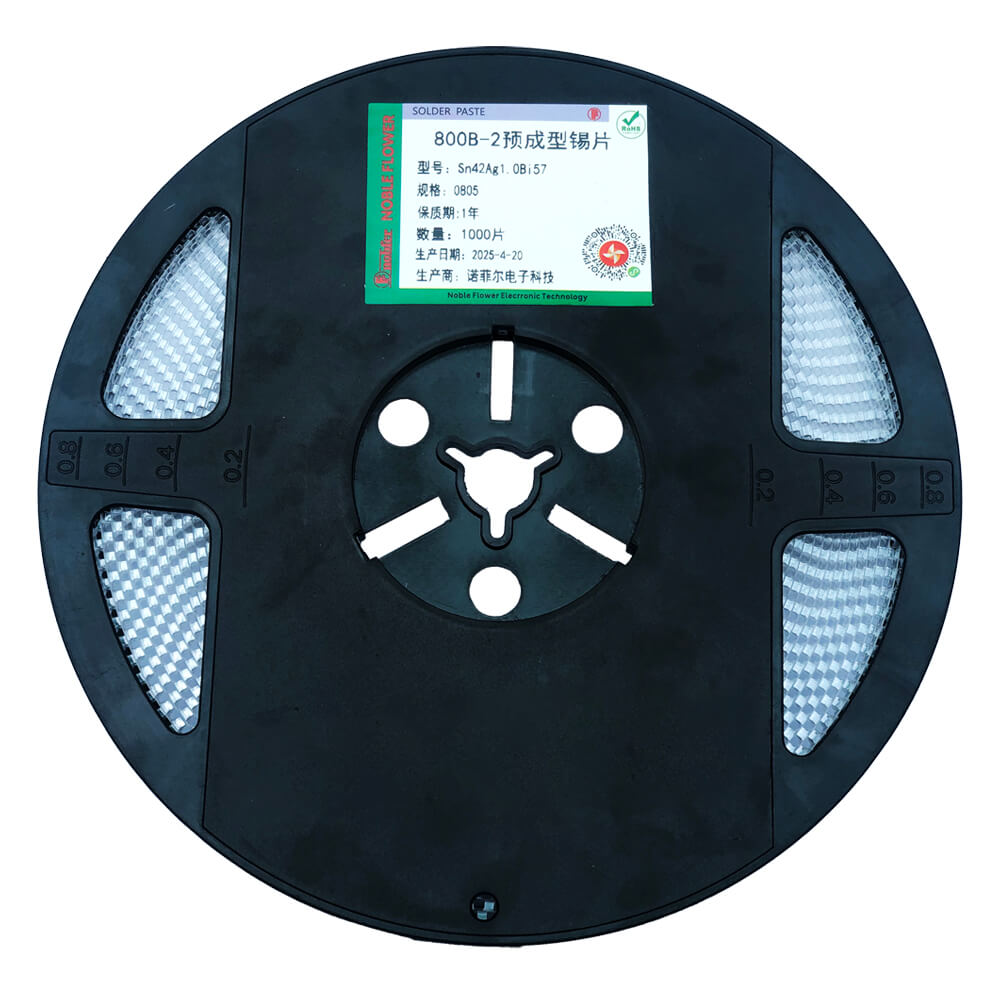
4. Preforming process: a form revolution
that amplifies advantages
The SAC305 is a revolution in traditional
solder forms, making it a great addition to precision packaging. This kind of
pre-made solder parts with specific shapes (such as round, square, ring) solves
the measurement problem of traditional wires and solder pastes through
micron-level size control (thickness tolerance ±0.002mm, profile accuracy
±0.01mm) - in the soldering of 01005 specification components, the solder usage
error of preformed solder sheets can be controlled within 5%, while the error
of solder paste printing is often more than 20%. Practical data from a MEMS
sensor packaging plant shows that the following metrics are significantly
improved after using SAC305 preformed solder sheets: Solder joint consistency:
Height difference decreased from ±0.03mm to ±0.008mm
Vacancy rate: from 12% to less than 3%; Production
efficiency: 30% faster automated placement; The pre-forming process also
compensates for the performance deficiencies of the SAC305 through structural
design. For example, the design of a micro-groove structure on the surface of
the welding blade can increase the chance of oxide film breakage during welding
and increase the wettability by 15%; The stepped design with local thickening
allows more solder to gather in the center of the BGA solder joint, alleviating
stress concentration issues.
5. Performance upgrade: a breakthrough in
the third generation of modification technology
In order to meet the stringent demands of
5G and AI chips, the industry is promoting the leapfrog improvement of SAC305
performance through multi-alloying and nanocomposite technology. A trace
addition of bismuth (Bi) (0.5-1wt%) is one of the most well-established options
– tested according to the IPC-J-STD-003B standard, this modification reduces
the melting point to 215-217°C while reducing the wetting time by 15-20%,
making it particularly suitable for welding heat-sensitive components. After
the application of an LED packaging company, the chip junction temperature was
reduced by 8°C and the optical decay rate was reduced by 10%.
Nanocomposite strengthening technology has
opened up a new path. The uniform dispersion of 0.1wt% TiO₂ nanoparticles (20-50nm
diameter) in the SAC305 matrix can improve the fatigue resistance by more than
40% through the dual action of pinning dislocation and refining of the grains
(JEDEC JESD22-A104 standard test). What's even more impressive is that the
addition of graphene (0.05wt%) can improve both strength and conductivity,
reducing the signal transmission loss of solder joints at 10GHz high frequency by
8%, providing an ideal connection solution for millimeter-wave radar modules.
The combination of these modification techniques and preforming processes is
giving rise to the concept of "smart solder" – an innovation that enables real-time monitoring of soldering
quality by pre-placing temperature indicators or stress sensors in the solder
lugs, reducing maintenance costs for 5G base stations by more than 30%.
epilogue
The development of SAC305 preformed solder
wafers reflects the evolution trajectory of lead-free soldering technology –
from simply meeting environmental requirements, to achieving a balance between
performance and process, to addressing high-density packaging challenges
through form innovation and composition optimization. Today, as electronic
devices move towards three-dimensional integration and system-in-package, it is
not only a product of technological transition, but also the starting point of
material innovation. In the future, with the maturity of cutting-edge
technologies such as high-entropy alloys and adaptive solders, SAC305 may
gradually withdraw from the historical stage, but its design concept of
"environmental protection first, balanced performance, and process
adaptation" will continue to influence the development direction of
next-generation soldering materials. For manufacturing companies, a deep
understanding of the performance characteristics and application boundaries of
SAC305 is not only the need for current production, but also the key to
grasping packaging technology trends.
 Su Gongwang Security 32058302004438