


Tampilan:1 创始人: Site Editor Publish Time: 2026-03-22 Origin: Site


In the CPU chip of each computer, nearly
1,000 solder balls with a diameter of only 0.3 mm are silently supporting the
high-speed flow of data. In the battery management system of new energy
vehicles, the welding points of ultra-fine tin wire ensure the stable
transmission of current; Behind each panel of a photovoltaic module, the
precise connection of low-temperature solder determines the level of power
generation efficiency...... These seemingly insignificant tin-based materials,
like the "neural network" of the industrial system, not only
penetrate all aspects of daily life, but also support the development of
national strategic emerging industries. Tin, a metal known as "industrial
monosodium glutamate", is being upgraded from a traditional industrial raw
material to a strategic new material with high added value through
breakthroughs in deep processing technology.
1. Ultra-fine tin wire: a welding
revolution with hair-level precision
In a clean workshop with a constant
temperature of 25°C and a humidity of 50%, a bundle of tin wire with a diameter
of only 0.1 mm is continuously being ejected from the precision drawing
equipment – a metal wire that is thinner than a human hair (about 0.07-0.1 mm
in diameter) and requires ten processes of precision forging to form. Starting
from the ratio of solder alloy, the ratio of tin to silver, copper and other
elements should be controlled within the error range of ±0.01% to ensure the
stability of subsequent soldering performance. The ingot casting process adopts
vacuum melting technology to control the gas impurity content below 5ppm to
avoid wire drawing fracture caused by internal pores; In the final ultra-fine
drawing process, the deformation of each pass is accurately controlled between
8% and 10%, and through more than 20 times of progressive stretching, the wire
is gradually reduced from the initial diameter of 5 mm to the target size, and
its processing accuracy is comparable to the meshing tolerance of clock gears.
The birth of this φ0.1mm ultra-fine solder wire broke the size barrier in the
field of electronic soldering. In the fingerprint recognition module of
smartphones, it can achieve precise connection of 0.05 mm pitch solder joints, reducing
the risk of solder bead splashing by 30% compared to traditional wires. In the
gyroscope assembly of space satellites, its uniform composition distribution
keeps the solder joints stable over temperature cycles from -50°C to 120°C,
increasing connection reliability to 99.9%. Zhang Chenghai, head of the
company's business department, pointed out: "The technical difficulty of
ultra-fine tin wire is not only in size control, but also in maintaining the
mechanical properties under small diameters - our products can withstand more
than 50 repeated bends in the 180-degree bending test, while ordinary tin wires
will crack about 10 times. "
The industrial application of this
technology has formed significant economic benefits. In 2023, the sales volume
of ultra-fine solder wire alone will exceed 500 tons, and the new sales revenue
will exceed 80 million yuan. More importantly, it has led to the technological
upgrade of the entire product line, and the company has launched a series of
high-reliability solder wires, which has replaced imported products in the
welding of motor controllers of new energy vehicles, reducing the procurement
cost of similar components by 40%.
2. BGA solder balls: a precision world of
one in five million
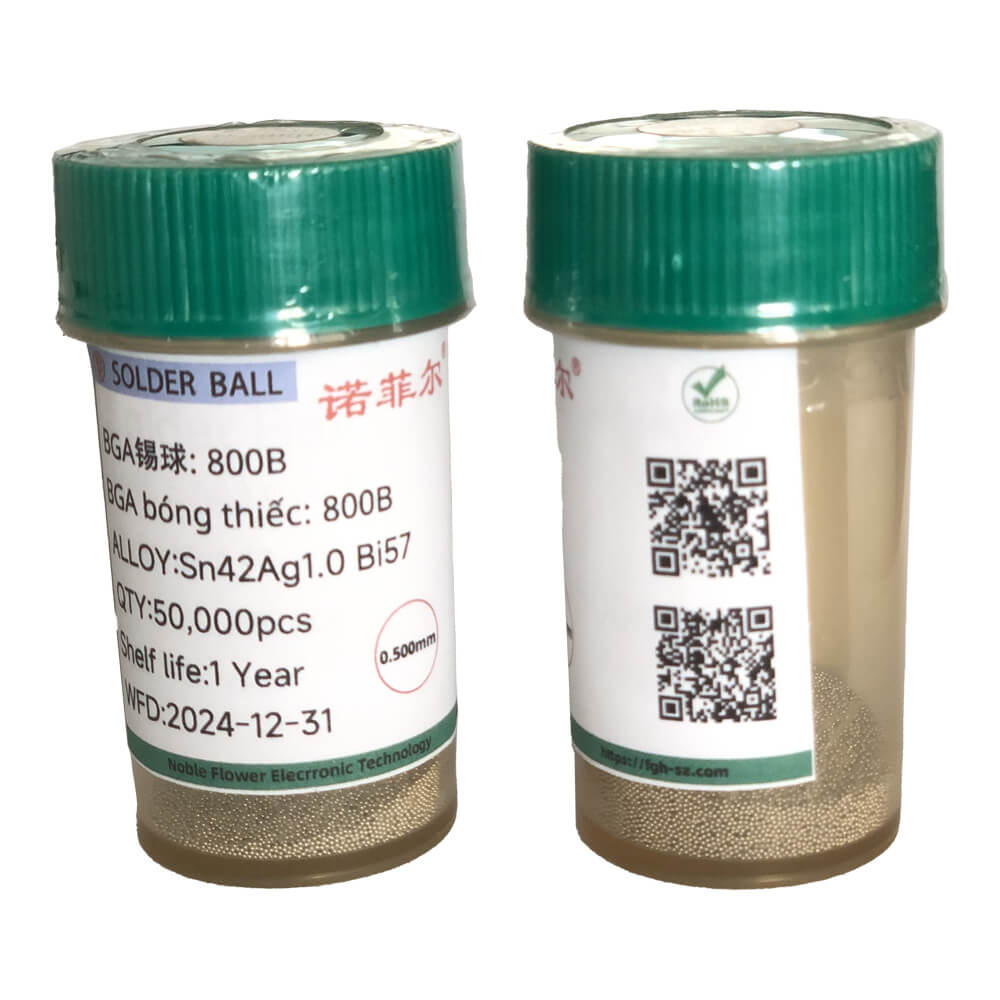
In a glass jar the size of a household seasoning bottle, about 5 million solder balls are neatly arranged - these metal spheres with a diameter of 0.3-1.2 mm, each of which has undergone triple inspection of roundness, diameter, and surface finish, can be called the "standard parts" of the microscopic world. As the core material of ball grid array packaging (BGA) technology, BGA solder balls play a key role in replacing traditional pins, building hundreds or even thousands of electrical interconnect channels between the chip and the substrate, and its performance directly determines the signal transmission speed and heat dissipation efficiency of integrated circuits. The production process of BGA solder balls is a protracted battle against microscopic defects. Due to the lack of mature production experience in China, Zhang Xianli, the company's equipment team leader, led the team to complete the process breakthrough in three years: the self-developed automatic roundness screening machine detects each solder ball 360 degrees through laser scanning technology, and all products with a roundness error of more than 0.002 mm are eliminated, and the pass rate has increased from 75% to 99.5% in the initial stage; The introduced precision drop casting equipment adopts the constant temperature liquid tin drop ball process under nitrogen protection, so that the oxide layer thickness on the surface of the solder ball is controlled within 5 nanometers, which is far lower than the industry standard of 20 nanometers, and significantly improves the wettability during welding. Intelligent transformation further releases production capacity potential. After replacing the high-cost imported ultrasonic power supply, the cleaning efficiency of the solder balls is increased by 40%, and the energy consumption of a single equipment is reduced by 25%. The newly launched fully automatic production line realizes the unmanned whole process from raw material input to finished product packaging, shortening the production cycle from the original 48 hours to 12 hours. These process optimizations bring more than just efficiency gains – in the core chip packaging of 5G base stations, using the company's BGA solder balls, the solder joint void rate has been reduced from the industry average of 8% to 2.3%, resulting in a 15% improvement in the base station's communication stability.
3. Innovation matrix: seamless connection
from the laboratory to the production line
At the company's R&D center, the flame
retardant team is making its 37th formulation adjustment – a tin-based flame
retardant that needs to maintain flame retardant efficiency while keeping the
material's dielectric constant below 3.0 to meet the signal transmission
requirements of 5G communication devices. This kind of tackling of the
"stuck neck" problem is a normal portrayal of the company's
innovation system. Focusing on the industrial chain of tin-based new materials,
the company has built a professional R&D team covering alloys, tin
chemistry, solder chemicals, flame retardants, high-purity materials and other
fields, forming a full-chain innovation capability of "basic research,
pilot incubation, and industrial transformation". In 2023, R&D
investment increased by 28.2% year-on-year, and this continuous technical
investment has yielded fruitful results: aluminum-based solder wire uses flux
to solve the oxidation problem during aluminum soldering, increasing the
welding efficiency of photovoltaic busbars by 50%; By adding 0.1% nickel
element, the high-temperature strength of the solder joint is increased to 1.8
times that of traditional products, meeting the high-temperature resistance
requirements of electric vehicle battery packs. Organotin compounds such as
dioctyl tin dichloride and dioctyl tin oxide have replaced toxic lead
stabilizers in the production of medical PVC materials, promoting the green
upgrading of medical packaging. The collaborative innovation system of
"government, industry, academia, research and application"
accelerates the transformation of achievements. The low-temperature solder for
photovoltaic soldering tapes developed by it reduces the soldering temperature
from 220°C to 180°C, reducing the thermal damage of solar cells and increasing
the conversion efficiency by 0.5 percentage points. The market advantages
brought by this technological innovation are emerging: in 2023, the company's
new product sales will reach more than 3,700 tons, and the new sales revenue
will be 480 million yuan, of which more than 80% of the products will be
imported substitution.
4. New quality productivity: the
"chemical reaction" of the talent echelon
On the whiteboard of the flame retardant
laboratory, various chemical reaction equations are densely written - this is
the trace of Yuan Yingjie's team brainstorming on market application problems.
As the leader of the flame retardant team, he led a team of 12 people,
including doctors with deep knowledge of materials science and engineers with
rich production experience. The hierarchical training system established by the
company provides customized growth paths for talents at different stages: for
fresh graduates who have just joined the company, the implementation of the
"mentorship system" training, the arrangement to participate in the
process optimization of specific projects, and the mastery of core technologies
in practice; For technical backbones with certain experience, they are selected
to exchange and learn from leading enterprises in Germany, Japan and other
countries, and track international cutting-edge technologies; For leading
talents, independent decision-making power for R&D projects is given, and
special financial support is provided to encourage disruptive innovation. This
talent training model has borne fruit. The octyl tin product team in the tin
chemical sector is composed of young engineers with an average age of 32 years
old, and the environmentally friendly octyl tin heat stabilizer they developed
solves the odor problem of traditional products through molecular structure
design, and successfully enters the supply chain of international retail giants
such as IKEA and Wal-Mart; The analysis and testing team has established a
testing system covering more than 80 indicators, and its test reports have been
mutually recognized by the International Laboratory Accreditation Cooperation
Organization (ILAC), clearing technical barriers for product exports.
epilogue
From φ0.1mm ultra-fine tin wire to BGA
solder balls of 1 part of 5 million, from laboratory formula research and
development to intelligent manufacturing of production lines, every
technological breakthrough of tin-based new materials reflects the hardships
and glory of the transformation of traditional industries to high-end
manufacturing. In this process, "new product development" is like the
rearrangement of atoms, "new process optimization" is like the
densification of crystal structure, and "new talent training" is like
the role of a catalyst - the synergy of the three is producing a "chemical
reaction" that promotes industrial upgrading. When these micro-scale
innovations accumulate to a certain extent, it triggers qualitative changes in
the industrial energy level. Today, the company's tin deep processing products
not only meet the needs of the domestic market, but also export to developed
countries such as Japan, South Korea, Europe and the United States, occupying a
place in the global electronics manufacturing supply chain. This identity
change from "industrial monosodium glutamate" to "strategic
materials" confirms a simple truth: real core technologies cannot be
introduced, and independent innovation must be relied upon; The cultivation of
new quality productivity must eventually return to the coordinated development
of the three fundamental elements of materials, technology and talents.
In the future, with the rapid development
of 5G, new energy, artificial intelligence and other industries, tin-based new
materials will usher in a broader application space. Those seemingly small
technological improvements may be laying the groundwork for the next generation
of electronic manufacturing technology - just as solder balls silently support
the data torrent in chips, innovations in these basic materials are supporting
the high-quality development of China's manufacturing industry.
 Su Gongwang Security 32058302004438