


Tampilan:1 创始人: Site Editor Publish Time: 2026-03-23 Origin: Site


Low-temperature sintered nano silver paste:
a paradigm innovation in electronic heat dissipation materials
When your smartphone suddenly experiences a
frame rate drop when running a large game, or when the laptop unexpectedly
blues during video rendering, there is often a key problem that is overlooked
behind these seemingly random glitches - the "thermal runaway" of
electronic components. Today, when the chip process has entered 5nm or even
3nm, the transistor density has increased nearly 100 times compared with ten
years ago, and the thermal power consumption per unit area has also surged
simultaneously, and the heat dissipation capacity has become the
"Achilles' heel" that restricts the performance breakthrough of
electronic devices. Traditional thermal conductive materials are gradually
falling short in this race against heat, and a low-temperature sintered
nano-silver paste called AS9120 is redefining the technical boundaries of
electronic heat dissipation with its unique ability to achieve sintering at
120°C but withstand high temperatures of 960°C.
1. Heat dissipation dilemma: the invisible
shackles of electronic devices
Modern electronic devices are trapped in a
cruel performance paradox: higher computing speeds inevitably come with greater
heat generation, and higher temperatures in turn lead to performance
degradation. Industry data shows that for every 2°C increase in operating
temperature of electronic components, their mean time between failures (MTBF)
is reduced by 10%; When the temperature exceeds 70°C, the computing efficiency
of some chips will drop by more than 30%. This vicious circle is particularly
evident in high-end devices such as 5G base stations and artificial
intelligence servers - test data from a communication equipment manufacturer
shows that the signal transmission bit error rate increases by 2 times for
every 10°C increase in temperature of the base station main chip under
continuous high load operation.
The limitations of traditional cooling
solutions are becoming increasingly prominent. The thermal conductivity of
polymer-based thermal conductive adhesives that are widely used today is
usually between 0.2-0.5W/(m・K), which is only about
one-fifth of that of metallic copper. More seriously, due to the microscopic
roughness (usually between 0.1-1μm) on the surface of electronic devices, the
actual contact area is often less than 10% of the geometric area, and the residual
air layer (thermal conductivity is only 0.026W/(m・K)) forms
a contact thermal resistance of up to 0.06K/W, just like adding a thermal
barrier between the chip and the heat sink. This structure results in about 60%
of the heat not being efficiently exported and can only accumulate inside the
device.
In advanced packaging technologies such as
3D chip stacking and system-in-package (SiP), thermal dissipation challenges
are even more severe. In these structures, the vertical distance between chips
is only a few microns to tens of microns, making it difficult to deploy
traditional heat dissipation channels, and the difference in thermal expansion
coefficients of different materials (CTE of about 2.6ppm/°C for silicon and
about 15ppm/°C for organic substrates) will generate huge stresses during
temperature cycling, leading to reliability issues such as solder joint
cracking and interface delamination.
2. Breakthrough of nano silver paste: the
dialectical unity of low-temperature forming and high-temperature service
The revolutionary nature of low-temperature
sintered nano-silver paste lies in its ability to solve the contradiction
between "low-temperature processing" and "high-temperature
use". By reducing the size of silver particles to the nanoscale (typically
20-100nm), their surface energy increases dramatically – when the particle
diameter is reduced from 1μm to 10nm, the specific surface area is increased by
a factor of 100, and the proportion of surface atoms jumps from about 3% to
more than 50%. This structure allows the silver particles to undergo diffusion
sintering at temperatures well below the melting point of bulk silver (961°C),
and the AS9120 nano-silver paste can complete the densification process at a
low temperature of 130°C, forming a continuous conductive and thermally
conductive network.
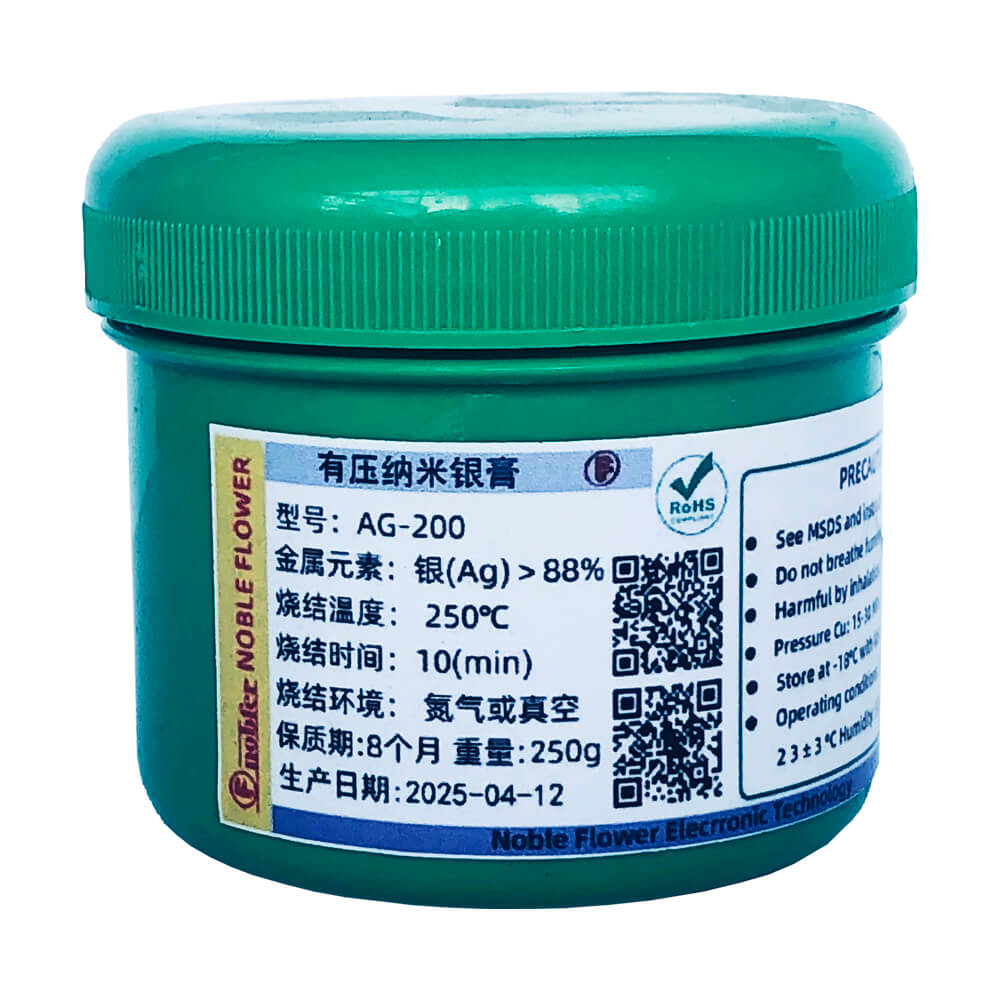
The sintered silver nanostructure exhibits amazing high-temperature stability. X-ray diffraction (XRD) analysis showed that the crystal structure was exactly the same as that of bulk silver, resulting in densities of more than 80% and no macroscopic pores that could affect performance. This structure gives the nano-silver paste excellent high-temperature resistance – its electrical and thermal properties are reduced by less than 5% at a high temperature of 960°C, which is much better than tin-based solder (softening failure above 200°C). Extreme environment tests at an aerospace research institute showed that after 1000 thermal and cold shock cycles from -180°C to 300°C, the connection structure using AS9335 nano silverpaste remained intact with a resistance change rate of less than 10%. This feature is perfectly suited to the temperature gradient requirements of electronic manufacturing. In the multi-stage assembly process of chip packaging, low-temperature nano-silver paste is used to complete the bottom connection, and then the upper layer is packaged through a higher temperature process to avoid thermal damage to the completed structure. For example, in the stacking process of 3D NAND flash memory, AS9330 nanometer silver paste can reduce the bonding temperature from the traditional 300°C to 150°C, increasing the number of stacked layers from 64 to 128, doubling the storage capacity and increasing yield by 25%.
3. Performance matrix: the synergistic
transition between electrical conductivity and thermal conductivity
Low-temperature sintered nano silver paste
has built an amazing performance balance system, achieving synchronous
breakthroughs in key indicators such as electrical conductivity, thermal
conductivity, and mechanics. In terms of electrical properties, the AS9376
model nano silver paste can have a volumetric resistivity as low as 4.6×10⁻⁶Ω
cm after sintering at 280°C for 60 minutes, which is only 1.2 times that of
copper and far better than conductive adhesives (usually on
the order of 10⁻⁴Ω cm). This high conductivity allows it to not
only serve as a heat dissipation material but also to perform electrical
connection functions, making it valuable in space-constrained scenarios such as
RF modules.
The improvement in thermal performance is
even more significant. Although the thermal conductivity of 246W/(m・K) is slightly lower than that of sterling silver blocks (429W/(m・K)), it is already 500 times that of epoxy resin and more than 20
times that of conventional thermally conductive silicone grease. In LED chip
packaging, the thermal resistance is reduced from 15K/W to 6K/W and the chip
junction temperature is reduced by 25°C, which not only extends the service
life (from 50,000 to 80,000 hours), but also increases the light output
efficiency by 15%.
Microstructural analysis reveals the secret
to superior performance. Scanning electron microscopy (SEM) images show that
the nano-silver slurry sinters form a continuous silver skeleton structure, and
the silver particles are tightly connected by neck growth, and the porosity is
controlled below 20%. This structure makes its coefficient of thermal expansion
(CTE) highly matched with bulk silver (19ppm/°C), which is about 21ppm/°C,
which is much lower than that of tin-lead solder (25-30ppm/°C), and significantly
reduces the thermal mismatch stress between the chip and the substrate.
Reliability tests by an automotive electronics manufacturer show that power
devices using nano-silver paste do not fail after 3,000 cycles in a temperature
cycle of -40°C to 125°C, while devices connected with traditional solder have a
50% failure probability after 1,500 cycles.
4. Morphological regulation: from micro
design to macro performance
The performance optimization of nano silverpaste is inseparable from the precise regulation of the morphology and
distribution of silver particles. It is found that the morphology of silver
powder has a decisive impact on the performance after sintering - spherical
silver powder has good fluidity and is easy to print; Flake silver powder has a
larger specific surface area and contact area, which is conducive to the
formation of a continuous conductive network. By compounding 20% flake silver
powder (average diameter of 5μm, thickness of 0.5μm), the conductive network
can be upgraded from traditional point contact to surface contact, and the
fish-scale overlapping structure increases the conductive efficiency by 30%
while reducing the contact resistance by about 40%. Particle size gradient
design is another key technique. Mixing micron-scale silver powder (5-10 μm)
with nano-scale silver powder (50-100 nm) in a specific ratio (typically 7:3)
can form the tightest stacked structure similar to "cobblestone paving",
reducing the porosity of the system by more than 5%. This structure not only
improves density but also reduces shrinkage during sintering (from 15% to 8%),
facilitating the control of dimensional accuracy in precision devices. In
mmWave radar's antenna package, this technology reduces signal transmission
loss by 10% and improves directivity by 5%. The choice of dispersant is also
crucial. Suitable dispersants such as polyvinylpyrrolidone PVP form a
protective layer on the surface of the silver particles to prevent
agglomeration, extending the stability of the nano-silver paste during storage
(at 25°C) from 3 to 6 months. At the same time, the dispersant will completely
decompose during the sintering process without leaving impurities that affect
performance, which is especially critical for high-end fields such as
aerospace.
5. Cross-border applications: from consumer
electronics to interstellar exploration
The application landscape of
low-temperature sintered nano silver paste is expanding from electronic
packaging to a broader field, and its unique properties show irreplaceability
in many scenarios. In the field of flexible electronics, its performance is
amazing - the elongation at break can reach more than 15%, which is 5 times
that of traditional ITO materials; After 1000 bending tests (5mm radius of
curvature), the resistance change rate is still less than 3%. A smartwatch
manufacturer used this technology to compress the circuit thickness of a
flexible display from 50μm to 10μm, which not only reduced weight, but also
increased the bending life of the screen from 10,000 to 50,000 times. New
energy vehicles are another important application scenario. In the connection
of power battery modules, nano silver paste solves two major problems of
traditional welding: first, through silver-clad copper technology (silver layer
thickness 50-100nm) to reduce material costs by 40%, reducing the battery
connection cost of each vehicle by about 300 yuan; Second, by adding 5% nickel
particles, the electromigration phenomenon is significantly inhibited (the
electromigration rate is reduced by 90% at 100°C, 10⁴A/cm² current density), which is
expected to extend the service life of battery modules to 15 years, far
exceeding the industry average of 8 years.
Its applications in the aerospace field
highlight its ability to adapt to extreme environments. The specially modified
AS9335 nano silver paste has been tested for a wide range of -180°C (liquid
nitrogen temperature) to 300°C and has a volatile content of less than 0.1% in
a vacuum environment, fully meeting the requirements of space applications. A
satellite manufacturer revealed that phased array antenna cooling modules using
this material reduce weight by 55%, reduce power consumption by 20%, and improve
in-orbit operation stability by 30%, which is of great significance to
spacecraft that need to strictly control the launch weight. The heat
dissipation problem of 5G communication base stations has also been alleviated
by nano silver paste. By introducing directionally arranged SiC seeds (100nm in
diameter) into the nano-silver paste system, a "silver-ceramic"
composite thermal conductivity network is constructed, and the axial thermal
conductivity reaches 160W/(m・K), which is three times
that of the conventional scheme. Tests by a telecom operator showed that 5G
base stations with this technology reduced main equipment temperatures by 12°C,
reduced energy consumption by 15%, and increased signal coverage by 8%.
6. Technological evolution: the
never-ending exploration of performance boundaries
Breakthroughs in surface modification
technology continue to promote the performance upgrade of nano silver paste. By
coating the surface of the silver particles with an ultra-thin titanate
coupling agent (approximately 2 nm thick), the interfacial binding with the
epoxy resin can be increased from 50 mJ/m² to 180 mJ/m², and the interfacial
thermal resistance is reduced by 70%. This modification has resulted in a
thermal conductivity of the nano-silver paste-resin composite jumping from
1.16W/(m·K) to 2.136W/(m・K),
extending the luminaire life to 100,000 hours when applied in the heat
dissipation fins of LED street lights.
Low silver technology is a key direction to
reduce costs. By optimizing the morphology of silver powder and sintering
additives, Shanren New Materials has reduced the silver content from the
traditional 85% to 60% while maintaining the same performance. Even more
groundbreaking is silver-clad copper technology, which forms a uniform layer of
silver on the surface of the copper core, which not only retains the high
thermal conductivity of copper, but also takes advantage of the oxidation
resistance of silver, reducing material costs by 40% while reliability is not
compromised. This technology enables large-scale applications of nano-silver
paste in consumer electronics.
Intelligent manufacturing improves product
consistency. The laser particle size meter was used to monitor the particle
size distribution of silver powder online, and the difference between batches
was controlled within 5%. Real-time adjustment of slurry viscosity by rheometer
improves printing accuracy from ±5μm to ±2μm. These technologies have improved
the yield of nano-silver paste from 60% to 95%, laying the foundation for
industrialization.
epilogue
From the initial exploration of the
laboratory to the stable mass production of the production line, Shanren New
Materials' low-temperature sintered nano silver paste has completed the
technological transformation in 12 years, and has also witnessed the leap from
following to running in China. The true value of this material lies not only in
its excellent performance indicators, but also in its breaking the traditional
perception that "high temperature is the only way to achieve high
strength", and redefining the design logic of electronic connections and
heat dissipation materials.
As technologies such as 5G, artificial
intelligence, and quantum computing continue to drive electronic devices to
higher performance, smaller size, and more extreme environments, materials with
"contradictory properties" such as low-temperature sintered
nano-silver paste will play an increasingly important role. Perhaps in the near
future, the electronic devices in our hands will completely say goodbye to
bulky cooling fans and release more powerful performance in silent operation -
and behind all this is the macro revolution of microscopic materials such as
nano silver paste. ]]>
 Su Gongwang Security 32058302004438