


Tampilan:1 创始人: Site Editor Publish Time: 2026-03-26 Origin: Site


Nano cubic silver solder paste: material
breakthrough and packaging revolution of low-temperature and low-pressure
sintering
In the silicon carbide chip packaging
workshop, a 3mm×3mm virtual chip is tightly bonded to the substrate through a
special process - in the air at 280°C, without significant pressure, relying
only on the characteristics of the material itself, a strong joint with a shear
strength of 31MPa is formed in 30 minutes. This seemingly incredible joining
technology stems from an innovation in microscopic structure: nano-cubic silver
particles with a side length of about 54nm form a superlattice structure through
self-assembly, and the porosity of the sintered joints is only 0.76%, which is
much lower than the 5%-10% of traditional spherical silver particles. The
emergence of nano-cubic silver pasta soldernot only breaks the dependence on
high-voltage processes for power device packaging, but also redefines the
performance boundaries of low-temperature sintering technology, providing a new
solution for high-density packaging of third-generation semiconductor devices.
1. Material innovation: the structural
advantages of nanocubic silver
When electron microscopy captured clear
images of nanocubic silver for the first time, materials scientists realized
that this special structure could lead to breakthroughs in packaging
technology. Compared with traditional spherical silver particles, the cube
structure gives silver nanomaterials three unique advantages, which together
form the core foundation of low-temperature and low-pressure sintering.
The high surface atomic ratio is the most
striking feature of nanocubic silver. Calculations show that cubic silver
particles with a side length of 54 nm have a surface atom ratio of 23%, which
is nearly three times that of spherical particles of the same volume (8%
surface atoms). This structure increases the contact area between particles by
more than 40% and significantly reduces the energy barrier of atomic diffusion
during sintering. High-resolution transmission electron microscopy showed that
the cubic silver particles began to show significant neck growth at 150°C,
while the spherical particles needed to reach 200°C for a similar phenomenon.
This low-temperature activity allows nanocubic silver to complete densification
within a temperature window that is not possible with traditional processes.
The self-assembly feature builds an orderly
microstructure. Under the action of ultrasonic vibration, the nanocubic silver
particles spontaneously form a closely arranged superlattice structure as if
guided by an invisible force, and the average spacing between the particles is
controlled at 2-3nm. This ordered arrangement results in shorter atomic
diffusion paths and significantly reduced porosity during sintering.
Comparative experiments show that under the same process conditions, the
porosity of the cubic silver sintered layer (0.76%) is only 1/7 of that of
spherical silver (5.2%), resulting in a density increase of nearly 90%. What's
more, this self-assembly does not require the forced action of external high
pressure, fundamentally avoiding the risk of chip damage.
The precise regulation of the surface
coating solves the agglomeration problem of nanoparticles. Nanocubic silver
prepared by polyol reduction method is evenly coated with a 3.3nm thick PVP
(polyvinylpyrrolidone) organic shell. This protective layer effectively
prevents particle agglomeration through steric hindrance, extending the
stability period of solder paste under cryogenic storage conditions (4°C) for
more than 6 months. When the temperature rises to 150°C, PVP begins to
decompose gradually, without losing its protective effect prematurely or
affecting conductivity – thermogravimetric analysis shows that at 280°C
sintering, the organic matter removal rate can reach 99.5%, and the final
silver content remains at 83% (mass fraction).
The synergy of these properties results in
a unique "temperature-pressure-performance" equilibrium system for
nanocubic silver pasta solder: at 280°C, its atomic diffusion rate is 2.5 times
that of spherical silver particles; The required sintering pressure can be
reduced to less than 1MPa, which is only 1/10 of the traditional process. Tests
by an IGBT module manufacturer have shown that the mechanical damage rate of
the chip has been reduced from 3% to less than 0.1% of the high-voltage process
and production costs have been reduced by 20% with this solder paste.
2. Preparation process: from nanoparticles
to functional solder paste
The preparation of nanocubic silver solder
paste is a micro-scale precision engineering, which requires precise
collaboration in particle synthesis, organic system preparation and process
parameter control to transform material potential into actual performance.
Polyol reduction is the core technology for
synthesizing nanocubic silver. In ethylene glycol solution, silver nitrate is
mixed with PVP at a molar ratio of 1:0.8, and after 3 hours of reaction at
160°C, a uniformly sized cubic silver particle is formed. During the reaction,
the quality of the product is ensured by precisely controlling the following
parameters:
The fluctuation of the reaction temperature
is controlled at ±2°C to avoid irregular particle shape caused by local
overheating.
The PVP concentration is maintained at
0.01mol/L to ensure a uniform coating layer of 3-4nm;
The stirring rate was set at 500rpm to
uniform the concentration of the reaction system, and the final particle size
deviation was controlled at ±5nm.
Transmission electron microscopy analysis
shows that the nano-cubic silver prepared by this process has a cube structure
integrity rate of more than 95% and an average edge length of 54nm, which meets
the consistency requirements of solder paste preparation.
The process of formulating solder paste is
like the art of formulating in the microscopic world. Nanocubic silver
particles are mixed with an organic carrier in an 83:17 mass ratio where the
organic carrier contains:
Solvent (glycol monoether, 60%): provides
the right viscosity to ensure printability;
Adhesive (ethylcellulose, 20%): maintains
the shape of the paste and prevents sagging;
surfactants (span - 80,15%): reduce
interfacial tension, improve wettability;
Combustion aid (citric acid, 5%): Promotes
atomic diffusion at low temperatures.
Through the three grinding of the three-roller machine (the roll distance is 50μm, 20μm, and 5μm, respectively), the silver particles are evenly dispersed, and the viscosity of the final solder paste is controlled at 100-150Pa・s (25°C, 10rpm), which not only ensures the formability during printing, but also realizes the particle rearrangement under ultrasonic vibration.
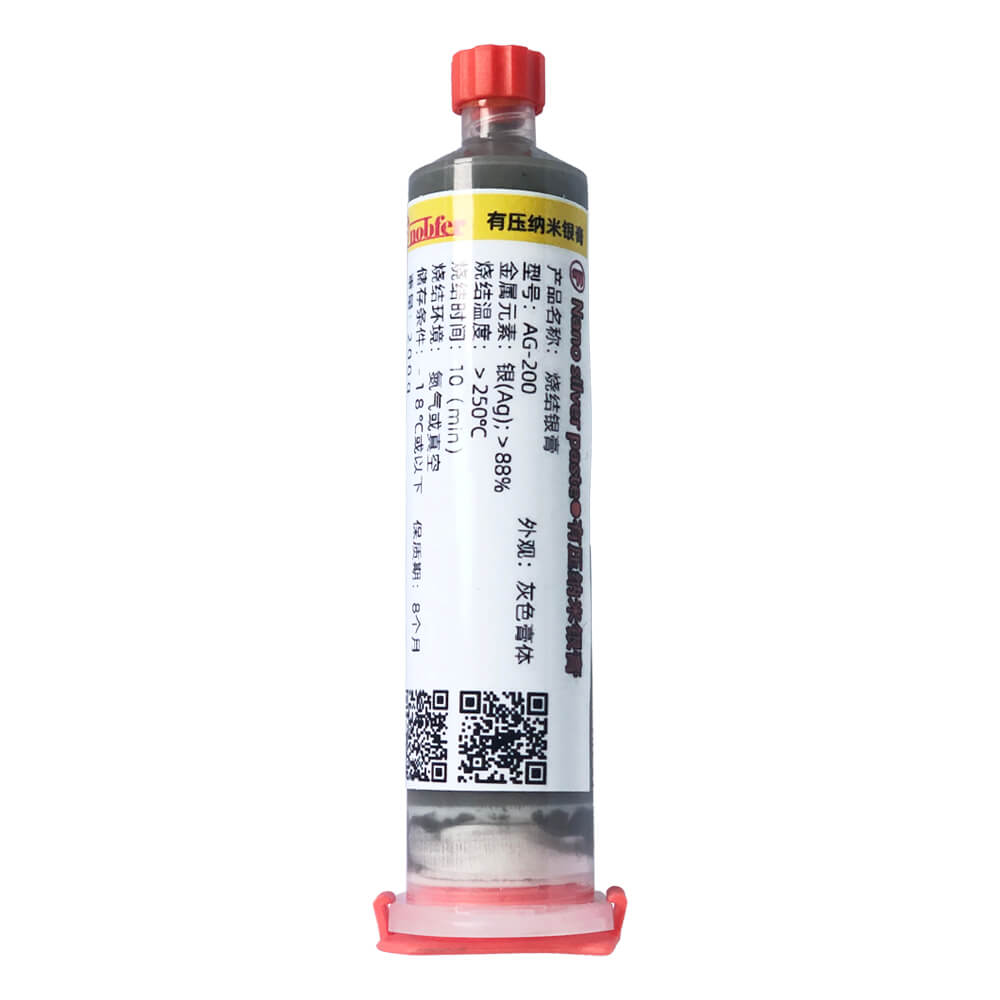
Substrate pretreatment lays the foundation
for high-quality sintering. The dual efficacy of a 3mm×3mm, 10mm×10mm copper
block simulating a chip and substrate with magnetron sputtering forms a
1μm-thick silver coating on the surface:
Provides an AG-Ag connection interface,
which reduces the contact resistance of the Ag-Cu interface by 60%;
The silver layer on the copper surface acts
as a diffusion barrier to control the migration of copper atoms at high
temperatures to less than 0.1%.
Before applying the solder paste, the
silver-plated copper block needs to be cleaned with ultrasonic alcohol for 10
minutes to remove organic contaminants on the surface, reducing the water
contact angle from 35° to 15°, and significantly improving the wettability of
the solder paste.
3. Sintering process: precise design of
temperature curve
Thermogravimetric analysis (TGA) provides a
clear thermal behavior map for nanocubic silver solder paste, which serves as a
scientific basis for optimizing the sintering process. Tests in air at a rate
of 10°C/min to 400°C showed that the quality of the solder paste changed in two
distinct stages, corresponding to different physicochemical processes.
The first stage (25-150°C) is the removal
period of organic matter. From room temperature to 150°C, the solder paste
quality is reduced by 16.6%, mainly due to solvent volatilization and adhesive
breakdown. The derivative analysis of the thermogravimetric curve showed that
the maximum weight loss rate occurred in the range of 100-120°C, which
corresponded to the rapid volatilization of ethylene glycol monoether. To avoid
stomatal defects caused by violent reactions, a slow heating rate of 5°C/min is
used at this stage and kept warm at 150°C for 20 minutes to ensure that more
than 90% of organic matter is smoothly removed at this stage. A comparative
experiment showed that extending the holding time at 150°C to 20 minutes
reduced the porosity of the final sintered joint from 1.2% to 0.76%.
The second stage (150-280°C) is the
critical period of densification. After the temperature exceeded 150°C, the
weight loss rate slowed down significantly, indicating that the organic matter
had been basically removed, and the silver nanoparticles began to diffuse
through the surface to form a sintered neck. In order to reduce the consumption
of non-dense diffusion in the low temperature zone, a rapid heating of 10°C/min
is used at this stage to quickly reach the sintering point of 280°C. During the
30-minute incubation at 280°C, the atomic diffusion changed from surface
diffusion to grain boundary and lattice diffusion dominant, and the sintered
neck continued to grow and the porosity continued to decrease. High-resolution
SEM observations confirmed that a continuous network was formed between the
particles after 20 minutes of insulation. After 30 minutes, the large pores are
largely gone, leaving only isolated nanoscale micropores.
Ultrasound-assisted and low-pressure
control are at the heart of process innovation. Substrates coated with solder
paste (approximately 60μm thick) are processed in an ultrasonic cleaner for 5
minutes (300W at 40kHz) to rearrange nanocubic silver particles through
mechanical vibration for tighter stacking. During the sintering process, a
special fixture is used to provide a slight pressure of less than 1MPa, which
does not promote densification, but ensures good contact between the solder
paste and the upper and lower substrates, and inhibits the damage to the
interface bond caused by the escape of bubbles generated by organic matter
volatilization. This low-voltage condition reduces the bending deformation of
the chip from 5μm to less than 0.5μm compared to the traditional 5-10MPa
process, which fully meets the packaging requirements of precision devices.
The atmosphere selection takes into account
both performance and cost. Although inert gas protection reduces the oxidation
of silver, experiments have shown that oxygen in the air contributes to the
complete combustion of organic matter (residual carbon content <0.1%) and
that the oxidation of nanocubic silver at 280°C is negligible (silver oxide
production <0.5%). Therefore, the solution of sintering directly in the air
not only ensures the quality of the joints, but also eliminates the cost of the
gas protection system, increasing process economy by 30%.
4. Performance characterization: from macro
strength to microstructure
The excellent performance of nano-cubic
silver sintered joints has been fully verified in macroscopic testing and
microanalysis, and its comprehensive indicators not only meet the packaging
requirements of power devices, but also show the potential to surpass
traditional technologies.
Shear strength tests show excellent
mechanical properties. The test was conducted at a speed of 30mm/min using a
push-pull force tester (HKE-3132), and the resulting thrust-displacement curve
showed a maximum thrust of 281N at 2.60mm, and the shear strength was
calculated to be 31MPa. This value is not only well above the minimum
requirement for power device packaging (15MPa), but more importantly, it
achieves a strength level comparable to that of a high-voltage process (10MPa)
under low voltage conditions. Comparative experiments show that the shear
strength of traditional spherical silver particles under the same low pressure
condition is only 18MPa, confirming the structural advantages of nano-cubic
silver.
Fracture surface analysis reveals
characteristic patterns of cohesive failure. Scanning electron microscopy
showed that the fracture mainly occurred inside the sintered silver layer, and
a large number of silver particles remained on the surface of the upper and
lower substrates, and there were obvious traces of plastic deformation -
tearing lines and closed tough holes in the same direction of stretching,
indicating that the fracture process consumed a lot of energy. This cohesive
failure mode is more reliable than adhesion failure (the strength is typically
< 10MPa), accounting for more than 90% of the entire fracture surface, and
mixed failure close to the silver-plated interface occurs only in the edge area
(about 5%).
Cross-sectional characterization reveals a
uniform and dense microstructure. The sintered silver layer thickness is
reduced from an initial 60μm to 40μm, with a shrinkage rate of 33%, mainly due
to two processes:
Assembly phase: Slight press on chip
placement to extrude part of the solder paste (approx. 10μm);
Sintering stage: Densification shrinkage
due to atomic diffusion (about 10μm).
The high-magnification microscope shows
that a continuous grain network is formed in the silver layer, and the original
cubic particle contours have disappeared, indicating that sufficient diffusion
and fusion have occurred. Energy dispersive spectrometry (EDS) analysis showed
that there was significant elemental cross-diffusion at the interface between
the silver layer and the copper substrate, with copper atoms diffusing to the
silver layer at a depth of 2μm, while the diffusion of silver to the copper substrate
was negligible, which is consistent with the theory that the diffusion
coefficient of Cu in Ag (10⁻¹⁴cm²/s) is much
higher than that of Ag in Cu (10⁻¹⁶cm²/s).
The porosity calculation confirmed the
compactness of the structure. The longitudinal SEM image was binarized using
MATLAB software, defining the black area as a porosity, and the porosity was
calculated to be only 0.76%. These pores are mostly isolated nanoscale holes
(< 500 nm in diameter) that do not form a connected defect path, so they
have little impact on overall performance. In contrast, the sintering porosity
of traditional spherical silver particles at low pressure is usually more than
5%, and there are a large number of connecting pores, which seriously affects
thermal and electrical conductivity.
5. Technological breakthroughs and
application prospects
The successful research and development of
nano cubic silver solder paste has achieved three key breakthroughs in the
field of power device packaging, paving the way for the industrialization of
low-temperature and low-pressure sintering technology.
The pressure-dependent breakthrough
fundamentally solves the problem of chip damage. Traditional silver nano solder
pastes require an applied pressure of 1-10MPa to obtain high-strength joints,
which can easily lead to chipping or warping of thin chips (<100μm). With
its self-assembly characteristics and high surface energy, nanocubic silver can
achieve a shear strength of 31MPa at a low pressure of <1MPa, fully meeting
the reliability requirements of IGBT, SiC and other power devices. Mass production
data from a semiconductor manufacturer shows that after using this technology,
the sintering yield of chips has increased from 82% to 99%, reducing losses by
more than 5 million yuan per year.
Process simplification leads to significant
cost advantages. The process design without high-pressure equipment and inert
gas protection reduces the cost of production line renovation by 60%; The
sintering temperature of 280°C is compatible with existing reflow soldering
equipment, avoiding the investment of new equipment; The introduction of
ultrasound-assisted sintering time has been reduced by 30% and equipment
capacity has increased by 1.5 times. According to comprehensive calculations,
the manufacturing cost per unit product is reduced by 25% compared with the
traditional high-pressure process and 40% lower than that of imported
low-temperature silver paste using the packaging process of nano-cubic silver
paste.
Performance improvements push the
boundaries of applications. The low porosity of 0.76% enables the thermal
conductivity of the sintered joint to reach 230W/(m·K), which is 40% higher than that of traditional low-pressure
sintered products, effectively solving the heat dissipation problem in
high-density packaging. In the long-term aging test at 175°C, the resistance
change rate is only 0.3%/1000 hours, which is much lower than the 1%/1000 hours
of automotive electronics standards, proving that it can meet the reliability
requirements of automotive-grade specifications.
These advantages make nano cubic silver
solder paste show great application potential in many fields:
New energy vehicles: high-density packaging
of SiC motor controllers to achieve a 30% increase in power density;
5G base station: low-temperature connection
of GaN power devices, reducing thermal resistance by 15%;
Aerospace: Reliable interconnection in
extreme environments, withstanding temperature cycles from -55°C to 200°C;
Smart Grid: Efficient packaging of
high-voltage IGBT modules for improved operational stability.
Future technological evolution will focus
on three directions: reducing material costs through the design of silver-clad
copper cubic particles; Develop a sintering process with a lower temperature
(<200°C) to adapt to flexible substrates; Optimizing the particle size
distribution further increases the density. These innovations are expected to
make nanocubic silver solder paste a mainstream solution for next-generation
power device packaging, driving electronics manufacturing towards higher
performance, lower cost, and reliability.
Conclusion: Macroscopic changes in
microstructure
The story of nanocubic silver solder paste
reveals a profound truth in materials science: the precise regulation of
microstructure can bring revolutionary breakthroughs in macroscopic
performance. When silver cubes with sides of 54nm are self-assembled to form a
superlattice structure, it not only achieves high-strength connections under
low pressure conditions, but also redefines the boundaries of people's
perception of low-temperature sintering technology.
The value of this technological innovation
is not only reflected in the performance indicators, but also in the fact that
it solves the core contradiction of traditional processes - how to obtain
high-strength joints while avoiding chip damage. By translating the forced
action of external pressure into the material's own self-assembly capabilities,
nanocubic silver solder paste offers a smarter and more efficient solution for
power device packaging.
With the rapid development of
third-generation semiconductor technology, the requirements for packaging
materials will become increasingly demanding, and the low-temperature activity,
low-pressure process, and high reliability exhibited by nanocubic silver solder
paste make it ideal for addressing these challenges. From motor controllers for
new energy vehicles to power modules for 5G base stations, this microstructure
innovation is quietly changing the landscape of electronics manufacturing,
laying a solid foundation for electronic devices with higher power density and
higher reliability.
In today's continuous integration of
materials science and engineering technology, the success of nanocubic silversolder paste is just the beginning. It proves that through a deep understanding
of the microscopic behavior of matter, we can create new materials and
processes that transcend traditional cognition, thereby promoting the
continuous progress of industrial technology and ultimately providing stronger
technical support for the development of human society.
 Su Gongwang Security 32058302004438