


Tampilan:1 fubing: Site Editor Publish Time: 2026-03-30 Origin: Site


Noble flower Sintered Silver: A
Breakthrough from Laboratory Innovation to Industrial Innovation
In the evolution of electronic packaging
materials, every material innovation has been accompanied by the reshaping of
the industrial pattern. The sintered silver series products developed by Noble
flower New Materials are rewriting the supply chain choices of 319 global
leading companies with their disruptive performance - from power modules of new
energy vehicles to superconducting chips for quantum computing, this connection
material made of low-temperature sintering of nano-silver particles is at a
high temperature limit of 961°C, 260W/m・K's ultra-high thermal
conductivity, redefining the reliability standards of electronic devices.
Exploring the refining trajectory of Noble flower sintered silver can not only
see the breakthrough path of materials science, but also touch the innovative
pulse of China's high-end electronic materials to achieve import substitution.
1. Industry pain points: the performance
ceiling of traditional packaging materials
When the power density of silicon carbide
chips exceeds 300W/cm² and the operating temperature of the RF module of 5G
base stations climbs to 150°C, the performance shortcomings of traditional
packaging materials become more and more prominent. In a 2015 market survey,
the R&D team of Noble flower New Materials found that the field of
electronic packaging is facing three irreconcilable contradictions:
The paradox between heat dissipation
efficiency and temperature tolerance is particularly prominent in power
devices. Conventional tin-based solder has a thermal conductivity of only
30-60W/m·K, which cannot export the heat generated by
high-power chips in time, resulting in a 1°C increase in junction temperature
that can shorten the device life by 10%. Test data from a new energy vehicle
company shows that the chip temperature of the motor controller using SAC305
solder will rise by 20°C every 15 minutes when running at high load, and
eventually fail due to thermal runaway. Although high-temperature brazing can
withstand temperatures above 400°C, the process temperature of 600°C will cause
irreversible damage to precision chips.
The contradiction between process
temperature and material compatibility constrains sensitive device packaging.
In products such as lidar and MEMS sensors, silicon-based and gallium nitride
materials are extremely sensitive to temperature, and welding processes above
200°C may lead to component performance drift. Experiments by an optical module
manufacturer have confirmed that traditional high-temperature soldering will
reduce the coupling efficiency of silicon optical chips by 15%, which directly
affects the transmission performance of 400G optical modules.
The imbalance between connection strength
and reliability plagues complex applications. Automotive electronics During a
temperature cycle of -40°C to 125°C, the shear strength of conventional solder
can plummet from 30MPa to less than 5MPa, causing frequent joint failure in
vibrating environments. Statistics show that the failure rate of in-vehicle
electronic systems using traditional materials is as high as 8% per 100,000
kilometers, which is far from meeting the safety requirements of intelligent
driving.
Behind these industry pain points are the
inherent limitations of traditional materials at the atomic level - the low
melting point characteristics of tin-based solder, the polymer insulating phase
of conductive adhesives, and the risk of thermal damage from high-temperature
brazing, which together constitute the performance ceiling of electronic
packaging technology. The doctoral team of Noble flower New Materials realized
that in order to break through this bottleneck, it is necessary to start from
the essence of the material and find new connection materials with high thermal
conductivity, high temperature resistance and low temperature process characteristics.
2. Technological breakthroughs: size effect
and process innovation of nano-silver particles
The core breakthrough of Noble flower
sintered silver lies in taming the "surface energy" characteristics
of silver nanoparticles, transforming this nanomaterial, which is easily
aggregated in nature, into an industrial-grade packaging material with stable
performance. This process involves multi-dimensional innovation in material
preparation, process development, and formulation optimization.
(1) Synergistic effect of mixed-size
nano-silver
In the laboratory of Noble flower New
Materials, the nano-silver particles under transmission electron microscopy
show a carefully designed size distribution - large particles of 80nm and small
particles of 20nm form a "gradient structure" in a ratio of 1:9. This
innovative design stems from the team's deep understanding of sintering
mechanisms:
Low-temperature activity of small-sized
particles: 20nm silver particles account for up to 20% of surface atoms, and
significant surface diffusion can occur at 150°C, powering low-temperature
sintering;
Skeletal support for large-sized particles:
80nm particles form a rigid network to avoid volume shrinkage caused by
excessive sintering of small particles (precise control from 60μm to 40μm);
Increased density due to gradation effect:
Gap filling of two size particles results in density over 99%, which is 15%
higher than that of single-size particles.
To solve the problem of silver
nano-agglomeration, the team developed a "molecular-level coating"
technology that forms a 3.3nm thick organic protective layer on the surface of
silver particles, extending the stability period of the silver paste at 4°C to
6 months through steric hindrance. This protective layer will gradually
decompose at 150°C, which will not hinder the sintering process and avoid the
influence of residual carbon on the conductivity, and finally control the
volume resistivity of the sintered layer below 5×10⁻⁸Ω・m.
(2) Paradigm revolution of low-temperature
and pressure-free technology
The 150°C pressureless sintering process of
Noble flower AG-100 has revolutionized the industry's perception of silver
sintering. While traditional processes require high temperatures above 250°C
and 10MPa pressure, the AG-100 can be sintered with a normal oven alone.
Surface energy-driven self-densification
mechanism: The high surface energy of the nano-silver particles allows them to
generate spontaneous diffusion dynamics at 150°C, forming a continuous
conductive network through three-stage evolution of "neck growth-pore
filling-grain boundary fusion". High-resolution electron microscopy showed
that after 30 minutes of sintering, a sintered neck with a diameter of 10 nm
was formed between the particles, and after 60 minutes, a connection layer with
a density of more than 95% was formed.
A 100-fold jump in production efficiency:
From a capacity of 30 pieces per hour with traditional silver sintering
technology to a breakthrough of 3,000 pieces per hour with the AG-100, this is
not only due to process simplification, but also due to the development of
automated coating systems. The squeegee printing equipment independently
designed by Noble flower New Materials can control the thickness of silver
paste to 50±2μm and the line width accuracy of ±5μm, providing a stable process
foundation for large-scale mass production.
According to the production line data of an
optical module manufacturer, after using the AG-100 pressureless sintering
process, the product yield has increased from 78% to 99.5%, the annual
production capacity of a single production line has been expanded from 100,000
to 1 million pieces, and the unit manufacturing cost has been reduced by 40%.
(3) Scenario-based adaptation of formula
design
Noble flower New Materials has built a
product matrix covering different application scenarios, and each formula has
been optimized through hundreds of orthogonal experiments:
AS9376's ultra-high thermal conductivity
formulation: through the directional arrangement of 85% flake silver powder
(diameter-to-thickness ratio 20:1), the high-efficiency thermal conductivity
path is constructed, and the thermal conductivity of 260W/m・K is close to that of copper metal, which is especially suitable for
high-power chips above 300W;
AS9335's low-temperature co-firing system:
10% modified epoxy resin is added to reduce the sintering temperature to 150°C
while maintaining a shear strength of 25MPa, which is perfectly compatible with
silicon-based and gallium nitride materials;
AS9385's pressurized sintering formulation:
Active silver paste developed for bare copper substrates can form an Ag-Cu
interdiffusion layer at 25MPa pressure, with a contact resistance as low as
5×10⁻⁵Ω·cm², breaking the dependence on precious metal
coatings.
This scenario-based design has continuously
expanded the application boundaries of Noble flower sintered silver - from a
liquid helium environment (quantum chip) at -269°C to an automotive engine
compartment at 200°C, from micron-sized sensor packaging to a large substrate
of 100mm², showing strong environmental adaptability.
3. Product matrix: from laboratory samples
to industrial-grade solutions
Noble flower New Materials has built a
complete sintered silver product system in eight years, and each series
corresponds to clear market demand, forming an accurate match between technical
characteristics and application scenarios.
(1) Unpressurized semi-sintered silver: a
cost-effective choice for large-area packaging
The AS9330 series works synergistically
with resin and silver powder to provide reliable connections at 150-200°C
pressure-free conditions. An application case of a photovoltaic inverter
manufacturer shows that after using AS9335 to package 100mm×150mm IGBT
substrates:
35% higher heat dissipation efficiency,
increasing inverter conversion efficiency from 96.5% to 97.5%;
100°C reduction in process temperature
avoids thermal distortion of the substrate (from 50μm to 5μm);
The material cost is reduced by 30%
compared with imported products, and the annual procurement cost is saved by 12
million yuan.
This series is especially suitable for low-
and medium-power scenarios such as optical communication modules and consumer
electronics, and currently occupies 40% of the domestic pressureless sintered
silver market.
(2) Unpressured fully sintered silver: a
benchmark for reliability in the field of high performance
The AS9375 series relies entirely on the
diffusion of silver particles to form connections, and although the process
temperature is slightly higher (200-250°C), the performance indicators are
better:
The volumetric resistivity < 5×10⁻⁸Ω·m, which is close to the conductivity level of bulk silver.
Shear strength exceeds 30MPa, and retention
rate reaches 90% after 1000 temperature cycles (-55°C to 150°C);
The temperature resistance is up to 961°C,
which is more than 5 times that of conventional solder.
In the field of quantum computing, the superconducting quantum chip of the University of Science and Technology of China adopts AG-100, which increases the resistance stability at liquid helium temperature by 10 times, providing a guarantee for the long coherence time of qubits. Tests by a quantum technology company have confirmed that the material's electromagnetic shielding properties reduce quantum state
manipulation errors by 60%.
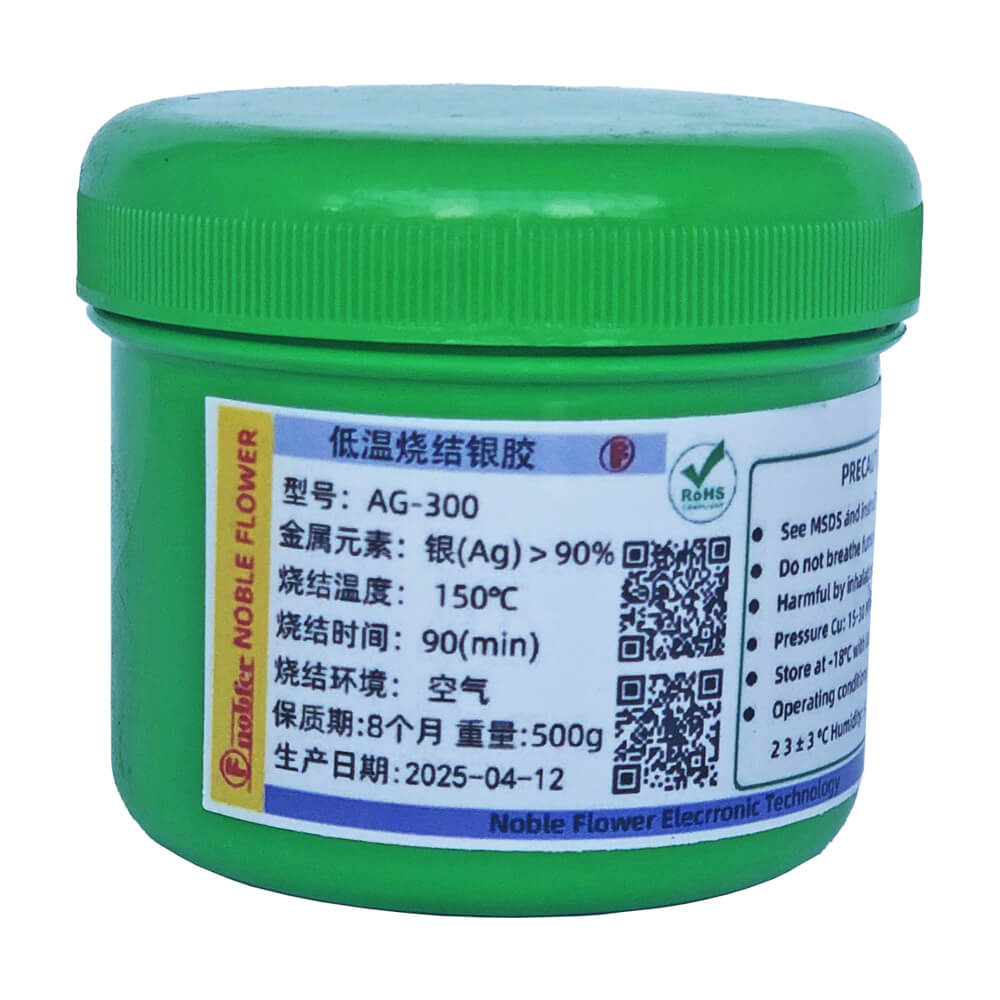
(3) Pressurized sintered silver: a
connection solution for extreme environments
The AS9385 series further increases density
with pressure assistance (10-30MPa), making it superior in extreme
environments. In the lidar of new energy vehicles, this product shows three
advantages:
The chip junction temperature is reduced by
10°C, which improves the ranging accuracy of LiDAR from ±5cm to ±2cm;
The failure probability after vibration
test (20-2000Hz, 20g) was reduced from 10% to 0.1%;
50% longer life, matching the 15-year /
300,000-kilometer service life of the car.
At present, the series has entered the
supply chain of many leading car companies, and shipments in the automotive
field will increase by 300% year-on-year in 2023.
4. Quality control: quality link from
atomic level to industrial level
Noble flower New Materials has established
a quality control system covering the whole life cycle, which perfectly
combines the microscopic characteristics of nanomaterials with the consistency
requirements of the industrial level.
The "silver powder ID card"
system is implemented in the raw material screening process - each batch of
nano silver powder needs to pass:
Dynamic light scatterometer (DLS) particle
size distribution detection (CV value<5%);
X-ray fluorescence spectroscopy (XRF)
purity analysis (silver content ≥99.99%);
Topography observation by scanning electron
microscopy (SEM) (sphericity > 0.9).
A batch of silver powder was judged to be
unqualified and recycled due to a standard deviation of particle size
distribution exceeding the standard by 3%, which made the raw material
qualification rate stable at more than 99.5%.
The production process uses a "digital
twin" monitoring system to control key process parameters in real time:
The grinding gap of the three-roller
machine is controlled at 5±0.1μm to ensure that the silver paste is evenly
dispersed.
The stirring speed is maintained at
1500±50rpm to avoid secondary agglomeration of particles;
The temperature field uniformity of the
curing furnace is controlled at ±2°C, ensuring consistent performance from
batch to batch.
This system reduces the batch-to-lot
variance rate from 5% to less than 1%, providing stable quality assurance for
large-scale mass production.
The "performance pyramid" test
system is constructed in the finished product testing process:
Base layer: resistivity (four-probe
method), thermal conductivity (laser flash method);
Intermediate layer: shear strength
(push-pull test), density (metallographic analysis);
Top layer: temperature cycling (-55°C to
150°C, 1000 times), moist-heat aging (85°C/85% RH, 1000 hours).
Only products that pass all 28 tests leave
the factory, an almost demanding testing standard that has resulted in a
customer complaint rate of less than 0.1% for Noble flower sintered silver for
three consecutive years.
5. Market breakthrough: from technical
recognition to ecological co-construction
The market expansion path of Noble flower
sintered silver shows the typical paradigm of China's high-end materials from
the laboratory to industrialization - winning reputation with technical
performance, driving popularization with application cases, and finally
realizing import substitution.
The breakthrough in the domestic market
began in the field of third-generation semiconductors. In 2018, a test by a
silicon carbide device manufacturer showed that a 1200V SiC module using AG100 had a power cycle
life of 100,000 cycles, which is five times that of traditional solutions. This
result prompted the manufacturer to include Nophiel sintered silver in the list
of main suppliers, which subsequently led to a demonstration effect in the industry.
At present, 80% of domestic SiC module manufacturers have adopted Noble flower's
new materials products, promoting the reliability of domestic silicon carbide
devices to reach the international leading level.
The penetration of the international market
relies on the combination of "technology benchmarking + cost
advantage". In a comparative test of an internationally renowned car
company, Nophiel sintered silver showed that the performance indicators were
the same as similar products in Japan, but the price was 20% lower and the
delivery cycle was shortened by 50%. This cost-effective advantage has allowed
it to successfully enter the company's global supply chain, with products now
exported to 12 countries, increasing its share of the global sintered silver
market from 1% in 2018 to 15% in 2023.
More strategic is the construction of
industrial ecology. Noble flower New Materials, the Chinese Academy of
Sciences, Tsinghua University and other institutions jointly established the
"Nano Connection Technology Joint Laboratory" to promote the
formulation of sintered silver standards; Cooperate with equipment manufacturers
to develop special sintering furnaces to control process temperature
fluctuations at ±1°C; Provide customers with full-process technical support
from material selection to process optimization, and this "material +
process + service" model shortens the customer's introduction cycle from 6
months to 2 months.
6. Future prospects: from material
innovation to scene reconstruction
Noble flower's R&D pipeline has been
extended to more cutting-edge application fields, and the next generation of
technological breakthroughs is brewing:
The path to cost optimization is clearly
visible. Through the development of a silver-clad copper core-shell structure
(silver layer thickness of 5nm), material costs are reduced by 40% while
maintaining 80% conductivity; The application of continuous sintering processes
has reduced energy consumption by 50% per unit, and these innovations will
drive the widespread adoption of sintered silver in mass markets such as
consumer electronics.
The boundaries of performance continue to
expand. The thermal conductivity of graphene-enhanced sintered silver under
development is expected to exceed 300W/m·K; Antioxidant formula with
rare earth elements can increase corrosion resistance by 10 times, providing
solutions for extreme environments such as marine engineering and aerospace.
Scenario innovation leads new applications.
In the field of flexible electronics, the stretchable sintered silver developed
by Nophiel New Materials maintains its conductive path under 100% strain. In
the field of biomedicine, antibacterial sintered silver provides a new option
for implantable electronic devices. For ultra-high frequency modules for 6G
communication, the research and development of ultra-low loss formulas has
achieved phased results.
Behind these innovations is Noble flower
New Materials' practice of the concept of "materials change the
world". From the first nano silver sample in the laboratory to the mass
production capacity of 3,000 pieces per hour on the production line, the
refining of Noble flower sintered silver is not only a breakthrough history in
material technology, but also a microcosm of China's high-end electronic
materials to achieve independent and controllable results. In the future, with
the unlocking of more application scenarios, this innovative material
originating from China is expected to write a more brilliant chapter in the
field of global electronic packaging.
 Su Gongwang Security 32058302004438