


Tampilan:1 创始人: Site Editor Publish Time: 2026-04-03 Origin: Site


AS9120BL Low-temperature sintered
nano-silver paste: a precision connection engine in the era of flexible
electronics
When the folding screen mobile phone
completes the 100,000th opening and closing in the palm of the user's hand, the
conductive wire with a diameter of only 8μm inside the screen still maintains a
conductivity of 95% - behind this is the material miracle created by AS9120BL
low-temperature sintered nano silver paste. This functional paste tailored for
flexible electronics is redefining the connectivity standards of flexible
electronic devices with ultra-low temperature sintering characteristics of
110-120°C, ultra-low resistivity of 5.3×10⁻⁶Ω・cm, and precise control to support fine line printing of 8μm. From
stretched circuits in wearable devices to glass antennas in new energy
vehicles, AS9120BL is like an invisible precision engineer, building efficient
and stable electronic pathways between the micron and nanometer scales.
1. Performance breakthrough: conductive
revolution in low temperature environment
AS9120BL's core competitiveness stems from
its performance balance at low temperatures – maintaining the high conductivity
of silver nano while avoiding damage to flexible substrates at high
temperatures, a seemingly contradictory property that can be perfectly solved
through innovation in material design.
The height and width ratio control of fine lines has reached a new height in the industry. By optimizing the particle size distribution (D50=0.8μm, particle size distribution span <1.2) and the thixotropic properties of the organic carrier, the silver paste can stably print rectangular cross-sectional lines with a width ratio of 1:1 and a line edge roughness of Ra<1μm. Even more amazing is its extreme printing capabilities: it can produce ultra-thin lines of 8 μm wide and 8 μm high with a dry film aspect ratio of 0.77 with a 500 mesh mesh, which is equivalent to printing 6 independent lines side by side on a hair section (about 50 μm) without bridging. Tests by a flexible display manufacturer showed that the short-circuit rate of 30μm pitch lines made of this silver paste was only 0.01%, which was far lower than the industry average of 0.5%.
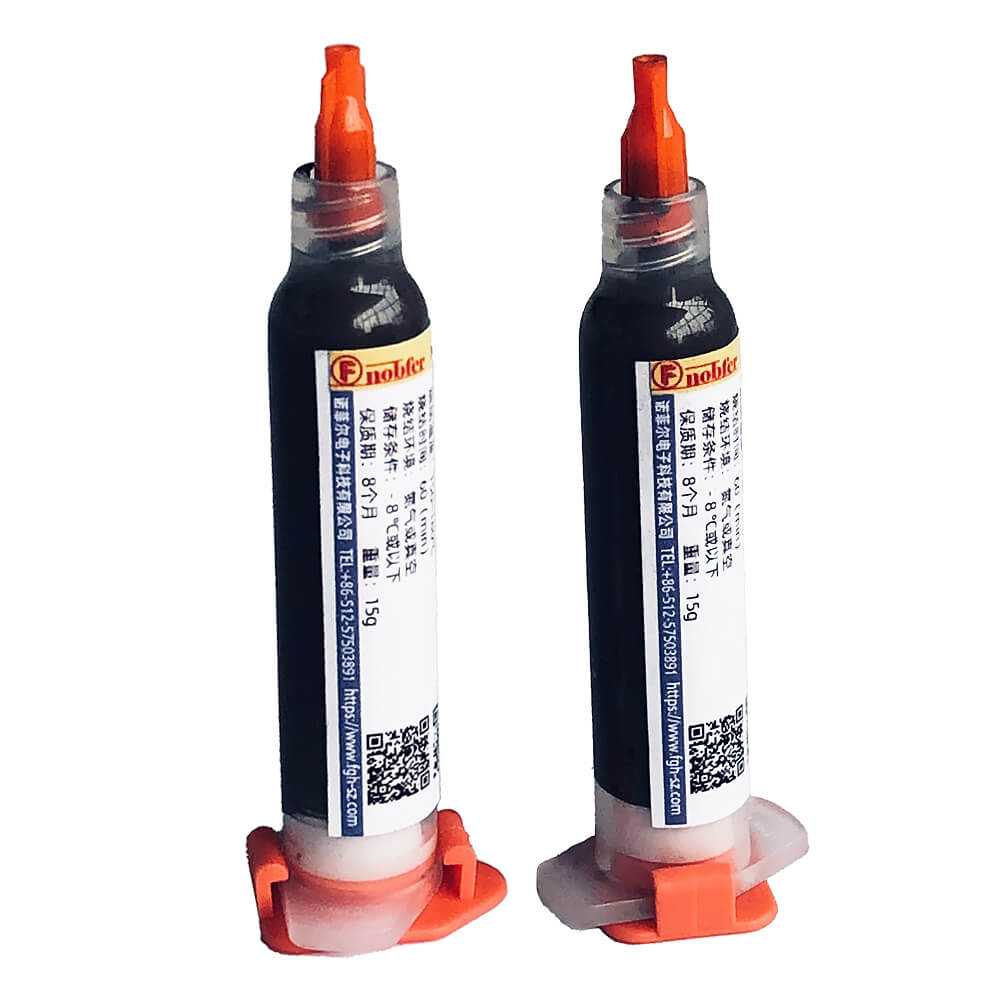
The conductive efficiency of
low-temperature sintering has been improved by leaps and bounds. After 15
minutes of sintering at 120°C, the volume resistivity of the silver slurry
layer was as low as 5.3×10⁻⁶Ω cm, which was not only 40%
better than the industry standard (9×10⁻⁶Ω cm), but even close to the bulk silver (1.67×10⁻⁶Ω・cm). High-resolution electron microscopy reveals the mystery: silver
nanoparticles (30-50nm) diffuse through surface diffusion at low temperatures
to form a continuous network, with sintered necks up to 40% of particle size
and density exceeding 88%. Comparative data from a photovoltaic laboratory
showed that the conductivity of AS9120BL was 1.8 times that of traditional
silver paste under the same 150°C process, increasing the filling factor (FF)
of perovskite cells from 72% to 78%. The ultra-low temperature rapid curing
mechanism overcomes the problem of flexible substrate resistance. The sintering
temperature range of 110-120°C just avoids the damage threshold of flexible
materials such as PET (upper limit of heat resistance 130°C) and ITO film
(easily degradable above 150°C). Experiments by a wearable device manufacturer
confirmed that the size change rate of PET substrate circuits using AS9120BL is
<0.3% after treatment at 120°C, which is much lower than the 1.2% of the
traditional 150°C process. More importantly, the 15-minute fast curing feature
increases the production efficiency of conventional low-temperature silver
paste (30-60 minutes) by 1 times, and with a high-speed printing capacity of
100-200mm/s, the mass production speed of flexible circuits can be increased
from 30 to 80 pieces per hour.
Excellent attachment reliability in complex
environments. Its shear strength can still reach 6MPa on low surface energy
substrates such as PET and PI, and the strength retention rate is > 85%
after 1000 hours of 85°C/85% RH humidity and heat testing. This stability is
due to the action of a dedicated silane coupling agent (modified with KH-560)
that forms a chemical bridge between the silver powder and the substrate,
increasing interfacial adhesion by 40%. An on-board electronic test showed that
the resistance change rate of the AS9120BL line used for windshield heaters was
only 8% after 300 hot and cold cycles from -40°C to 85°C, well below the 20%
required by vehicle specifications.
2. Scenario implementation: from laboratory
innovation to industrial-level application
AS9120BL's technical characteristics are
accurately matched with the needs of emerging industries, showing unique
advantages in flexible electronics, new energy, 5G communications, and other
fields, promoting the innovation of product forms and manufacturing processes.
(1) Flexible electronics and wearable
devices: stable connection in deformation
In the e-paper display, the electrode line
printed by AS9120BL can withstand repeated folding in half at 180 degrees
(radius 5mm), and the resistance value changes by <50% after 1000 cycles,
solving the problem of traditional metal circuits being folded in half. After
an e-reader manufacturer adopted this technology, the service life of the
flexible screen increased from 10,000 page turns to 50,000 times. The in-mold
electronics (IME) process is another important battleground. AS9120BL can
withstand a short high temperature of 160°C (within 10 seconds) during the
injection molding process and form functional circuits directly on 3D curved
plastic parts. An automotive interior supplier has shown that the steering
wheel touch circuit made of this silver paste eliminates the bonding process of
traditional FPCs, reduces parts costs by 35%, and achieves a waterproof rating
of IP67. The field of flexible sensors is more evident in its advantages. In
strain sensors, the silver paste line can be stretched by 20% without breaking,
and the resistance response linearity is R²>0.98. In medical skin
electrodes, its biocompatibility is tested by ISO 10993, and the impedance
value is < 1kΩ (1kHz), ensuring stable acquisition of ECG signals. The test
data of a health bracelet shows that the signal-to-noise ratio of the signal
signal is increased by 25% and the false positive rate in the exercise state is
reduced to 1.2%.
(2) New energy and photovoltaic technology:
key materials for efficient energy conversion
In perovskite/crystalline silicon stacked
cells, AS9120BL shows unique value as a top electrode material. Its
low-temperature process avoids the damage of the perovskite layer by high
temperature (usually withstands < 150°C), and the 8μm fine line printing
capability combined with 0BB main gateless technology reduces silver
consumption from 120mg/piece to 80mg/piece, reducing the cost per watt by 0.03
yuan. According to the mass production data of a photovoltaic company, the
efficiency of the stacked cells using this scheme reached 31.5%, an increase of
1.8 percentage points compared with the traditional scheme.
In HJT heterojunction batteries, AS9120BL
is a good match with the transparent conductive oxide (TCO) layer, with a
contact resistance of < 10⁻⁴Ω cm²,
which increases the battery open circuit voltage (Voc) by 5mV. The application
of TopCon batteries reflects their high-temperature stability - after annealing
at 200°C, the silver paste line resistance increases by only 6%, ensuring that
the battery's power decay over long-term use < 2%/year.
The battery module connection of new energy
vehicles is another important scenario. The AS9120BL lug connection solution
achieves a shear strength of > 20MPa after curing at 120°C, with
conductivity equivalent to 90% of that of copper bar with an equivalent
cross-sectional area, while reducing weight by 40%. A test by a car company
showed that the solution increased the energy density of the battery pack by
5Wh/kg and extended the charging cycle life to more than 3,000 times.
(3) 5G communication and automotive
electronics: double breakthroughs in high-frequency and lightweight
In the field of 5G transparent antennas,
AS9120BL's aspect ratio lines (18μm×18μm) form an invisible grid on the glass
substrate, with a visible light transmittance of >85%, which is much higher
than the 70% of traditional copper paste lines. A millimeter-wave antenna test
on a smartphone showed that the antenna with the silver paste was 65%
efficient, a 15% improvement over the LDS process, and was IP68 waterproof.
The application of car touch screens
highlights their fine printing capabilities. The touch electrode with 8μm line
width increases the screen-to-body ratio to 92%, and the 120°C low-temperature
process avoids thermal stress cracking between the glass and the ITO film. The
test of the central control screen of a new energy vehicle shows that the touch
response speed of this solution is < 50ms, and it still maintains a touch
accuracy of 99.9% in a low temperature environment of -40°C.
Automotive glass heaters are its
differentiated applications. AS9120BL Serpentine lines printed on curved glass
have a power density uniformity of up to ±5% and a 30% reduction in defrost
time compared to traditional tungsten filament solutions. Winter tests at a
luxury car manufacturer confirmed that the front windshield with this
technology clears 80% of frost in 2 minutes at -20°C, and the line is so
invisible to the human eye (3 meters away).
3. Technology Comparison and Market Value:
Redefining Industry Standards
The emergence of AS9120BL is not a simple
improvement of performance parameters, but a breakthrough in low-temperature
sintering technology to reconstruct the evaluation system of flexible
electronic materials, and its market value is reflected in the dual dimensions
of technology generation difference and cost advantage.
The intergenerational difference with
traditional silver paste is significant. In terms of sintering temperature, it
is 30-60°C lower than that of conventional low-temperature silver paste
(150-180°C), which just avoids the heat resistance critical point of most
flexible substrates. In terms of conductivity, the resistivity of 5.3×10⁻⁶Ω cm is 41% lower than the industry average, reducing energy loss by
more than 30%. In terms of fineness, the 8μm line capability is nearly 1 times
higher than the mainstream 15μm level, meeting the wiring needs of folding
screens and high-density sensors. A blind test by a third-party testing agency
showed that on the same flexible substrate, AS9120BL's comprehensive
performance score (100-point scale) reached 92 points, 23 points ahead of the
second-place traditional product. Comparison with other nanosilver materials
highlights the comprehensive advantages. Compared with similar nano silverpastes, its advantages are reflected in three aspects: first, it cures quickly
in 15 minutes, which is 1 times more efficient than similar products (30
minutes); second, the adhesion strength (6MPa) on PET substrate is 30% higher;
Third, the resistance fluctuation between batches <5%, which is far better
than the industry level of 10%. Switching tests at a consumer electronics
foundry showed that switching to AS9120BL increased the yield rate of flexible
circuits from 82% to 95% and reduced rework costs by 70%.
Market potential and cost advantages are
becoming increasingly apparent with the expansion of scale. In the field of
perovskite cells, its silver consumption is reduced by 40%, reducing the silver
cost per GW of batteries by about 12 million yuan; In folding screen phones,
replacing traditional isotropic conductive adhesives (ACFs) can reduce
interconnect costs by 50%. According to industry forecasts, with the shipment
volume of folding screen mobile phones exceeding 100 million units and the
production capacity of perovskite batteries reaching 50GW in 2025, the market
size of AS9120BL is expected to exceed 2 billion yuan, with a compound annual
growth rate of 65%. The more far-reaching impact lies in the innovation of
manufacturing processes. AS9120BL is compatible with existing screen printing
equipment and can be introduced without large-scale modification of the
production line, which lowers the threshold for technical upgrades of flexible
electronics by 60%. The transformation case of a flexible circuit manufacturer
shows that only by replacing the silver paste and adjusting the process
parameters, the leap from the 20μm line to the 8μm line has been achieved, and
the equipment investment has been saved by 8 million yuan.
Conclusion: The material cornerstone of the
flexible electronics era
AS9120BL's technological breakthrough
represents the evolution direction of conductive silver paste from
"general-purpose" to "scene-customized" - no longer
pursuing the ultimate in single performance, but maximizing comprehensive value
through accurate matching of material design and application requirements. Its
sintering window of 110-120°C just opens the door to high-performance
connections for flexible materials such as PET and ITO; The printing accuracy
of 8μm provides the possibility of high-density integration; The conductivity
of 5.3×10⁻⁶Ω cm ensures efficient transmission of energy and signals.
With the accelerated development of
emerging industries such as wearable devices, flexible photovoltaics, and 5G
communications, AS9120BL is becoming a key link connecting micromaterials and
macro products. Its application not only improves product performance, but also
promotes the innovation of manufacturing processes, so that the concept of
flexible electronics that once stayed in the laboratory can be transformed into
mass-produced and popularized consumer products.
In the future, with the optimization of
silver powder morphology (e.g., core-shell structure, nanowire composite) and
resin system innovations (e.g., self-healing functions), the boundaries of
AS9120BL's performance will continue to expand – perhaps in the near future, we
will see electronic skins that can automatically repair after 50% stretching,
or solar charging panels that can be curled into pens-sized solar charging
panels. The starting point of these innovations is the solid foundation laid by
AS9120BL in the field of cryogenic sintering.
 Su Gongwang Security 32058302004438