


Tampilan:1 创始人: Site Editor Publish Time: 2026-04-04 Origin: Site


The packaging revolution of silicon carbide
power semiconductors: the rise of domestic sintered silver technology
When a new energy vehicle completes a
"cup of coffee time" next to an 800V high-voltage fast charging pile,
when a photovoltaic inverter injects 12% of the additional power generation
into the grid under the scorching sun, and when the RF module of a 5G base
station maintains stable operation in extreme temperature differences - behind
these scenarios, it is inseparable from the breakthrough of third-generation
power semiconductors with silicon carbide as the core. What supports these
high-performance chips to realize their ultimate potential is the sinteredsilver packaging technology from behind the scenes to the front of the stage.
This innovative process of converting silver nanoparticles into
"electronic joints" is redefining the reliability standards of power
devices with a high temperature resistance limit of 961°C and an
ultra-high thermal conductivity of 260W/m・K, and has become a key
starting point for China to achieve corner overtaking in the field of high-end
electronic materials.
1. Sintered silver technology: the art of
atomic-level connection in the microscopic world
The magic of sintered silver technology
lies in its qualitative change from "particle accumulation" to
"atomic fusion", a microscopic level of precision manipulation that
allows electronic connections to jump from "glue bonding" to a new
height of "metal bonding".
The self-assembly mechanism of the
nano-silver particles forms the core of the technology. In a temperature field
of about 250°C, silver particles with a diameter of only 50-100nm seem to be
given life, and "self-welding" is completed through surface diffusion
and grain boundary migration. This process can be clearly observed under
high-resolution electron microscopy: in the initial stage, adjacent particle
contact points form a "sintered neck" with a diameter of about 10 nm;
As the insulation time increases, the neck continues to thicken, eventually
forming a continuous structure with a density of more than 95%. This connection
is much stronger than conventional solder – the shear strength can be more than
30MPa, which is 3 times that of tin-based solders, and is strong enough to
withstand the constant vibration and temperature shock of the automobile's
engine compartment. The essential breakthrough of high-temperature resistance
comes from the characteristics of the material itself. Unlike traditional solders,
which typically have a melting point below 250°C, the melting point of the
sintered silver structure is consistent with that of sterling silver, up to
961°C, meaning that the connecting layer maintains the stability of the solid
metal even at the silicon carbide chip's operating temperature of 175°C.
Extreme tests in an automotive electronics lab showed that after 1,000 hours of
continuous operation at 300°C at 300°C, the resistance of power modules
increased by only 5%, while conventional solder had long since softened and
failed at this temperature. The generational difference with traditional solder
is reflected in multiple dimensions. If traditional solder is compared to
"building blocks bonded with glue", then sintered silver is a "poured
alloy structure": Thermal cycling stability: In 1000 cycles of -65°C to
150°C, sintered silver has a resistance change rate of <10%, while tin-based
solder will crack due to thermal fatigue, and the resistance will soar by more
than 50%; Thermal conductivity: 260W/m・K The thermal conductivity
is the same as that of SAC305 solder (60W/m・). K),
which can quickly export the heat generated by the chip; Service life: Under
new energy vehicle conditions, the life expectancy of sintered silver modules
can reach 15 years/300,000 kilometers, which is 5 times that of traditional
solutions. This performance jump just matches the application needs of silicon
carbide power devices - when the chip power density is increased from 50W/cm²
for silicon to 300W/cm² for silicon carbide, only sintered silver can solve the
core problem of "reliable heat dissipation at high heat flux
density".
2. The heat dissipation revolution of power
devices: from "small stove" to "highway"
The high-efficiency performance of silicon
carbide chips is inseparable from the "thermal management highway"
built by sintered silver, which brings not only the reduction of temperature,
but also the comprehensive upgrade of electric vehicle range, charging speed
and space utilization. The significant reduction in chip temperature creates
multiple values. In the motor controller of new energy vehicles, the silicon
carbide module connected by sintered silver can reduce the chip junction temperature
by more than 50°C. Real vehicle tests by a car company show that this
temperature optimization brings three direct benefits: 12% increase in range:
the same 60kWh battery pack extends the range from 500 to 560 km, which is due
to the increase in module efficiency from 96% to 97.5%; Fast charging
capability breakthrough: supports continuous high power output of 800V
high-voltage platforms, reducing charging time from 40 minutes (30%-80%) to 20
minutes; Significantly reduced size: The cooling system is reduced by 1/4 of
the size, freeing up more space for the battery compartment and indirectly
improving battery life. Optimization of heat conduction paths is a key
mechanism. The continuous metal network formed by sintered silver transfers the
heat generated by the chip directly to the heat dissipation base, with a
thermal resistance as low as 0.05°C/W, which is only 1/3 of that of
conventional solder. In PV inverters, this efficient heat dissipation reduces
the operating temperature of IGBT modules by 30°C and increases conversion
efficiency by 0.5 percentage points – for a 1GW PV plant, this translates to 5
million kWh more electricity per year, equivalent to 3,000 tons of CO2
emissions saved. Increased power density drives device miniaturization.
According to the test data of a charging pile company, the size of the 30kW
module using sintered silver technology has been reduced from 4L to 2.5L in the
traditional scheme, and the power density has been increased by 60%, which
makes the installation of charging piles more flexible and the cost of a single
pile is reduced by 20%. In 5G base stations, the miniaturization of RF modules
means that more channels can be integrated in a limited space and signal
coverage can be increased by 30%.
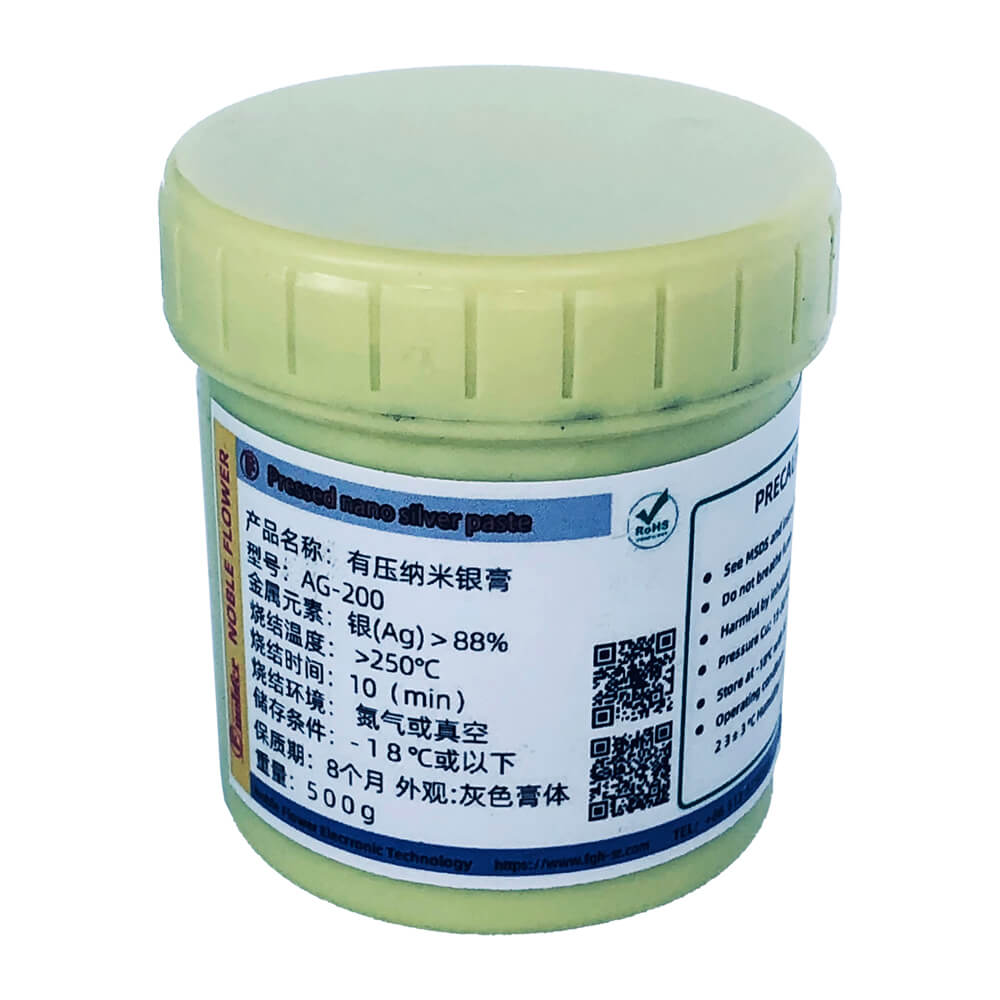
3. The ultimate guarantee of reliability:
the technical confidence of ten years of warranty
When Tesla dared to promise a "10-year
unlimited mileage warranty for motor controllers", when BYD's power module
life increased by 5 times, behind these quality upgrades was the excellent
performance of sintered silver technology in extreme environments, which
changed the reliability of electronic devices from "probability
guarantee" to "inevitable result". The extreme test of hot and
cold cycling verifies the toughness of the material. In temperature cycling
tests from -65°C to 150°C, the sintered silver junction shows a unique ability
to "self-heal" – tiny cracks created with each cycle are partially
repaired by the diffusion of silver atoms during subsequent high-temperature
phases. After 1000 cycles, its shear strength remains above 80% of its initial
value, while traditional solder has experienced significant delamination at
this stage, losing more than 50% of its strength. According to a report from a
third-party testing agency, the failure probability of silicon carbide modules
using sintered silver is only 0.1% in the test simulating the whole life cycle
of automobiles, which is far lower than the 5% of traditional solutions.
Comprehensive protection for vibration and shock is suitable for complex
working conditions. In vibration tests (20-2000Hz, 20g acceleration) in
automotive electronics, the sintered silver connection layer also performed
well. Through finite element analysis, it is found that its nanoscale
polycrystalline structure can effectively absorb vibration energy, and the
stress concentration coefficient is 40% lower than that of traditional solder.
A field test by a commercial vehicle company showed that after driving 100,000
kilometers of bumpy road sections, the failure rate of the electronic control
system using sintered silver was only 0.3%, compared with 3.5% of the
traditional solution. Long-term resistance to humidity and corrosion expands
the boundaries of application. After 1000 hours of humid and hot environment at
85°C/85% RH, the resistance change rate of the sintered silver layer <3%,
which is due to its high density and low porosity (<1.2%), which effectively
prevents the intrusion of water vapor and pollutants. In offshore wind
inverters, this corrosion resistance extends equipment maintenance intervals
from 1 to 3 years and reduces O&M costs by 60%.
Fourth, the breakthrough road of domestic
substitution: from technology to global leadership
In the past, companies such as Alpha in the
United States and Heraeus in Germany monopolized the global sintered silver
market, and the price of materials was as high as tens of thousands of yuan per
kilogram, which became a "bottleneck" link restricting the
development of China's silicon carbide industry. Today, Chinese enterprises
represented by Wuxi Dike Paitai have broken the monopoly through technological
innovation, so that domestic sintered silver not only has a performance
comparable to imports, but also forms unique advantages in cost and service.
The technological breakthrough of
DECA610-02T silver paste is a milestone. This domestic silver paste has
achieved three major innovations: low-temperature sintering characteristics:
sintering can be completed at 230°C, which is 20°C lower than imported products,
and is more suitable for substrate materials that are not resistant to high
temperatures; Low porosity control: By optimizing the particle size
distribution of silver powder (D50=1μm, Span=1.2) and organic carrier
formulation, the porosity of the sintered layer was < to 1.2%, and the
density reached 98%.
Batch Stability: Batch-to-batch resistance
fluctuates < 3%, far exceeding the industry standard of 5%, meeting the
stringent requirements of automotive electronics.
A comparative test by a silicon carbide
module manufacturer showed that the product using DECA610-02T was on par with
Heraeus products in Germany in various performance indicators, but the
procurement cost was reduced by 30%, and the lead time was shortened from 12
weeks to 4 weeks. The industrialization of large-area sintering technology has
promoted cost reduction. The "pressureless sintering process"
developed by Dike Paitai successfully solves the uniformity problem of
sintering large areas above 50mm × 50mm, and improves the sintering yield from
60% to 95%. This technological breakthrough directly reduces the cost of
silicon carbide modules by 30% and accelerates its popularization in new energy
vehicles - NIO ET7 became the first mass-produced model equipped with domestic
sintered silver modules, with an electric drive system efficiency of 97.5% and
support 4.5 seconds of acceleration to 100 kilometers per hour. Collaborative
innovation in the industrial chain builds ecological advantages. Domestic enterprises
are forming a complete industrial chain from silver powder preparation to
sintering equipment: the performance of spherical silver powder (purity 99.99%,
particle size 50nm) developed by an enterprise in Ningbo has reached the
international advanced level; The pressure sintering equipment of a
manufacturer in Shenzhen has a temperature control accuracy of ±1°C and a
pressure uniformity of <2%. This independent and controllable whole chain
has increased the number of patents in China in the field of sintered silver
technology from less than 100 in 2018 to more than 500 in 2023, accounting for
40% of the world.
5. The future picture of cross-border
applications: the material revolution from automobiles to space
The application boundaries of sintered
silver technology are constantly expanding, which is not only the "best
partner" for silicon carbide devices, but also creates new possibilities
in photovoltaic, aerospace, energy storage and other fields, and promotes the
technological upgrading of multiple industries. The efficiency leap of
photovoltaic inverters reflects significant value. In the 1500V photovoltaic
inverter, the IGBT module connected with sintered silver is used to increase
the conversion efficiency by 0.3 percentage points, which means that a 100MW
photovoltaic power plant can generate 600,000 kWh more electricity per year.
What's more, its high-temperature reliability increases the upper operating
temperature limit of the inverter from 70°C to 90°C, reducing the investment in
the cooling system and reducing the cost per unit by 15%. Aerospace adaptation
to extreme environments shows unique advantages. After using domestic sintered
silver devices, the power controller of the Chinese space station has continued
to operate stably for more than 3 years in the alternating high and low
temperatures (-100°C to 120°C) and strong radiation environments in space, and
there is no significant drift in various parameters. In the commercial
satellite sector, this reliability extends the design life of satellites from 5
to 8 years and increases payload per unit weight by 20%. The safety upgrade of
the energy storage system provides a new solution. In liquid-cooled energy
storage converters, the high-temperature resistance of sintered silver modules
reduces the risk of thermal runaway. Tests of an energy storage power station
showed that the thermal diffusion time of the system using this technology was
extended from 10 minutes to 30 minutes in the event of overcharging, short
circuit, and other faults, buying valuable time for safety protection. At the
same time, its long-life characteristics enable the energy storage system to
exceed 15,000 cycles, which is close to the service life of the battery,
reducing intermediate replacement costs.
Conclusion: The industrial leap behind the
material revolution
The rise of sintered silver technology is
not only a material substitution, but also an innovation in manufacturing
concepts - it has changed the design of power devices from "accommodating
material performance" to "unleashing chip potential", clearing
obstacles for the large-scale application of third-generation semiconductors
such as silicon carbide. As the performance and cost advantages of domestic
sintered silver continue to be highlighted, China's competitiveness in the
field of power semiconductors is undergoing qualitative changes: from relying
on imported chips to achieving independent control of the whole chain from
materials to devices. The impact of this change will be far-reaching: the
endurance and safety of new energy vehicles will reach a new level, the cost of
photovoltaic and energy storage will continue to decline, and the coverage and
capacity of 5G communication will continue to increase. Just as lithium
batteries have promoted the mobile Internet revolution, sintered silvertechnology is laying the "material cornerstone" for the development
of new energy and intelligent manufacturing, and the leading position of
Chinese companies in this material revolution will contribute unique oriental
wisdom to the progress of the global electronics industry.
 Su Gongwang Security 32058302004438