


Замечания:1 创始人: Site Editor Publish Time: 2025-12-22 Origin: Веб - сайт


When
Engineer Zhao from Suzhou Nuofeier's application engineering team stepped into
the workshop carrying a portable insulation tester, the battery management
system (BMS) production line at a new energy vehicle factory was at a
standstill due to a conformal coating issue. "The polyurethane coating you
are using has sufficient insulation strength, but its elastic modulus is too
high," he explained, pointing to the test data. "The coating film is
prone to cracking during battery vibration. Switching to a silicone coating can
resolve this issue." The selection of conformal coating is far from a
simple matter of "choosing a brand"; it is a comprehensive decision
involving the operating environment, electrical performance requirements, and
production processes—just like equipping workers in different roles with appropriate
personal protective equipment. Only through precise matching can maximum
effectiveness be achieved.
I.
The "Family Tree" of Conformal Coatings: Characteristics by
Composition
On the laboratory sample rack, six types of conformal coatings are arranged in order of their characteristics, with key parameters listed beside them: acrylic coating elongation at break 200%, silicone coating temperature resistance range -60~200°C, polyurethane coating insulation strength 40kV/mm... "These numbers form the basis for selection," Engineer Zhao said, picking up a PCB board coated with UV-curable coating. "It cures in just 3 seconds, making it suitable for high-precision products like smartphone cameras."
(A)
Acrylics: The Flexible and User-Friendly "Entry-Level Option"
On
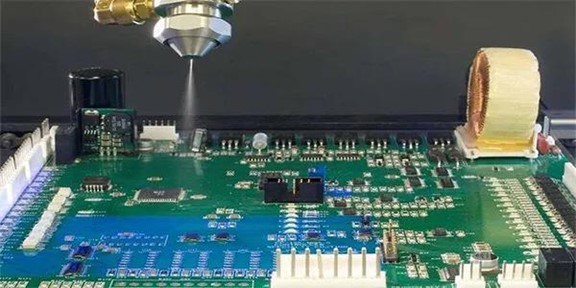
a consumer electronics assembly line, an automatic spraying machine is applying
acrylic conformal coating to a smart speaker mainboard. "Surface drying
takes only 5 minutes, allowing curing to complete during shift changes,"
the production supervisor noted, checking the cycle time chart. "And the
unit price is only 80 RMB per liter, suitable for our low-cost products."
Its single-component nature simplifies the operation process. Training data
from an OEM shows that new employees can master acrylic coating brushing
techniques in just 1 hour, whereas silicone coating requires half a day.
However, its shortcomings become particularly evident in extreme environments. Tests by an outdoor surveillance camera manufacturer showed that after 500 hours of salt spray testing, the solder joint corrosion rate for acrylic coating reached 15%, compared to only 3% for silicone coating. "We now use acrylic coating only for indoor products," the technical director pointed out. Although this increases costs by 15%, it reduces post-sales failure rates by 70%.
(B)
Silicones: The "Tough" Type for Extreme Environments
Inside a new energy vehicle battery compartment, a BMS board coated with silicone conformal coating is enduring temperatures of 85°C. "The temperature here is higher than in the engine compartment; only silicone coating can withstand it long-term," an engineer stated, presenting a reliability report. After 1000 cycles of thermal shock between -40°C and 85°C, the coating film retained 90% of its insulation strength. Its chemical bonds strengthen over time. Tracking data from a satellite device showed that after 5 years in space, the adhesion of the silicone coating had increased by 20% compared to its initial value.However, its application requirements are more stringent. In a military enterprise workshop, workers must wear solvent-resistant gloves: "Silicone coating curing agents are slightly toxic, and once cured, the coating is difficult to remove. Rework requires specialized coating removers." This characteristic limits its use in equipment that requires frequent maintenance.
(C) Polyurethanes: The "Balanced" Performer with Comprehensive Properties On a medical equipment production line, polyurethane conformal coating is being applied to an infusion pump control board via dip coating. "It shows no abnormalities after 1000 wipes with 75% alcohol, a mandatory requirement for medical devices," the quality manager stated. Tests indicate its chemical resistance is three times that of acrylic coating. In chemical control equipment, it is the preferred choice—after a chemical plant's PLC panel was coated with polyurethane coating, it was immersed in a 30% sulfuric acid mist for 30 days, and the insulation resistance remained above 10¹²Ω.
However, its curing speed is a drawback. Comparative tests at a precision instrument factory showed that at 25°C, polyurethane coating requires 24 hours for full curing, whereas acrylic coating only needs 8 hours. "We had to add a drying process step to reduce curing time to 6 hours," the factory director admitted, noting that this increased energy consumption by 15%.
(D)
Special Types: "Custom Solutions" for Niche Scenarios
UV-Curable
Coating: The Speed King
In a smartphone camera module workshop, the conformal coating cures completely after just 3 seconds under UV light. "It's 100 times faster than traditional coatings," a technician said, presenting data. This coating increases the coating process capacity by 5 times and contains no volatile organic compounds (VOCs), complying with the EU RoHS standard. However, its weakness is the shadow effect—areas under components that UV light cannot reach do not cure, requiring supplementary thermal curing, which increases equipment costs by 30%.Acrylic Fluoride: The Moisture Protection Expert After a humidifier control board adopted this coating, it was placed in a 95% humidity environment for 1000 hours, and the insulation resistance retention rate remained at 85%, significantly higher than the 60% for ordinary acrylic coating. "Its surface energy is low, making it difficult for moisture to adhere," an engineer explained. However, the film strength is relatively low, making it unsuitable for scenarios with mechanical friction, thus limiting its application scope.Water-Based Solvent Type: The Environmental Pioneer In a European automotive electronics factory workshop, the water-based conformal coating spraying area has no pungent odor. "VOC emissions are almost zero, passing the strictest environmental certifications," the EHS manager proudly stated. Although 90°C drying increases energy consumption, it eliminates the need for exhaust gas treatment equipment investment, resulting in a 10% reduction in comprehensive costs. However, its drying time is as long as 2 hours, making it suitable only for production lines with slower cycle times.
II.
The "Golden Rules" of Selection: Comprehensive Consideration from
Environment to Process
The conformal coating selection flowchart at an aerospace electronics factory spans 3 pages, covering 18 evaluation indicators including ambient temperature, humidity, electrical performance requirements, and production processes. "Any single mistake could lead to launch failure," a reliability engineer pointed out. They once experienced a circuit failure in a satellite after 3 months in orbit due to insufficient radiation resistance of the selected conformal coating.
(A)
Operating Environment: The "Adaptation Benchmark" for Conformal
Coatings
The "Dual Test" of Temperature and Humidity Equipment in tropical regions must use silicone or polyurethane coatings resistant to damp heat. A lesson from a Southeast Asian project was profound: communication base stations using acrylic coating short-circuited within 6 months due to mold growth. After switching to anti-mold silicone coating, the service life extended to 5 years. In cold regions, low-temperature flexibility must be considered—at -40°C, acrylic coating becomes brittle and cracks, necessitating the use of silicone coating with a glass transition temperature of -80°C."Precise Defense" Against Chemical Corrosion Equipment in chemical workshops must select coatings based on the medium type: polyurethane is preferred for acidic environments, silicone is suitable for solvent environments. A fertilizer plant's control board was corroded by ammonia gas within 3 months using ordinary coating; after switching to chemical-resistant silicone coating, the service life reached 3 years. Equipment in coastal areas must pass a 5% salt spray test. In such scenarios,conformal coatings containing zinc additives can provide additional protection."Flexible Response" to Mechanical Stress The vibration frequency in an automotive engine compartment can reach 2000Hz. Circuit boards here must use silicone coating with an elastic modulus below 200MPa to follow the deformation of the metal housing. Tests by an automotive company showed that polyurethane coating with excessively high rigidity had a cracking rate of 30% after 100,000 kilometers in this environment, whereas silicone coating's rate was only 5%.
(B) Electrical Performance: The "Baseline Requirements" for Insulation Protection
"Safety Margin" for Insulation Strength
High-voltage circuit boards (above 1000V) require conformal coating with an insulation strength ≥30kV/mm. Tests by an inverter manufacturer showed that coating rated at 25kV/mm experienced a 40% drop in breakdown voltage at 90% humidity, necessitating the selection of a 35kV/mm product to leave sufficient margin. For low-voltage signal boards (below 50V), this can be relaxed to 20kV/mm to reduce costs."High-Frequency Consideration" for Dissipation FactorHigh-frequency circuits (28GHz) in 5G equipment have stringent requirements for dissipation factor. A comparison by a base station manufacturer showed that the dissipation factor (at 1GHz) of ordinary acrylic coating was 0.02, while that of specialized low-loss silicone coating was only 0.005, reducing signal attenuation by 15%. This difference directly affects the communication range of the equipment in high-frequency scenarios.
(C)
Circuit Board Layout: The "Inherent Condition" for Coating Process
"Rational Planning" of Uncoated Areas
A PCB design engineer's experience is to concentrate components that need to remain exposed, such as connectors and adjustable resistors, within a 1cm range from the board edge, facilitating simple masking during coating. They once faced a situation where scattered components caused masking time to account for 40% of the entire coating process; after optimizing the layout, this was reduced to 10%. "Spraying Obstacle" of Component Height Tall components exceeding 5mm create "shadow zones" underneath, necessitating the use of dip coating or selective coating. The SOP at an industrial control board factory明确规定: areas with a height difference exceeding 3mm are prohibited from using ordinary spraying; needle valve selective coating machines must be used to ensure every solder joint is covered.
(D)
Production Process: The "Balancing Act" of Efficiency and Cost
"Compatibility" of Batch Size and Equipment For small factories producing 100,000 boards annually, manual spraying combined with acrylic coating is the most economical, with equipment investment of only 20,000 RMB. For large factories producing 1 million boards annually, automated dip coating lines are suitable; although the initial investment is 500,000 RMB, the utilization rate per ton of coating increases from 60% to 90%, saving 300,000 RMB annually in coating material costs. Calculations from a consumer electronics OEM show that for production volumes exceeding 500,000 units, the comprehensive cost of automated lines is lower. "Reversibility Choice" Based on Rework NeedsPrototypes in the R&D stage are recommended to use acrylic coating because it can be removed with alcohol; mass-produced products can use silicone or polyurethane coating to pursue higher reliability. Statistics from an R&D center show that the rework efficiency for prototypes using removable coating is 3 times higher than for those using less removable coating.
III.
"Custom Solutions" for Special Scenarios
The special requirements of different industries make the selection of conformal coating more challenging. The aerospace sector not only requires resistance to temperatures from -55°C to 125°C but also demands passing a 100kGy radiation test; deep-sea equipment needs to withstand 10MPa of water pressure, requiring a coating film thickness of at least 50Мm. These extreme scenarios often require customized conformal coating products.
(A)
Military and Aerospace: Reliability Above All
A certain UAV company's reconnaissance-strike integrated model uses a specially formulated silicone conformal coating. By adding nano-zinc oxide to the formulation, it maintains 50% elasticity even at -55°C. Ground tests showed that this coating exhibited no significant change in insulation resistance in a simulated low-pressure environment equivalent to 10,000 meters altitude, fully meeting operational requirements. Conformal coatings for satellites have even more stringent requirements, needing to pass proton radiation tests. A product from a research institute showed a change rate in dissipation factor ≤10% after 100kGy radiation, reaching international advanced levels.
(B)
Medical Equipment: Biocompatibility
ISO 10993 biocompatibility certification is the entry threshold for medical-grade conformal coatings. The polyurethane coating selected by an infusion pump manufacturer underwent cytotoxicity testing (L929 cell survival rate ≥90%) and skin irritation testing (no erythema reaction) before it could be used in devices contacting the human body. The cost of this coating is twice that of ordinary versions, but it avoids patient allergy risks.
(C)
New Energy Vehicles: Safety First
For BMS boards inside battery packs, the conformal coating not only needs to provide insulation but also must be flame retardant (UL94 V0 level). Tests by an automotive company showed that ordinary coating would continue burning in a short-circuit fire, while flame-retardant silicone coating self-extinguished within 3 seconds, preventing fire spread. This characteristic makes its price 40% higher than ordinary coating, but it can prevent losses amounting to millions in battery safety incidents.
IV.
Supplier Cooperation: The "Invisible Guarantee" of a Stable Supply
Chain
In the qualified supplier list of a communication equipment factory, there are only three conformal coating manufacturers, all certified to ISO 9001 and IATF 16949. "We conduct annual audits, including their raw material control and production capacity reserves," the procurement manager stated. A small manufacturer once caused a 2-week delivery delay due to a key resin supply disruption, resulting in production line stoppage.
High-quality suppliers can provide more value-added services. An automotive company jointly developed with a conformal coating supplier to create a specialized "high-temperature resistant + anti-vibration" coating tailored for the battery pack environment. By adjusting the siloxane bond ratio, they reduced the coating film's elastic modulus from 300MPa to 150MPa, solving the long-standing cracking problem. Such deep cooperation accelerated product iteration speed by 30%.
 Безопасность сети 32058300438