


Замечания:1 创始人: Site Editor Publish Time: 2025-12-23 Origin: Веб - сайт


Conformal coatings are primarily classified
into acrylic, silicone, and polyurethane types based on their chemical
composition. From the perspective of curing methods, they can be further
divided into solvent-based curing, room temperature curing, thermal curing, and
UV curing, among others. The selection of a specific process typically depends
on the characteristics of the product itself. Manufacturers generally provide
specialized thinners to adjust the concentration of the product, meeting the
requirements of various processes such as spraying, brushing, and dipping.
Solvent-based acrylic conformal coatings are the most widely used products in the market, offering several advantages: fast surface drying and curing, excellent protective properties (against moisture, salt spray, and mold), cost-effectiveness, transparent color, flexible texture, and ease of repair.
The conformal coating used in this study is
of the solvent-based acrylic type. The transparent acrylic protective film it
forms effectively resists erosion from weak acids, alkalis, alcohol, and
moisture. Additionally, this coating exhibits high-temperature resistance,
softening at 100°C and becoming viscous at 120°C without dripping. Containers for the conformal coating should be
made of metal or plastic, avoiding wood or PVC materials to prevent chemical
reactions that could damage the container and compromise the coating's
protective performance. Furthermore, the conformal coating should be stored in
a cool, dry area, with the storage environment temperature controlled not to
exceed 54°C.
In practical usage environments, circuit
boards often face various harsh conditions, such as chemical exposure (e.g.,
fuels, coolants), vibration, high dust, salt spray, humidity, and high
temperatures. These conditions can lead to issues like corrosion, softening,
deformation, and mold growth on the circuit boards, ultimately causing circuit
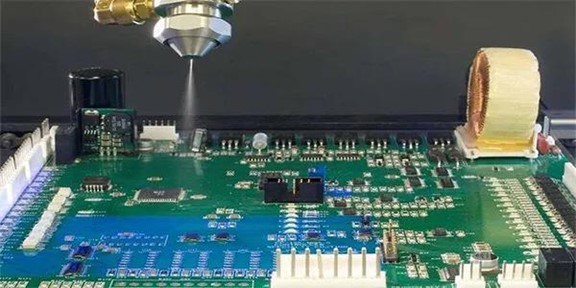
failures. After applying the conformal coating, a thin and flexible film,
approximately 25–50 microns thick, forms on the surface
of the circuit board. This flexible film provides effective protection for the
circuit under the aforementioned harsh conditions, preventing damage.
Content and Scope: This operating procedure
specifies in detail the operating standards, process requirements, and quality
requirements for brushing conformal coating (against damp heat, salt spray, and
mold) on all types of PCBA boards within the company.
Materials and Tools: Conformal coating,
coating container, rubber gloves, mask or respirator, brush, masking tape,
tweezers, ventilation equipment, drying rack, oven.
Technical Requirements
3.1 Conformal coating protection for PCBA
boards must be performed after testing, inspection, and confirmation of
qualification, and the surface must be thoroughly cleaned before assembly.
3.2 The brushes used should be kept clean
and not used for other tasks; during brushing, prevent the coating from
dripping onto non-coated areas; after use, clean thoroughly with thinner
immediately.
3.3 The coating should be transparent and
uniform, completely covering the PCB board and components, with consistent
color and viscosity.
3.4 The process steps are: first coat side
A, after surface drying coat side B, and finally perform room temperature
curing.
3.5 The spraying thickness should be
controlled between 0.1mm–0.3mm.
3.6 All coating operations should be
carried out in an environment with a temperature not lower than 16°C and relative humidity below 75%. Since PCB is a composite material
prone to moisture absorption, if moisture is not removed, the conformal coating
may not provide optimal protection. Moisture can be removed through pre-drying
or vacuum drying.
Brushing Process Requirements for Conformal
Coating:
4.1 First, clean and bake the PCBA board to
remove surface moisture and water. Before brushing, thoroughly remove dust,
moisture, flux residues, and other impurities to ensure good adhesion of the
conformal coating to the circuit board surface. The baking conditions are:
temperature controlled at 60°C, baking time for 30–40 minutes. Coating immediately after removal from the oven while
still warm can yield better results.
4.2 Based on the product size and the
layout of the board and components, select an appropriate brush. Pour the
conformal coating into a dedicated container, then dip the brush into an
appropriate amount of the coating and apply it evenly to the surface of the
circuit board.
4.3 The brushed area should be slightly
larger than the area occupied by the components to ensure complete coverage of
the components and pads.
4.4 During brushing, the PCBA board should
be kept as horizontal as possible. After brushing, there should be no dripping,
the coating should be smooth without any exposed areas, and the brushing
thickness should be 0.1–0.3mm.
4.5 After brushing is completed, place the
side with more inserted components facing up, horizontally on a drying rack for
surface drying and curing (heating can accelerate the curing process).
4.6 When applying conformal coating to the
PCB, all connectors, sockets, switches, heat sinks (or fins), and heat
dissipation areas (refer to the notes for components that should not be coated)
must not be coated with conformal coating. During the brushing process, use
masking tape to cover and protect these areas.
4.7 If a thicker coating is desired, it can
be achieved by applying two thinner layers (but the second layer must only be
applied after the first layer has completely dried).
Operational Requirements
5.1 Brushing work with conformal coating
should be conducted in a separate enclosed room, and the operating room must be
equipped with adequate ventilation facilities.
5.2 Smoking, eating, and drinking are
strictly prohibited in the operating room. Do not consume alcoholic beverages
before work.
5.3 Operators should wear masks or
respirators, rubber gloves, and chemical protective goggles to ensure personal
protection.
5.4 After work, clean the utensils
promptly, organize and wipe down tools and equipment, and tightly seal the
conformal coating container.
5.5 The workplace should be kept clean and
dust-free, and unauthorized personnel are prohibited from entering.
5.6 All tools and equipment used should be
properly grounded, and electrostatic protection measures should be implemented.
5.7 During the operation, PCBA boards
should not be stacked and should be kept level.
5.8 Before using each batch of raw
materials, conduct a small-sample curing test (test quantity 3–5 PCS).
Quality Requirements
6.1 The PCB board surface must not show
running, dripping, or partial wetting of the coating.
6.2 The conformal coating layer should be
smooth, glossy, uniform in thickness, and effectively protect pads, SMD
components, and conductor surfaces.
6.3 The coating surface must not exhibit
orange peel, bubbles, pinholes, or ripples.
6.4 Components or parts that do not require
protection should not be coated with conformal coating.
6.5 The printed board after conformal
coating treatment should be clean and tidy, with no component damage.
6.6 The board surface and components must
not have contaminants, fingerprints, ripples, pinholes, dust, or other defects
and foreign matter, and there should be no chalking or peeling.
Storage Requirements
7.1 Raw materials should be stored in a
cool, dry warehouse (room temperature should not exceed 30°C). The warehouse should be equipped with explosion-proof
ventilation systems and equipment, and the raw materials should be kept away
from heat sources.
7.2 They should be stored separately from
other types of chemicals, with clear material identification. Mixed storage is
strictly prohibited.
7.3 Fire prevention measures should be
taken, and corresponding fire-fighting equipment should be available.
7.4 The storage warehouse should be
equipped with leak emergency equipment and appropriate containment materials
(such as sand, etc.).
7.5 The warehouse should maintain good
ventilation to prevent the accumulation of leaked harmful gases and avoid
accidents.
7.6 The storage container must indicate the
valid use-by date.
7.7 The storage shelves or equipment should
be well grounded, and equipment and tools that are prone to generating sparks
are prohibited.
Precautions:
8.1 Conformal coating that has exceeded its
shelf life is prohibited from continued use.
8.2 After opening the storage container, it
should be sealed for storage.
8.3 Do not pour unused conformal coating
back into the original storage container; it should be sealed and stored
separately.
8.4 Before entering a workroom or storage
room that has been closed for a long time (over 12 hours), ventilate it for 15
minutes first.
8.5 If conformal coating splashes into the
eyes, immediately lift the eyelid and rinse with flowing clean water or saline,
and seek medical attention as soon as possible.
8.6 If discomfort is felt during the
brushing process, quickly leave the work area to a well-ventilated place; if
breathing difficulties occur, administer oxygen immediately and seek medical
attention.
Components that should not be coated with
conformal coating:
9.1 High-power components with heat
dissipation surfaces or heat sinks, power resistors, power diodes, cement
resistors.
9.2 DIP switches, adjustable resistors,
buzzers, battery holders, fuse holders (tubes), IC sockets, tactile switches.
9.3 All types of connectors, pin headers,
terminal blocks, and DB connectors.
9.4 Through-hole or surface-mount LEDs,
digital tubes.
9.5 Parts and components specified in the
drawings as not to be insulated with coating.
9.6 Screw holes on the PCBA board.
Selecting the Correct Conformal Coating
Fixture: For each circuit board requiring double-sided spraying, corresponding
front and back side conformal coating fixtures should be provided. During
spraying operations, the correct fixture must be used to ensure even coverage
of the areas to be sprayed and prevent coating of non-spray areas (such as
connector interfaces, DIP switches, etc.).
Quality Inspection Process
11.1 Visual Inspection: After brushing,
first conduct a visual inspection. Inspectors should carefully check the PCB
board surface for running, dripping, or partial wetting of the coating; ensure
the coating layer is smooth, glossy, uniform in thickness, and properly
protects pads, SMD components, and conductor surfaces; the coating surface must
not have orange peel, bubbles, pinholes, or ripples; the board surface and
components must not have contaminants, fingerprints, ripples, pinholes, dust,
or other defects, and there should be no chalking or peeling; confirm that
non-protected components are not coated with conformal coating, and the printed
board is clean and undamaged.
11.2 Thickness Inspection: Use professional
measuring tools to inspect the thickness of the conformal coating spray,
ensuring it is within the 0.1mm–0.3mm range. If a
thicker coating is achieved by applying two thinner layers, inspect the
thickness of each layer and the total thickness to ensure they meet
requirements, and confirm that the first layer is completely dry before
applying the second layer.
11.3 Adhesion Test: Use specific methods to
test the adhesion of the conformal coating to the PCB board and component
surfaces. Insufficient adhesion may cause the coating to peel off, affecting
circuit protection.
Employee Training and Assessment
12.1 Training Content: To ensure the
quality and safety of conformal coating brushing work, comprehensive training
should be provided to relevant operators. The content includes the chemical
composition and characteristics of conformal coatings (such as the fast surface
drying and curing, good protective properties, cost-effectiveness, transparent
color, flexible texture, ease of repair, etc., of solvent-based acrylic
conformal coatings), the applicable scope of various conformal coatings,
correct usage methods of tools (brushes, coating containers, tweezers, etc.),
brushing process steps (cleaning and baking boards, brush selection, brushing
operation, surface drying and curing, etc.), quality requirements (appearance,
thickness, adhesion), safety precautions (wearing protective equipment,
environmental requirements, etc.), and knowledge of components that should not
be coated with conformal coating.
12.2 Assessment System: Establish a strict
assessment system to evaluate trained employees on both theory and practical
operation. Theoretical assessment covers key knowledge points related toconformal coatings; practical operation assessment requires employees to
complete the brushing of a PCBA board according to standard procedures within a
specified time and meet the standards. Only those who pass the assessment are
qualified to work.
Equipment Maintenance and Management
13.1 Regular Inspection: Equipment used for
conformal coating brushing (such as ovens, ventilation equipment, etc.) should
be inspected regularly. Confirm that the oven temperature control is accurate
and heating is normal, ensuring that board baking and curing meet requirements;
check if the ventilation equipment's air volume meets needs and if the ducts
are clear to prevent the accumulation of harmful gases.
13.2 Cleaning and Maintenance: Clean
equipment promptly after use. For example, brushes and coating containers must
be cleaned with thinner to prevent residual conformal coating from drying and
hardening; the interior of the oven should be cleared of dust and debris to
maintain good heat dissipation of heating elements; ventilation equipment
filters should be cleaned or replaced regularly to ensure ventilation
effectiveness.
13.3 Equipment Update: With technological
development and equipment aging, the need for equipment updates should be
assessed in a timely manner. If equipment performance cannot meet increasing
production demands, or if equipment failures are frequent and repair costs are
too high, consider replacing with new equipment to improve production
efficiency and product quality.
Environmental Protection
14.1 Waste Disposal: During the use of
conformal coating, some waste is generated (such as used brushes, wipes
contaminated with conformal coating, expired conformal coating, etc.). This
waste should be classified and handled according to environmental protection
requirements. Waste containing conformal coating must not be discarded
arbitrarily; it should be properly collected and handed over to professional
environmental agencies for treatment to prevent environmental pollution.
14.2 Exhaust Gas Emission: The exhaust gas
discharged by the ventilation equipment in the workroom may contain volatile
organic solvent components from the conformal coating. Ensure that the
ventilation equipment is equipped with effective exhaust gas treatment devices
to purify the discharged exhaust gas. It must meet national environmental
emission standards before being released into the atmosphere to reduce air
pollution.
14.2 Exhaust gas emissions: The exhaust gas
emitted by the ventilation equipment in the workshop may contain volatile
mechanical solvent components of conformal paint. It should be ensured that the
ventilation equipment is equipped with effective exhaust gas treatment devices
to purify the exhaust gas to avoid causing to the environment and only be
discharged after meeting the standards, so as to reduce air pollution.
14.2 Exhaust gas emissions: The exhaust gas
emitted by the ventilation equipment in the workshop may contain organic
solvents and other components volatilized by conformal paint. It should be
ensured that the ventilation equipment is equipped with effective exhaust gas
treatment devices to purify the exhaust gas and discharge it into the
atmosphere after meeting the environmental protection emission standards
stipulated by the state, so as to reduce pollution to the atmospheric
environment.
 Безопасность сети 32058300438