


Замечания:1 创始人: Site Editor Publish Time: 2026-01-20 Origin: Веб - сайт


Low-temperature conductive silver glue:
characteristics and application analysis
In the field of electronic materials,
low-temperature conductive silver adhesive is a special conductive material
with great characteristics. Its core composition contains fine silver
particles, which act as miniature conductive bridges that work together to
build efficient conductive paths. More importantly, it has the unique ability
to cure at lower temperatures. This property makes it ideal for applications
where temperature resistance is critical—low-temperature conductive silver
adhesives are ideal when conductive paths need to be built on materials with
poor temperature resistance.
With the advantages of excellent
conductivity and stable bond strength at conditions lower than conventional
soldering temperatures, low-temperature conductive silver adhesive has opened
up a broad application space in many fields such as electronic component
assembly, semiconductor packaging, and printed circuit board (PCB) production,
and has become an important material force to promote the development of
technology in these fields.
1. Main features: low temperature
advantages and multiple properties coexist
1.1 Cryogenic curing: the "gentle
power" of guarding sensitive materials
Compared to traditional high-temperature
welding techniques, the curing temperature of low-temperature conductive silver
adhesive exhibits significant "low-temperature friendly"
characteristics. The curing temperature is typically between 100°C and 150°C,
and some products can be cured at room temperature by breaking the temperature
limit.
This "gentle" curing method is
undoubtedly a boon for components and substrates that are extremely sensitive
to temperature. For example, some electronic components made of plastic are
likely to deform or even be damaged if subjected to high-temperature welding,
and the application of low-temperature conductive silver adhesive perfectly
avoids this risk, ensuring the safety and integrity of these sensitive
materials during processing.
1.2 Excellent conductivity: efficient
pathway created by silver particles
As a metal with excellent electrical
conductivity, silver plays a central role in low-temperature conductive silverglue. When silver particles are integrated into the colloid, it is like laying
countless efficient conductive paths in the colloid, making the conductive
adhesive exhibit excellent conductivity as a whole.
This feature ensures smooth current
transmission between electronic components and provides a solid foundation for
the stable operation of electronic devices. Whether it's a tiny chip internal
connection or a complex circuit signal transmission, low-temperature conductive
silver adhesive ensures efficient and stable current flow with its excellent
conductivity.
1.3 Good bonding: take into account the
dual guarantee of electrical and mechanical
Cryogenic conductive silver glue is not
limited to building electrical connections, it also excels in mechanical
connections. While ensuring smooth electrical connections, it also imparts a
solid mechanical bond between different materials.
This dual guarantee means that it not only
allows good signal communication between electronic components, but also firmly
fixes them together to resist external vibration, shock and other interference,
and ensures the structural stability of electronic devices in various use
environments. Whether it is the bonding of metal to plastic or the combination
of ceramics and glass, low-temperature conductive silver adhesive can show
reliable bonding results.
1.4 Adaptability: A "versatile
expert" compatible with a variety of substrates
The adaptability of low-temperature
conductive silver adhesive is "versatile", it can harmoniously
coexist with a variety of substrates and is suitable for a wide range of common
materials such as glass, ceramics, plastics, and metals.
This wide range of substrate compatibility
allows it to function in different electronics manufacturing scenarios. In the
manufacture of glass displays, it can be stably connected; In the circuit
construction of ceramic substrates, it can also be competent; It also performs
well in the face of flexible electronic components made of plastic. This strong
adaptability greatly expands its application possibilities in the field of
electronics.
2. Application field: penetrate many
corners of the electronics industry
2.1 Electronic assembly: an
"alternative" to high-temperature exclusion zones
In the field of electronic assembly,
surface mount technology (SMT) is one of the commonly used processes, but in
some specific scenarios where high-temperature soldering processes are not
suitable, low-temperature conductive silver adhesives have become an ideal
alternative.
For example, when assembling a circuit
board containing heat-sensitive components, high-temperature soldering may
cause irreversible damage to these components, while using low-temperature
conductive silver glue for connection can avoid the harm caused by high
temperature while ensuring the quality of the connection, ensuring the stable
performance of the entire electronic component.
2.2 Semiconductor Packaging: The
"Guardian" of Chip Security
In the semiconductor packaging process, the
electrical connection between the chip and the package is crucial, and at the
same time, it is necessary to avoid damage to the chip caused by high
temperatures. Low-temperature conductive silver adhesive plays a key role in
this field, it can help achieve a stable electrical connection between the chip
and the package, and its low-temperature curing characteristics effectively
avoid the adverse effects that high temperature may have on the internal
structure and performance of the chip, providing a reliable guarantee for the
safe packaging of the chip.
2.3 Flexible electronics: the
"right-hand man" of bendable equipment
Flexible electronics is a popular
development direction in the field of electronics in recent years, advocating
the construction of circuits on flexible substrates to promote the research and
development and production of bendable or foldable electronic products.
Low-temperature conductive silver adhesive is very useful in this field, it can
adapt well to the characteristics of flexible substrates, and still maintain
good conductivity and adhesion in the process of dynamic changes such as
bending and folding, providing important material support for the realization
of flexible electronic devices.
2.4 Medical Devices: A "Reliable Partner" for Biosecurity
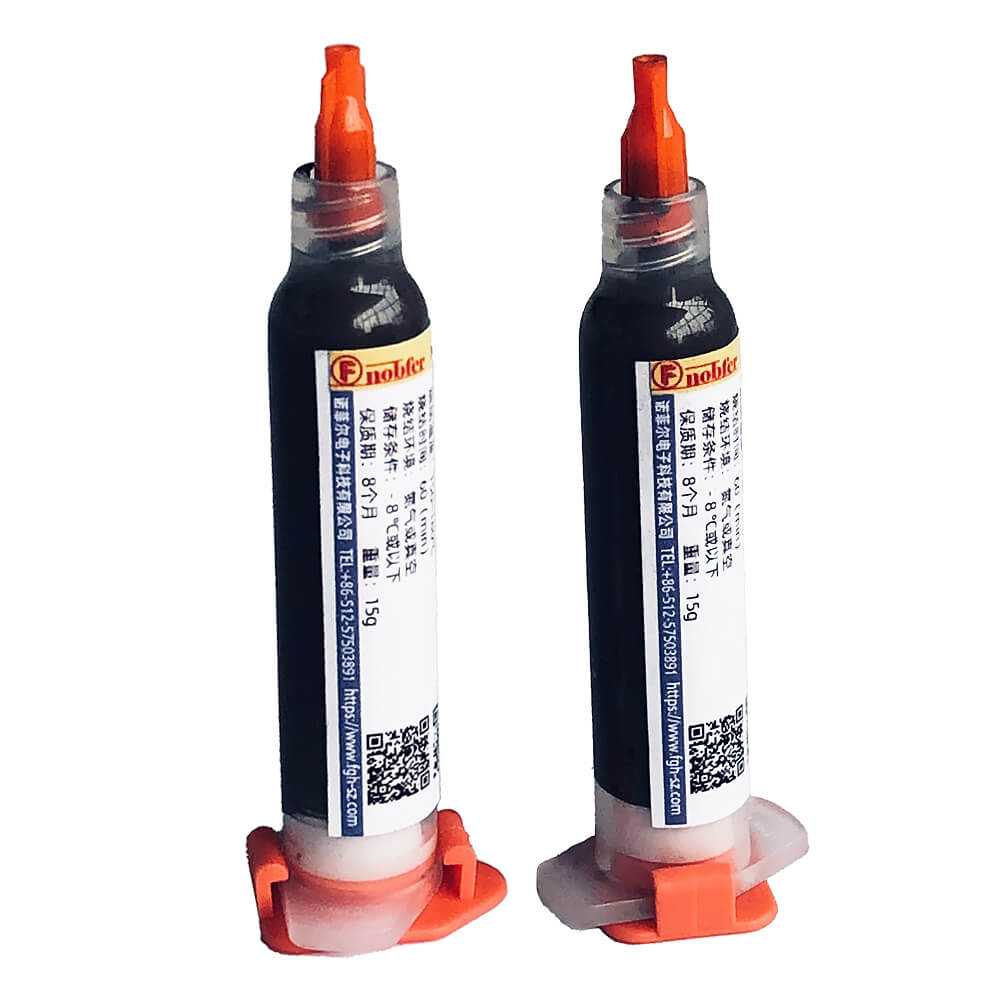
In the field of medical device
manufacturing, especially for electronic devices with special requirements for
biocompatibility, cryogenic processing plays a key role. The application of
low-temperature conductive silver glue helps to ensure the safety of biosensors
and other vulnerable components.
Its low-temperature curing process does not
destroy the properties of the biomaterial, while its own composition also meets
the requirements of biocompatibility, ensuring the safety and reliability of
medical electronic devices when in contact with the human body or when used in
scenarios such as biological testing.
3. In-depth analysis: ingredients,
properties and more applications
3.1 Main components: the core components
of each performing their duties
Low-temperature conductive silver rubber is
mainly composed of silver fillers, resin matrix and several additives, which
perform their own duties and jointly create its excellent performance.
Silver fillers: At the heart of conductive materials, the introduction of silver
powder or silver flakes is key to building conductive paths. These silver
particles are evenly distributed in the colloid, forming a conductive network
that ensures the smooth passage of electricity.
Resin matrix:
Epoxy, silicone, or polyurethane are usually used as materials, which are the
"skeleton" of the colloid. After curing, the resin matrix imparts the
required mechanical strength to the conductive adhesive structure while
providing excellent bonding properties that hold the silver particles together
with the material being bonded.
Additives: Although the amount of additives
is relatively small, the effect should not be underestimated. They are mainly
used to improve the fluidity of conductive adhesives, making them smoother
during the coating process; improve the stability of colloids and extend the
storage time; and adjusting the curing speed to suit different production
process needs.
3.2 Core Features: Performance beyond
the basics
In addition to the key features mentioned
above, low-temperature conductive silver adhesive also possesses some core
properties that make it useful in a wider range of scenarios.
Wider Curing Temperature Range: Suitable for substrates that are not resistant to high
temperatures (e.g., plastics, flexible circuit boards), this product can cure
in a temperature range of 80°C to 150°C, further expanding the temperature
range for its application.
High electrical conductivity: Its volumetric resistivity ranges from 10⁻⁴ to 10⁻⁵ Ω·cm, which is very close to
the conductivity of metals, ensuring efficient conductivity in delicate
electronic component connections.
Flexibility:
Many formulations are designed specifically for flexible applications and are
suitable for bending or use in dynamically stressed environments, such as in
flexible electronics, where their performance remains stable even after
repeated bending.
Process friendliness: It can achieve precise coating through dispensing, printing, etc.,
meeting the precision requirements of different production processes, and
improving production efficiency and product quality stability.
3.3 Typical applications: Expand to more
professional fields
In addition to the application fields
mentioned above, low-temperature conductive silver adhesive is also widely used
in the following professional fields:
Refined Applications of Electronic
Packaging: In specific links such as chip bonding,
LED installation, and RF component positioning, low-temperature conductive
silver adhesives can provide reliable connections and fixation, ensuring the
stable performance of these components after packaging.
In-depth exploration of flexible
electronics: Focusing on the repair technology of
printed circuit boards (FPCs) and wearable device wires, when these flexible
circuits are damaged, low-temperature conductive silver adhesive can accurately
repair and restore its conductive function.
New contributions in the photovoltaic
field: It plays a role in the preparation of solar
cell grid electrodes, and its good conductivity and adhesion help improve the
power generation efficiency and service life of solar cells.
Key materials for sensors and displays: Used in the manufacturing of touch electrodes and shielding
materials, ensuring that sensors can accurately perceive signals, displays can
clearly display images, while providing effective electromagnetic shielding to
reduce external interference.
4. Advantages and limitations:
Comprehensive understanding of material properties
4.1 Advantages: Adapting to modern
manufacturing needs
Effectively avoid stress problems caused by
high temperatures, protect sensitive materials and components, and improve
product qualification rate and reliability.
Good compatibility with a wide range of
substrates reduces the constraints of material selection and provides more
flexibility in product design.
The process design is simple and the
operation is relatively simple, especially suitable for the field of precision
manufacturing, which helps to improve production efficiency and reduce
production costs.
4.2 Limitations: Usage considerations
that require attention
The relatively high cost is mainly due to
its silver-containing composition, which is a precious metal and has a large
price fluctuation, which to a certain extent affects the wide application of
low-temperature conductive silver glue.
Its long-term stability may be affected by
changes in environmental humidity, and in humid environments, problems such as
reduced conductivity or weakened bonding strength may occur, which need to be
paid attention to during use and storage.
5. Selection considerations: key
elements to match needs
When selecting low-temperature conductivesilver glue, it is necessary to conduct a comprehensive evaluation of various
factors for specific application scenarios to ensure that the selected product
can perfectly match the usage needs.
Conductivity requirements: Clarify the project's resistivity requirements, as the
conductivity requirements vary greatly between different application scenarios,
such as high-precision sensors may require lower resistivity.
Curing conditions: Choose the appropriate curing temperature and curing time based on
the production process and substrate characteristics to ensure smooth curing
under existing production equipment and processes.
Mechanical strength: Consider the external forces that electronic devices may withstand
during use, and choose products with corresponding bonding strength and
flexibility.
Cost factors:
On the premise of meeting performance requirements, comprehensively consider
product price and usage costs to seek the most cost-effective solution.
In addition, there are specific
requirements in special fields, such as medical devices may need to be
biocompatible to ensure safe use; Automotive electronics need to have
high-temperature aging resistance to adapt to the complex temperature
environment inside the car.
With its excellent performance,
low-temperature conductive silver adhesive occupies a pivotal position in the
field of modern electronics industry. Especially in the process of promoting
the development of electronic products towards miniaturization, lightweight and
high performance, it plays a crucial role, providing solid material support for
the continuous innovation and breakthrough of electronic technology.
 Безопасность сети 32058300438