


Замечания:1 创始人: Site Editor Publish Time: 2026-01-27 Origin: Веб - сайт


In-depth analysis of defects in the reflow
soldering process and system optimization strategy
In the production chain of surface mount
technology (SMT), reflow soldering is like a "precision tailor",
tightly stitching electronic components with PCB boards (printed circuit
boards), and its process quality directly determines the reliability and
service life of PCBA (printed circuit board components). According to industry
statistics, about 65% of SMT production defects stem from defects in the soldering
process, so in-depth analysis of typical problems in the reflow soldering
process and the construction of a scientific optimization system have become
key issues for electronic manufacturing enterprises to improve product quality.
This paper systematically disassembles the formation mechanism of seven common
welding defects, and proposes targeted improvement plans based on production
practice data to provide a practical quality improvement path for SMT
production lines.
1. Analysis of the formation mechanism and
characteristics of typical welding defects
The reflow welding process involves
multiple physicochemical actions such as heat conduction, metallurgical
reactions, and material deformation, and any subtle deviation in parameters can
trigger defects. The following analyzes the essential characteristics of
various defects from three dimensions: thermodynamics, materials science and
process control.
1. SMD Element Offset and Rotation: A
microscopic representation of force field imbalances
Walking into the AOI (Automatic Optical
Inspection) workshop of an electronics factory, the red mark flashing
frequently on the screen showed that a batch of 0402 chip resistors had obvious
rotational deviations, and some components even deviated from the center of the
pad by 0.3mm. This phenomenon, known as "element walking," is rooted
in an imbalance in surface tension during the welding process.
When there is a temperature difference of
more than 15°C between the pads at both ends of the component, the surface
tension of the molten solder creates a counterclockwise or clockwise torque.
For example, when the left pad temperature is 18°C higher than the right side,
the surface tension coefficient of the left solder (about 0.5N/m) will be lower
than the right side (about 0.55N/m), and this difference creates enough lateral
force to push the lightweight component (0402 resistor weight of only 0.0012g) to
rotate. In addition, differences in wettability due to pad oxidation (solder
rejection at a wetting angle of > 90°) can exacerbate this imbalance,
creating a "one-sided pull" effect that shifts the component to the
side with better wettability.
Statistics from an automotive electronics
company show that the component offset rate can reach 3.2% without controlling
the pad temperature difference; When the temperature difference is controlled
within 5°C, this proportion drops to 0.15%.
2. BGA Solder Ball Bridging: A chain
reaction of excess solder
In BGA-packaged X-ray inspection images,
the "molten bridge" between adjacent solder balls is one of the most
troublesome defects. A failure analysis report from a communication equipment
manufacturer pointed out that 80% of BGA bridging stemmed from the loss of
control of parameters in the solder paste printing process.
The size of the stencil cutout is a key
influencing factor. When the cutout area exceeds the pad design value by 20%,
the amount of solder paste printed exceeds the standard by more than 30%. For
example, if the design area of a BGA pad with a 0.8mm pitch is 0.3mm², if the
stencil opening is expanded to 0.36mm², the excess solder paste will shrink due
to surface tension to form a "tin bridge" connecting adjacent solder
joints after melting. In addition, insufficient squeegee pressure (less than
4kg) can lead to uneven solder paste printing, and solder paste buildup at the
edges is more likely to trigger bridging when reflowed.
The rapid warming rate (>3°C/s) during
the warm-up stage is another trigger. Experimental data shows that when the
heating rate reaches 4°C/s, the flux will volatilize early at 120°C, losing the
effect of preventing solder oxidation, resulting in the formation of metal
connections when adjacent solder balls are melted.
3. BGA solder ball virtual welding: failure
of metallurgical bonds
In a reliability test of a medical device,
a batch of BGA-packaged master control chips failed after 1,000 temperature
cycles. Slice analysis shows that there is a significant gap between the solder
joint and the pad, which is a typical non-wetting feature.
Insufficient amount of solder paste is the primary reason. When the stencil thickness was reduced from the standard 0.12mm to 0.08mm, the solder paste printing volume was reduced by 40%, and sufficient metallurgical bonding layers could not be formed. In one case, the local solder paste was missing due to blockage of the stencil openings, causing the BGA false welding rate to plummet to 5.7%. Thermal deformation of PCBs is also not to be ignored: substrates with a Tg value (glass transition temperature) < 130°C will produce 0.1mm warpage above 220°C, which disrupts the close contact between the solder ball and the pad, forming a "cold solder interface".
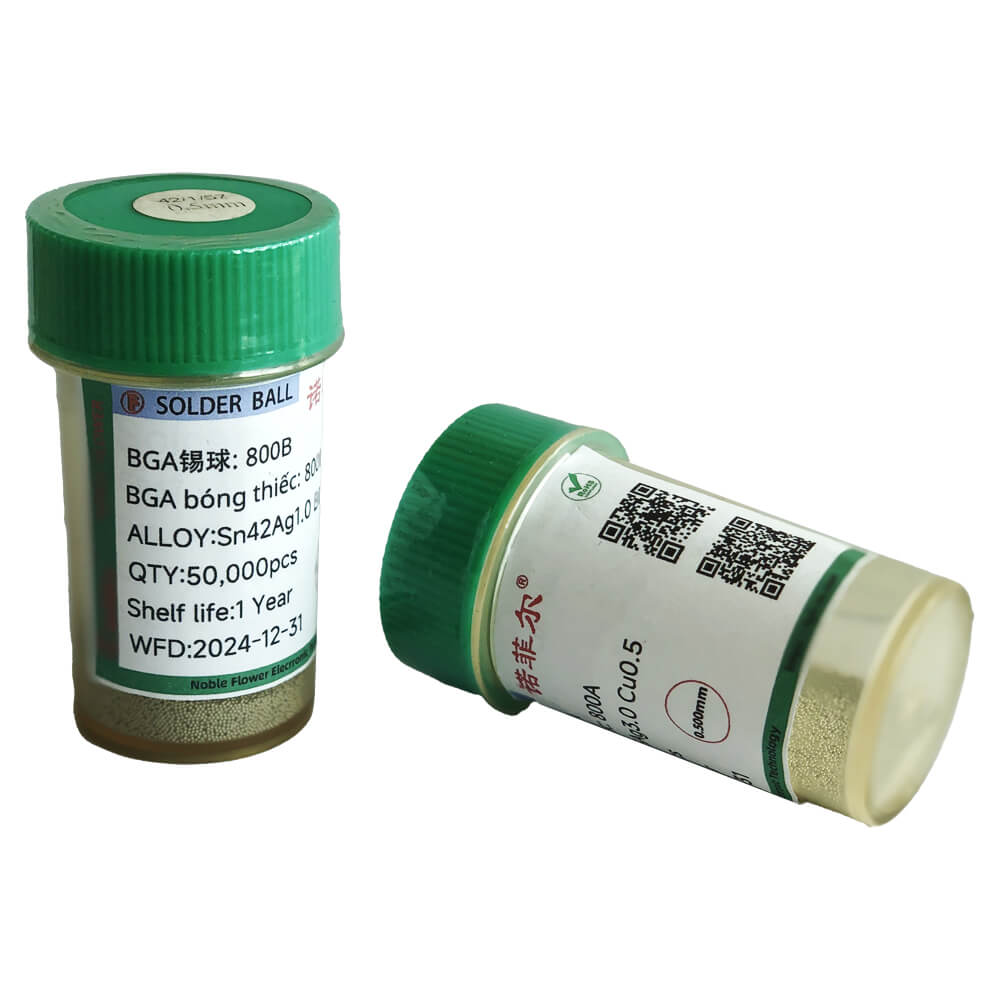
The issue of material compatibility cannot
be ignored either. Сварочный шар BGAusing SAC305 (tin 3 silver 0.5 copper)
alloy, when paired with Sn-Pb (tin-lead) solder paste, will cause the soldering
temperature window to mismatch due to the melting point difference (SAC305
melting point 217°C, Sn-Pb melting point 183°C), resulting in a brittle
interface layer.
4. SMD element virtual soldering:
Interruption of interface reactions
An on-site failure analysis of a consumer
electronics company found that the virtual soldering of QFP pins is often
accompanied by "gray-white solder joints", which is a typical
manifestation of the non-formation of intermetallic compound (IMC) layers.
Excessive pin coplanarity (>0.1mm) can lead to poor local contact, and
effective infiltration cannot be achieved even with solder melting. The oxide
layer (thickness > 5nm) formed by excessive humidity in the storage
environment (>30% RH) will hinder the diffusion reaction between tin and
copper, resulting in an IMC layer thickness of less than 0.5μm (the standard
should be > 1μm).
Virtual soldering of leadless components
such as MLCCs is closely related to design specifications. When the pad aspect
ratio violates the IPC-7351 standard (e.g., aspect ratio <1.2), the wetting
spread of the solder is limited, resulting in a "virtual edge"
phenomenon. Experimental data shows that a standard pad design can control the
false weld rate below 0.05%, while the false weld rate of the illegal design is
as high as 2.8%.
5. The Monument Phenomenon: The
"Imbalance Dance" of Miniature Elements
Under the microscope, the 0201 resistors
are like miniature "tombstones", and the essence of this phenomenon
is the difference in heat capacity between the pads at both ends of the
component. The thermal mass of small-sized components is extremely low (0201
components have a heat capacity of about 0.005J/°C), and when the temperature
difference between the pads exceeds 10°C, the surface tension generated by the
melting of the hot-end solder first will "pull up" the components.
The production data of an LED driver board
shows that the inscription rate of the 0402 component is 1.2% when the pad size
difference is 15%; When the pad symmetry is adjusted to ±5%, the inscription
rate drops to 0.08%. In addition, an uneven amount of solder (> 20%
difference between the two ends) can exacerbate this effect, creating a
"unilateral over-wetting" lifting effect.
6. Cold welding: the "unfinished
state" of metallurgical reactions
The microstructure of cold solder joints
exhibits typical "tofu dregs" characteristics – the solder particles
are not fully fused and there are a large number of tiny pores. This is due to
the peak temperature not reaching 15°C above the solder liquid line, or less
than 60 seconds of liquid zone time. For example, SAC305 solder can only
partially melt at a peak temperature of 200°C (below the melting point of
17°C), resulting in a very low-strength solder joint (tensile shear strength
< 15MPa, standard should be > 30MPa).
Uneven heat conduction in multilayer PCBs
can also lead to localized cold soldering. When the difference in inner copper
thickness exceeds 35 μm, the heat is rapidly dissipated towards the copper
thickness area, resulting in low solder joint temperatures in the thin copper
area. A military enterprise observed through an infrared thermal imager that on
a PCB with uneven copper thickness, the temperature difference between the
solder joints can reach 25°C, and the cold soldering rate is as high as 4.3%.
7. Solder joint cracks: destructive
expressions of stress release
Microcracks (> 1μm in width) in the
solder joint cross-section after temperature cycling tests are the culprits of
early product failure. This defect stems from a mismatch between the device's
coefficient of thermal expansion (CTE) and the PCB. For example, the difference
between a ceramic package (CTE≈7ppm/°C) and an FR4 substrate (CTE≈17ppm/°C) is
as high as 10ppm/°C, and the shear stress generated per cycle can reach 80MPa
in a cycle of -40°C~125°C, which exceeds the yield strength of solder (about
50MPa).
Cooling rate control is also critical. When
the temperature gradient of forced cooling exceeds 80°C/min, a thermal stress
concentration zone forms inside the solder joint. Experimental data shows that
when the cooling rate is reduced from 100°C/min to 50°C/min, the crack rate of
the solder joints decreases from 2.1% to 0.2%.
2. Whole process optimization system: from
source control to dynamic adjustment
Based on the in-depth understanding of the
defect mechanism, a four-dimensional optimization system including thermal
management, printing control, design specifications, and material selection can
be constructed to achieve a leapfrog improvement in welding yield.
1. Precise control of thermal management
system
The reflow oven renovation project of an
avionics company proved that the temperature difference between the two sides
of the component can be controlled within 5°C through zonal temperature
monitoring and intelligent algorithm adjustment, reducing the offset defect
rate by 90%. Specific measures include:
Stepped preheating design: Adopt
three-stage preheating (80°C→120°C→150°C), the heating slope is strictly
controlled at 1-2°C/s, and the 170°C platform is maintained for 90-120 seconds
to ensure that the flux is fully activated without evaporating in advance.
Reflow Zone Parameter Optimization:
Customize the temperature profile according to the solder paste specifications,
SAC305 solder paste adopts a peak temperature of 245-255°C and a liquid phase
time of 60-90 seconds, stabilizing the IMC layer thickness in the ideal range
of 1-3μm.
Dynamic temperature compensation: The
temperature of different areas of the PCB is monitored in real time through a
16-point thermometer in the furnace, and the heating power is automatically
increased for the local low temperature zone, ensuring a temperature difference
of < 3°C.
2. Micron-level control of the solder paste
printing process
In the workshop of a smartphone foundry, a
"printing process parameter intelligent recommendation system" is
running - after entering the PCB model and component specifications, the system
automatically generates parameters such as stencil thickness and scraper
pressure, increasing the printing yield from 88% to 99.5%. Core control points
include:
Precision selection of stencil: 0.5mm pitch
BGA uses 0.13mm thick laser cutting stencil, and the hole size is 5% smaller
than the pad (to prevent the solder paste from collapsing); The 0402 element
corresponds to a 0.1mm thick steel mesh with a "half-moon" design
with openings (reducing the risk of monuments).
Squeegee Parameter Optimization: A 60°
polyurethane squeegee is adopted, the pressure is set to 5±0.5kg, and the
printing speed is 20-50mm/s, ensuring a deviation of < 10% in solder paste
thickness.
SPC process control: 5 PCBs are extracted
every hour for 3D solder paste inspection, CPK value is calculated (required
> 1.33), and printing parameters are automatically adjusted when offset
trends are detected.
3. DFM optimization of design
specifications
A case study from an automotive electronics
design company showed that a 12% increase in soldering pass-through rate was
increased from 0.15mm to <0.1mm through DFM (Design for Manufacturability)
checks. Key design improvements include:
The NSMD design of the BGA pads: The solder
mask covers the edges of the pad (exposing 80% of the area) to prevent pad
oxidation and limit over-spread of the solder, resulting in an 82% reduction in
bridging rate.
CTE matching design: Choose a ceramic
substrate (CTE≈8ppm/°C) with a copper-molybdenum alloy heat sink (CTE≈9ppm/°C)
to control ΔCTE within 6ppm/°C, significantly reducing the risk of solder joint
cracks.
Pad size standardization: Strictly follow
the IPC-7351 standard, 0402 component pad aspect ratio is 1.2:1, the difference
in pad area between the two ends is <5%, and the monument phenomenon is
reduced by 75%.
4. Scientific matching of material
selection
In the materials lab of a medical device
company, engineers are testing the voiding rate of different solder pastes - by
comparison, they found that the voiding rate of Type5 fine-grained solder paste
(particle size 10-25μm) in BGA soldering is only 3.2%, which is much lower than
the 8.7% of Type3 solder paste. The core principles of material selection
include:
Solder paste particle size classification:
Fine pitch components (<0.5mm pitch) are made of Type 4 or higher solder
paste to ensure printing resolution; The large pad components are available
with Type3 solder paste to balance cost and performance.
Low-cavity alloy system: Sn-Ag-Cu-Ni series
solder paste is preferentially used, which inhibits the rapid growth of the IMC
layer through nickel elements, and increases the fatigue life of solder joints
by 50%.
Storage conditions control: Solder paste
should be refrigerated at 5-10°C, reheated for 4 hours after removal (avoid
condensation), and the ambient humidity should be controlled at 30-50% RH to
prevent solder oxidation.
3. Implementation effect and continuous
improvement mechanism
By introducing the above optimization
scheme, an EMS (electronic manufacturing service) enterprise achieved
remarkable results within three months: the BGA bridge defect rate was reduced
from 1.2% to 0.2% (down 82%), the PPM value of the monument phenomenon was
reduced from 500 to 125 (a decrease of 75%), the overall pass-through rate
increased by 15 percentage points, and the annual rework cost was saved by
about 2.8 million yuan.
To maintain this improvement, enterprises
need to establish a closed-loop management mechanism:
Parameter database construction: record the
optimal temperature curve and printing parameters of different products to form
a reusable process template, which can shorten the commissioning cycle by 60%
when new products are introduced.
Regular furnace temperature verification:
Furnace temperature curve testing (using a 9-point temperature measuring plate)
before each shift to ensure that equipment parameters drift within ±3°C.
AI Visual Inspection Upgrade: Introduce
deep learning algorithms to optimize AOI inspection parameters, increasing the
defect recognition rate from 92% to 99.8%, reducing false positives and missed
detections.
The optimization of the reflow soldering
process is a "micron-level practice" that requires continuous
improvement in thermodynamic balance, material matching, equipment accuracy,
etc. With the increasing reliability requirements in 5G, automotive
electronics, and other fields, only by controlling the process parameters at
the "Six Sigma" level (defect rate < 3.4ppm) can we gain a head
start in the fierce market competition. The practice of Suzhou Nofil shows that
through the synergy of material innovation and process optimization, the
systematic control of welding defects can be realized, laying a solid
foundation for the high-quality development of electronic manufacturing
enterprises.
 Безопасность сети 32058300438