


Views: 1 创始人: Site Editor Publish Time: 2026-02-17 Origin: Site


1. Introduction
Analyze various technical difficulties in
the interconnection of Stand-off Stitch Bond (SSB) bonded with insulating
coating bonding and copper wire bonding in lead frame packages, and study and
validate solutions. From the aspects of chips, tools, materials, and processes,
the key influences of chip surface quality, bonding fixtures, and bonding
splitting knives on the SSB process of insulating coating bonded copper wire
were analyzed. The stability of the size of the airless ball (FAB) under
different shielding gases and the stability of the shape of the FAB in
different protection devices are studied, as well as the technology to prevent
damage to the SSB-bonded pads of insulating coating-bonded copper wires and to
control "aluminum extrusion". The key points and improvement methods
of SSB process control are determined, and the effectiveness of the measures
and methods is confirmed by experiments.
The wire bonding process is dominant in
integrated circuit lead frame packaging technology. Due to the advantages of
insulating coating bonded copper wire in terms of cost, electrical properties,
mechanical properties and reliability, the bonding technology of insulating
coating bonded copper wire has become the main welding process technology. SSB
(Stand-off Stitch Bond) bonding of insulating coating-bonded copper wire is a
process method in insulating coating-bonded copper wire bonding, that is, first
planting a solder ball at the chip or pin position, and then performing a
normal welding wire, and welding the second solder point of the normal solder
wire to the ball implantation point, so as to complete the entire welding
process. The SSB process is used in the interconnection of multiple chip
functions, with the aim of enabling multiple chips to be integrated in a single
package to achieve complete connection and output of functions.
Due to the high hardness and easy oxidation
characteristics of insulating coating bonded copper wire, the SSB bonding
process of insulating coating bonded copper wire is difficult. With the rapid
development of the application of insulating coating bonded copper wire
technology, the number of products that require chip interconnection such as
multi-chip, stacked chip, multi-layer wiring and so on is increasing, in order
to make the packaging technology such as insulating coating bonded copper wire
interconnection process be rapidly applied, and the quality and reliability are
sufficiently guaranteed, the difficulties and process control of insulating
coating bonded copper wire SSB interconnection technology are studied.
2. Analysis of principles and technical
difficulties
1. The SSB process is mainly used in multi-chip components or stacked chip products, and the insulating coating bonded copper wire SSB process is shown in Figure 1. SSB soldering wire mainly includes three types of wiring methods: 1) inter-pad wiring between chips, that is, from one chip to another; 2) Wiring between pads of the same chip, that is, connecting between 2 or more pads on the same chip; 3) Reverse line from the frame carrier or inner tube pin to the pad of the chip, first plant the ball on the chip, and then line the ball planting point on the chip from the frame carrier or inner tube foot.
<!--[if gte vml 1]>
<!--[if gte vml 1]>
Figure 1: SSB process for bonding copper wire with copper insulating coating
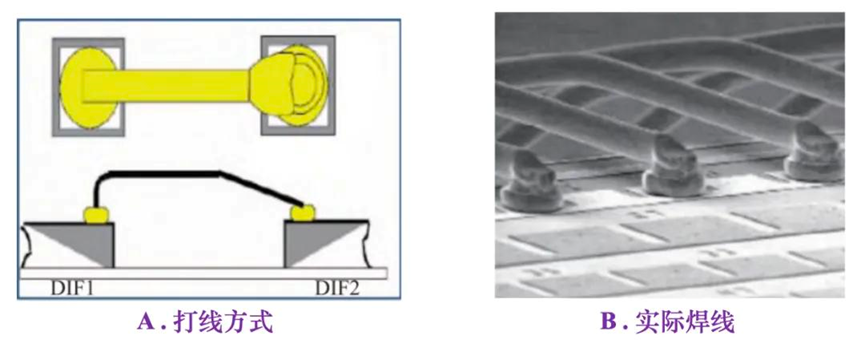
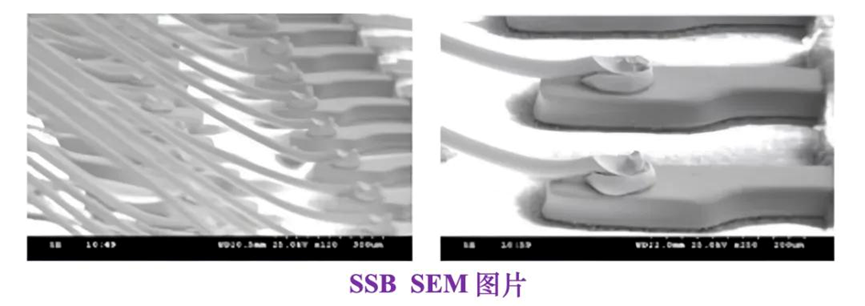
2. Insulation coating bonding Copper wire
oxidation will cause CuO to form on the surface of the copper sphere. Because
of the differences in molecular structure and melting point between CuO and Cu,
a regular structure cannot be formed at the moment of burning, resulting in
inconsistent size and shape of airless balls (FABs). At the same time, any
oxidation in the Cu-A1 binding region will cause abnormalities such as bond
breakage and reduced shear strength of the binding surface, thereby weakening
the strength of the Cu-Al binding surface. If the FAB is not round, the force
will be uneven when the aluminum pad of the ball and the chip acts, causing
various risks. The CuO on the surface of the insulating coating bonded copper
wire is both hard and brittle amorphous substance, which is not easy to remove
during the bonding process, and its existence directly affects the strength and
performance of the bonding. There are many technical difficulties, which are
reflected in the low production efficiency of the SSB interconnection of
insulating coating bonded copper wire, the instability of the FAB of the
insulating coating bonded copper wire due to the influence of the shielding gas
and protective devices, and the damage of the pad pad and "aluminum spatter"
of the first bonded solder joint caused by the oxidation of the copper ball,
which are extremely challenging in the practical application process.
3. Influencing factors and process control
of insulating coating bonding copper wire SSB bonding
1. The Impact of Chip Surface Quality on
SSB Bonding!
The quality of the core surface has a key impact on the insulating coating bonded copper wire SSB bonding. The differences between different chips and the abnormalities on the surface of the chip caused by the wafer manufacturing process will be reflected in the bonding
process, the most obvious manifestation is that the wire is not sticky, aluminum loss and other abnormalities are frequent, so it is necessary to inspect the surface quality of the chip to prevent the chip with unqualified surface quality from being used in copper wire process products. The surface quality and bonding abnormalities of the chip are shown in Fig. 2, the normal chip is shown in Fig. 2(A), the surface contamination of the old chip is shown in Fig. 2(B), the probe print of the chip is too large as shown in Fig. 2 (C), and the problem of wire non-sticking and aluminum loss caused by abnormal surface quality of the chip is shown in Fig. 2(D).
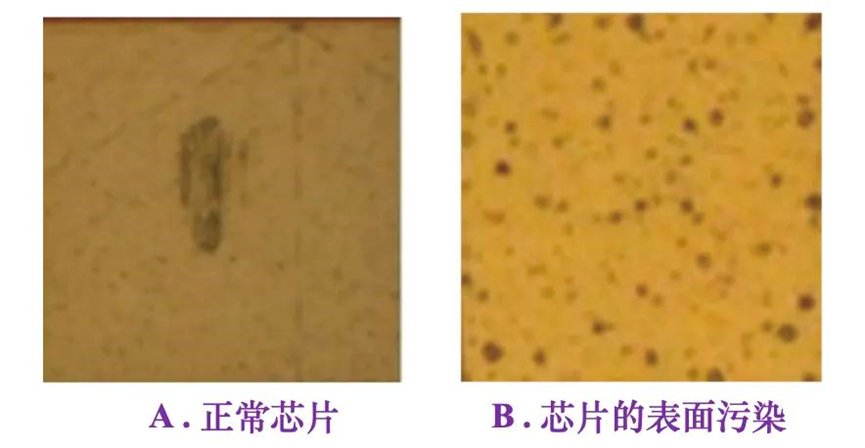
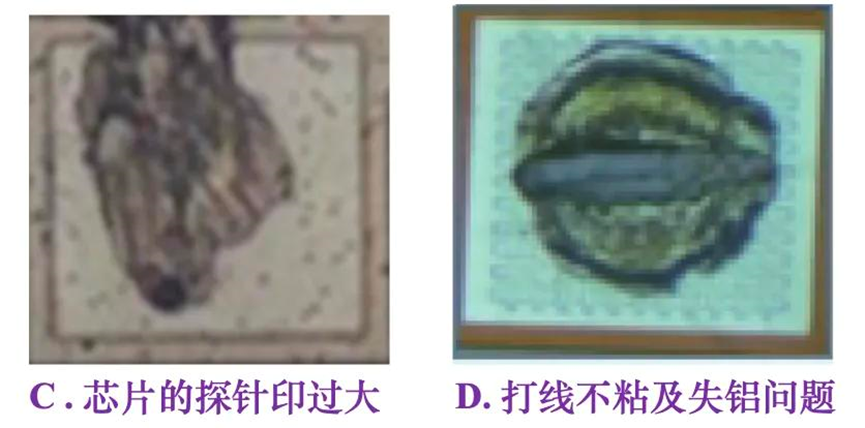
Figure 2: Abnormal surface quality and
bonding of the chip
Through the study of the bonding process of insulating coating bonded copper wire, the size of the pad size and the matching requirements of the allowable wire diameter of the SSB interconnection bonding of insulating coating bonded copper wire are summarized. Different insulating coating bonded copper wire diameters have different requirements for the thickness of the aluminum layer, the thicker the wire diameter, the thicker the aluminum layer of the pad, and the corresponding aluminum layer is too thin will lead to the reliability of the package, so different aluminum layer thicknesses are suitable for different insulating coating bonded copper wire diameters. The pad size and required chip aluminum layer thickness for insulating coating bonded copper wire SSB bonding are shown in Table 1. Based on experience, the packaging rules are summarized, the chip pads are designed according to the rules, and then the bonding process is formulated with a safe parameter range to ensure the quality of the soldering wire.
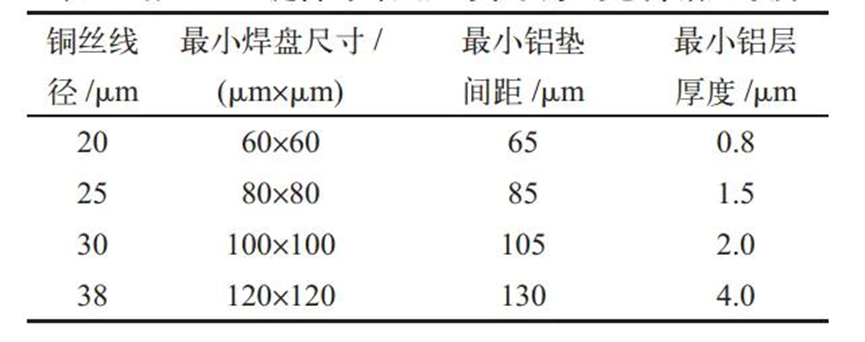
Table 1: Pad size and required aluminum
layer thickness of the chip for insulating coating bonded copper wire SSB
bonding
2 . The Influence of Insulating Coating
Bonding Copper Wire Bonding Process on SSB Bonding!
At present, the automatic bonding machine
for insulating coating bonding copper wire commonly used in the industry is to
prevent the oxidation of insulating coating bonded copper wire by installing N2
and H2 on the machine and mixing protective gas devices to achieve the
reliability of insulation coating bonded copper wire welding. The key to the
realization of wire welding in the insulating coating bonding copper wire
bonding process lies in the gas protection method during electronic ignition,
so the design and structure of the N2, H2, and mixed shielding gas (5%N2,
95%H2) device are particularly critical when the insulating coating bonds the
copper wire to form FAB.
#2.1 Stability of FAB size in different
shielding gases
Insulating coating bonding There are two
types of shielding gases used for copper wire bonding: one is N2, which is
usually 99.99% purity, and the other is N2, H2 mixture gas (5% H2, 95% N2); N2
is an inert gas, its chemical properties are very stable, it is difficult to
react chemically with other substances, and it is a good gas isolation
material. H2 is a flammable and explosive gas with strong reducing chemical
properties that can reduce metals from oxides. According to the needs of
different bonding processes, when using silver alloy wire and palladium-plated
copper wire, pure N2 can be added to protect it. When using pure copper wire,
N2, H2 gas mixture protection should be added.
The size of the FAB of insulating coating bonded copper wire in different shielding gases is shown in Table 2 The process capability index (CPK) of FAB in N2 and H2 mixed shielding gas is greater than 1.33, and the CPK in N2 shielding gas is less than 1.33, so the size of FAB is more stable when using N2 and H2 mixed shielding gas than when using N2. Increasing the current intensity of spark ignition and shortening the ignition time of discharge can effectively reduce the degree of oxidation and obtain a better copper ball spherical shape.

Note: The wire diameter is 18μm; The flow rate of the shielding gas is 0.4~0.8L/min.
Table 2 : Insulating coating-bonded copper
wire FAB sizes in different shielding gases
#2.2 Stability of FAB shapes in different
protection devices
N2 and H2 protective gases require a set of
equipment to realize, and the gas protection devices of different structures
are shown in Figure 3. The test was divided into 4 groups of 2 schemes, and the
FAB test results in different protection devices are shown in Table 3.
According to the test results, there are far more qualified FABs in the annular
gas protection device than in the unilateral gas protection device. Therefore,
the spherical, appearance and anti-oxidation properties of the FAB are better
and more stable in the gas protection device with a ring structure than in the
unit with a normal single-sided blowing structure.
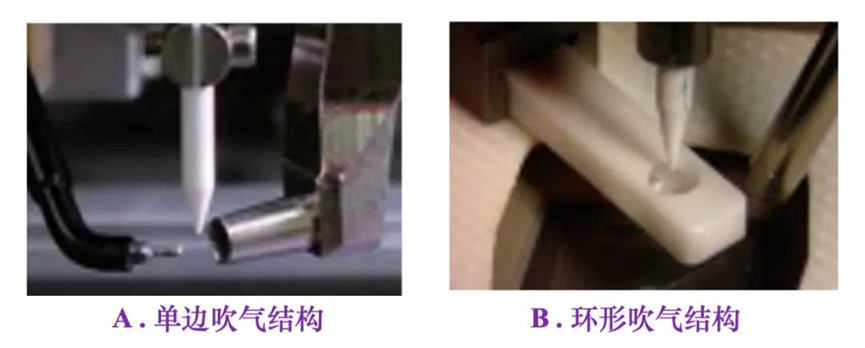
Figure 3: Gas protection devices with different structures
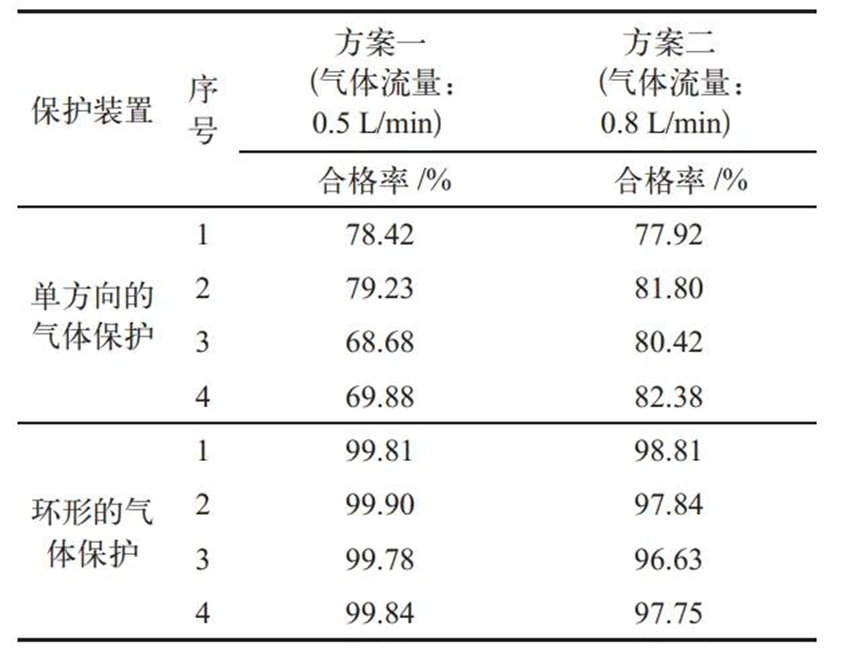
Table 3: FAB test results in different
protective devices
#2.3 Prevent damage to insulating
coating-bonded copper wire-bonded pads and "aluminum extrusion"
control technology
Due to the high hardness of the insulating
coating bonded copper wire, the SSB process requires pelleting and then welding
on the same pad, and the two impacts will cause damage to the circuit under the
pad. Improving and controlling the hardness and roundness of copper balls is
key to the SSB process.
(1) Using an insulating coating with a wire diameter of 18 μm to bond the copper wire, N₂ and H2 mixed gas, the gas flow rate is set to 0.4~0.8 L/min, the shape of the FAB is observed under different ignition currents and ignition times, and a set of process parameters that are most suitable for product processing are obtained through comparative analysis, and the shape of the FAB at different ignition times when the ignition current is 45 mA and 65 mA respectively is shown in Fig. 4 (A) (B).
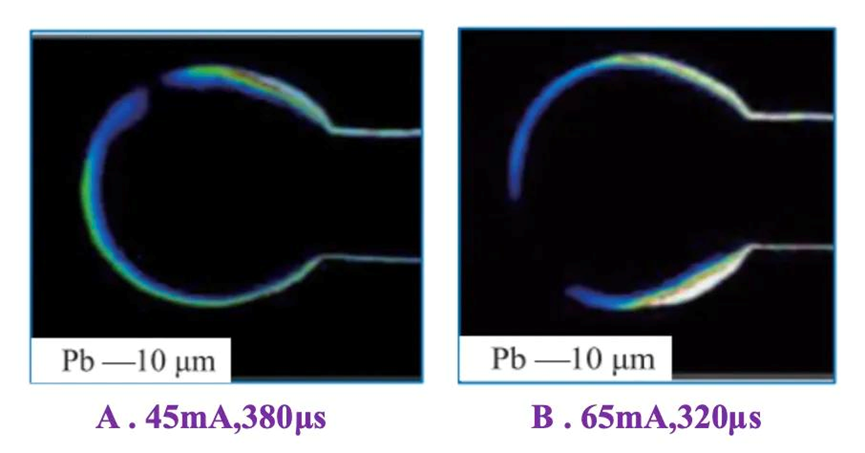
Figure 4: FAB profile at different ignition
currents and firing times
The test results show that when the
ignition current is 65 mA and the duration is 320 μs,
the exposed area of copper is large and the hardness of FAB is small. At a
sparkling current of 45 mA and a duration of 380μs, the
exposed area of copper is small and the hardness of FAB is larger. Therefore,
under the conditions of high current and short time test, the hardness of FAB
is small. In practical engineering applications, reducing the hardness of FAB
will help improve aluminum loss and aluminum pad cracks in the SSB process and
prevent pad damage.
(2) "Aluminum extrusion" is a common phenomenon in the insulating coating bonding copper wire bonding process, because the copper ball is more hardness than the aluminum pad when welding, and the welding power and pressure when it comes into contact with the aluminum pad are extruded from the pad. The SSB process requires the same pad to be stressed twice, making it more prone to "aluminum extrusion" than other insulating coating-bonded copper wire bonding processes. The "aluminum extrusion" phenomenon of insulating coating-bonded copper wire SSB is shown in Figure 5.
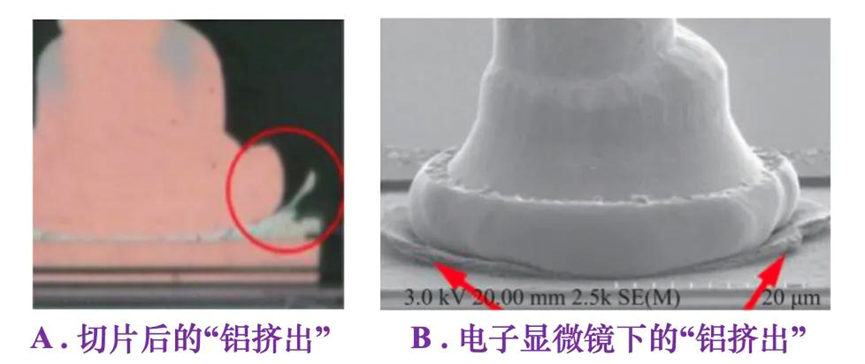
Figure 5: Copper insulating coating bonded
copper wire SSB "aluminum extrusion" phenomenon
Through the study of the bonding process
parameters, the experimental design method (DOE) optimizes the welding
parameters such as power, impact force, friction in the x/y direction,
rotational friction, etc., and determines the ideal process parameters. On this
basis, in order to prevent the oxidation of the insulating coating bonded
copper wire FAB, the abnormal monitoring and alarm system of N2 and H2 mixed
gas pipelines is designed and installed, and the thickness and composition of
the aluminum layer of the chip pad are improved to meet the requirements of
insulating coating bonded copper wire welding wire. Increase the plasma
cleaning process of the product before bonding to remove contaminated
particulate matter from the surface of the wafer, and comprehensively prevent
and improve the "aluminum extrusion" problem of the SSB process.
At the same time, to control the formation
of copper-aluminum bonding surfaces, there are five factors that affect the
formation of intermetallic compounds, including atomic size, electronegativity
(electrochemistry), electron valence, atomic number and adhesion energy. The
metals at the welding interface have mutual penetration and diffusion, so that
the thickness of the interface increases with time, thus affecting the
stability of the welding interface.
3. Other influencing factors and solutions
#3.1 Requirements for SSB Bonding Fixtures
The pressure plate and heating block of the
bonding fixture need to match the worktable of the bonding machine, which
cannot affect the stepping system and welding head movement of the equipment.
The bonding fixture should match the lead frame, and there should be no
problems of interference with the soldering wire, frame carrier and pin
loosening. In order to improve the uniformity of heat dissipation, it is
necessary to ensure that the temperature difference between the center position
of the bonding fixture and the four corners is within ±3
°C. In order to ensure the welding quality of
insulating coating bonded copper wires, the bonding fixture must meet the
following requirements.
(1) The carrier reinforcement and the
spacer must match. Observe whether the carrier reinforcement at the four
corners is located in the middle of the spacer, ensure that the pins on the
edges of the four corners have a certain distance from the edges of the
carrier, check whether the frame is completely pressed, and confirm that the
pins are not loose.
(2) The vacuum value of the equipment
fixture needs to meet the requirements. The frame carrier is suctioned by
vacuum so that the frame carrier and the pin are compacted at the same time,
and the vacuum value of the equipment cannot be lower than the specified
minimum standard value.
(3) The boss of the clamp platen should not
be damaged, and the clamp should not have foreign objects adhering to it. If
the bonding fixture cannot meet the requirements, it is easy to shake the chip
during the bonding process. During the SSB wiring process, the chip will
rebound from the splitting knife to the surface of the chip to the process of
forming and returning the copper ball, resulting in problems such as poor
soldering of the copper ball, non-sticking of the copper wire bonded by the
insulating coating, and peeling of the aluminum layer (loss of aluminum).
What's more, due to the uneven force on the solder joints of the chip, aluminum
pad cracks or craters will appear, which seriously affects product quality and
reliability.
#3.2 Requirements for SSB Bonding Splitter
and Pad
The selection of bonding and splitting
tools should consider factors such as the wire diameter of the insulating
coating bonded copper wire, the size of the pads, the spacing of the pads, and
the height of adjacent arcs. The head surface of the insulating coating bonded
copper wire splitter was roughened to increase its roughness. Due to the hard
material of insulating coating bonded copper wire, the use of a thickened
splitter head can make the frame hold the insulating coating bonded copper wire
more firmly, so that it can get a better second solder joint and improve the
tensile strength of the SSB second solder joint, improve the level of
reliability, and also extend the service life of the splitting knife. The
specific requirements for SSB bonding splitters and pads are as follows.
(1) The aperture of the ordinary splitting
knife is 1.2~1.4 times the diameter of the bonding wire. When the splitting
cutter hole diameter is too large, the edge and angle of the drawn line arc are
not obvious, and the line arc is prone to swing. When the splitting aperture is
too small, the splitting knife is easy to block, and the line arc is prone to
instability or scratching, which affects the production efficiency.
(2) The size of the pad is not less than
the sum of the guide angle diameter (CD) of the bonding splitter, the accuracy
of the model (2~4μm) and the power circle (2~6μm); The solder ball is 1.1 times the diameter of the CD. When the CD
is too small, eccentric balls (golf balls) will occur, and when the CD is too
large, aluminum pads will be crushed.
(3) The pad spacing should not be less than
half of the pad size and the length of the splitting cutter head.
(4) According to the adjacent arc height
and adjacent spacing, the top diameter of the splitting knife determines the
length of the second solder joint, and the larger top diameter is conducive to
increasing the bonding area and bonding strength of the second solder joint.
(5) The diameter of the top of the
splitting knife should be less than 1.3 times the minimum spacing of the pad.
#3.3 Application of different bond wires in
SSB bonding
At present, there are different types of
packaging bonding wires such as bare copper wire, palladium-plated copper wire,
gold-palladium copper wire, silver alloy wire, etc., among which gold-palladium
copper wire and silver alloy wire have been better improved and applied in
terms of anti-oxidation and hardness reduction. In addition to the
characteristics of conventional copper wire, gold-palladium-copper wire and
silver alloy wire also have the advantages of high strength, low arc, corrosion
resistance, etc., which can improve the reliability of products."
Insulating gold-palladium copper wire is to add a layer of gold plating on the
surface of gold-palladium copper wire to prevent oxidation and improve the
welding characteristics, thereby improving the package bonding process.
It has been verified that on the SSB
process, insulating coated gold-palladium copper wire can achieve better FAB
anti-oxidation effect, which is very helpful in improving aluminum pad cracks
or abnormal aluminum loss, and at the same time helps to enhance the welding
ability of the second solder joint, which is more suitable for production
applications with different wire diameters. When using insulating coating tobond copper wires, attention should be paid to storing them in a nitrogen
cabinet, with a temperature of 20~25°C and a relative
humidity of less than 50%. Insulating coated bonded copper wire typically lasts
for 6 months and should be used up within 9 days after opening the vacuum
packaging.
4. Conclusion
Aiming at the difficulties of SSB
interconnection technology of insulating coated copper wires, the main factors
affecting the SSB process of insulating coated copper wires are analyzed,
including the structure and composition of the pad pads, bonding fixtures,
bonding splitting tools, bonding processes, bonding wires, etc. On this basis,
the technology to prevent damage to insulating coating-bonded copper
wire-bonded pads and "aluminum extrusion" was investigated by
analyzing the stability of the FAB size in different shielding gases and the
stability of the FAB shape in different protection devices. Effective solutions
were developed to address the existing difficulties and the requirements for
matching pad sizes and allowable wire diameters for insulating coating-bonded
copper wires and SSB interconnect bonds were established.
By applying process control methods,
technical difficulties in SSB interconnection processes can be solved and
controlled. With the rapid development of insulating coating bonded copper wire
process in integrated circuit packaging, through the optimization and control
of equipment, process, materials and other links, the insulating coating bonded
copper wire SSB interconnection process will be better developed.
 苏公网安备32058302004438