


Views: 1 创始人: Site Editor Publish Time: 2026-03-14 Origin: Site


Low-temperature sintered nano silver paste:
a breakthrough material in the field of heat dissipation in electronic
packaging
When your mobile phone freezes frequently,
or the running computer suddenly freezes, have you ever thought that there may
be a fatal problem of "thermal failure" hidden behind it? In today's
era where 5nm chips have become the mainstream configuration, heat dissipation
problems have become the biggest obstacle to further improvement in the
performance of electronic devices. While traditional thermal conductive
materials are becoming overwhelming in the wave of miniaturization of
electronic devices, a nano-silver paste called AS9120 is quietly changing this
situation and redefining the rules of electronic heat dissipation with its unique
ability to achieve sintering at a low temperature of 120°C while still serving
stably in a high temperature environment of 960°C.
The severe challenge of electronic heat
dissipation and the breakthrough of nano silver paste
Modern electronic devices are trapped in a
vicious cycle of heat dissipation dilemma. The data clearly show that for every
2°C increase in temperature, the reliability of electronic components drops
dramatically by 10%. As chip packaging density increases exponentially, the
thermal conductivity of traditional polymer-based thermal adhesives of
0.2-0.5W/(m・K) has long been unable to meet the heat
dissipation needs and is stretched. What's even more fatal is that the actual
contact area between the surface of the device is often less than 10%, and the
residual air forms a thermal resistance of 0.06K/W, which is like covering the
chip with a thick "insulation quilt", which seriously hinders the
dissipation of heat.
The emergence of nano silver paste has brought a groundbreaking solution with its original "low-temperature sintering, high-temperature service" characteristic. By nanoprocessing silver particles, the surface energy of silver particles increases dramatically, which allows the sintering temperature to be reduced to 130°C, while the dense structure formed after sintering can withstand high temperatures of nearly 1,000 degrees. This feature perfectly solves the temperature gradient challenge faced in the multi-level assembly of electronic devices, clearing obstacles for the development of cutting-edge technologies such as 3D chip stacking, and allowing more room for electronic device performance improvement.
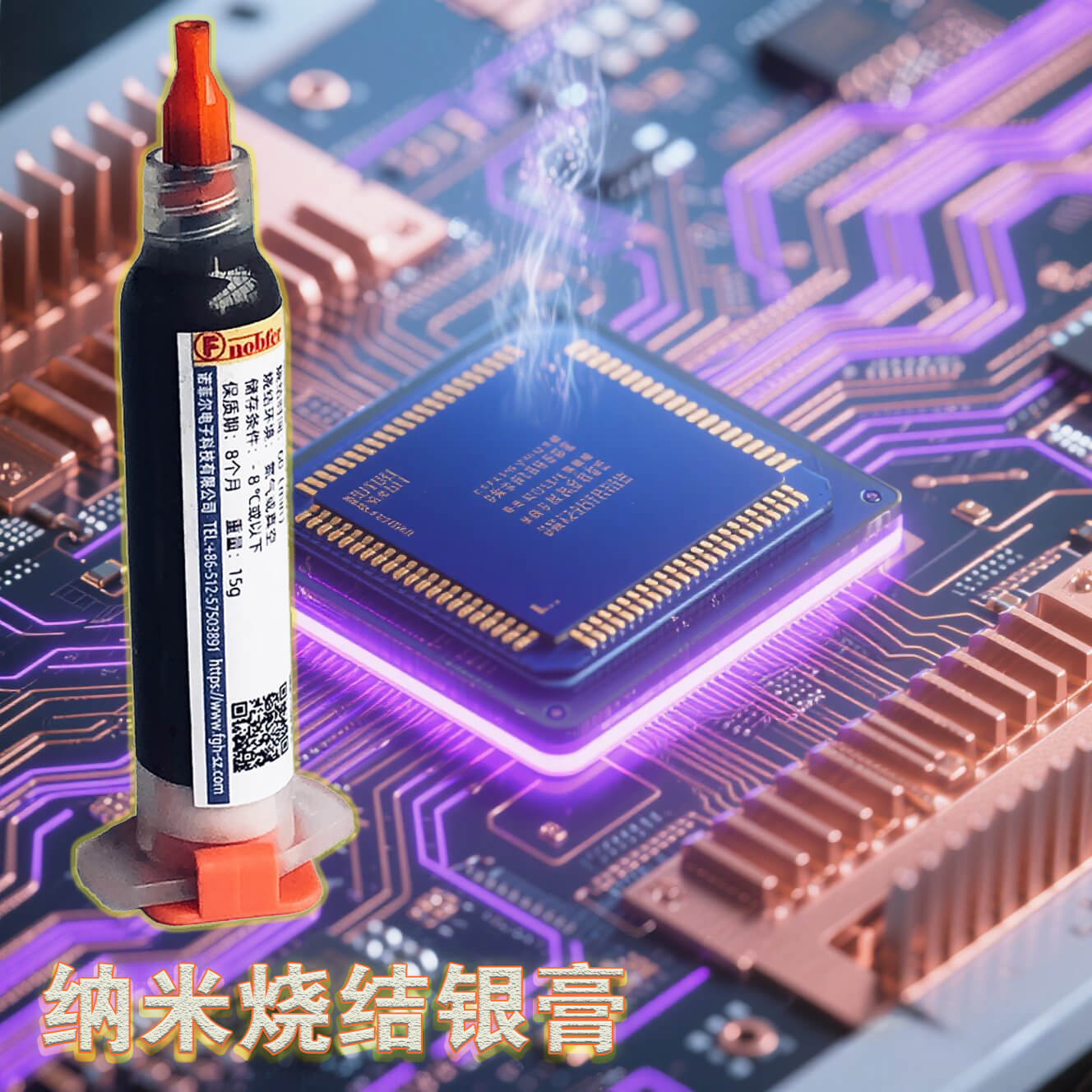
A synergistic leap in dual performance: a
qualitative breakthrough in electrical and thermal conductivity
Compared with traditional silver paste,
low-temperature sintered nanosilver AS9376 achieves a qualitative leap in both
electrical and thermal conductivity. In terms of conductivity, when sintered at
280°C for 60 minutes, its resistivity can reach 4.6×10⁻⁶Ω・cm. In terms of thermal conductivity, although the thermal
conductivity of 246W/(m・K) is slightly lower than
that of sterling silver blocks, it is more than 500 times that of epoxy resin,
which is enough to make it stand out in the field of heat dissipation. From the
perspective of microstructure, the density of the sintered body reaches 80% and
there are no macroscopic pores, and this unique structure makes its thermal
expansion coefficient highly match that of bulk silver, which fundamentally
reduces the damage caused by thermal stress and greatly improves the stability
and service life of electronic devices.
What is even more revolutionary is its
morphological regulation technology. It was found that when 20% flake silver
powder was compounded, the conductive network could be upgraded from the
original point contact to surface contact, and the fish-scale overlapping
structure increased the conductivity by 30%. At the same time, through the
particle size gradient design, the porosity of the composite system composed of
micron silver and nano silver is reduced by 5%, forming the closest stacking
effect similar to "cobblestone paving". These innovative applications
in LED chip packaging have achieved an astonishing 60% reduction in thermal
resistance, making a qualitative leap forward in the heat dissipation
capabilities of LED chips.
A game-breaker in the field of flexible
electronics: performance and environmental protection
In the field of flexible electronics,
low-temperature sintered silver paste has shown the advantages of
dimensionality reduction. Compared with traditional ITO materials, its
elongation at break is increased by more than 5 times, and the resistance change
rate is still less than 3% after 1000 bending tests, which makes it a wide
range of application prospects in flexible electronic devices. After adopting
this technology, a smartwatch manufacturer successfully compressed the
thickness of the flexible circuit to the 10-micron level while increasing the
thermal diffusion efficiency by 200%, greatly improving the performance and
user experience of the smartwatch. In wearable medical devices, its good
biocompatibility solves the problem of metal ion leaching that may occur during
long-term wear, providing a strong guarantee for the safe use of wearable
medical devices.
Environmental protection is another major
advantage of low-temperature sintered silver paste. It does not contain toxic
substances such as lead and cadmium, and can easily pass RoHS certification,
which is in line with modern environmental protection concepts. At the same
time, the maturity of silver-clad copper technology has reduced raw material
costs by 40%, improving performance and reducing production costs. After a new
energy vehicle company adopted a modified formula doped with 5% nickel, the electromigration
phenomenon of battery module connection points was reduced by 90%, and the
module life was expected to be extended to 15 years, which not only improved
the safety and reliability of new energy vehicles, but also reduced the cost of
use for users.
The next stop in technological evolution:
continue to push the boundaries of performance
Surface modification technology is
continuously promoting the performance boundary of low-temperature sintered
nano-silver paste. As a result of the improvement, the thermal resistance of
the interface with the epoxy resin was reduced by 70%, and the thermal
conductivity jumped from 1.16 to 2.136 W/(m・K). The
directional arrangement of SiC seed composite system has created a miracle of
axial thermal conduction of 160W/(m・K), providing a new
solution to the heat dissipation problem of 5G base stations and contributing
to the better application and development of 5G technology.
With the increasing demand for lightweight
heat dissipation materials in the aerospace sector, the space version of nanosilver paste has passed the test for extreme environments of -180°C~300°C. A
satellite manufacturer revealed that the phased array antenna cooling module
using AS9335 is 55% lighter and consumes 20% less power. This achievement
indicates that low-temperature sintering technology is gradually moving from
the field of electronic packaging to a broader range of industrial application
scenarios, and will play an important role in more fields in the future.
From the laboratory to industrialization,
it took 12 years to complete the technological transformation of
low-temperature sintered nano silver paste. Today, standing at the critical
point of the electronic materials revolution, this contradictory unity of
"low-temperature processability" and "high-temperature
stability" is writing a new paradigm of heat dissipation materials. When
more companies master the core process like Shanren New Materials, perhaps the
next generation of electronic devices will completely bid farewell to the roar
of cooling fans and serve people's lives and work in a more efficient and
stable state.
 苏公网安备32058302004438